
MVNO Billing Software helps MVNOs monetize their services by helping with rating and charging the recurring mobile plans as well as the usage consumption of the mobile service. An MVNO billing system also helps with invoicing and collecting payments using various payment methods. It is an end to end revenue management system which helps track and manage revenue from inception (customer onboarding and new sales) till revenue realization (collection of payments for the services rendered).
What are MVNOs?
MVNOs are Mobile Virtual Network Operators. This means they do not have their own networks and rely on services provided by infrastructure providers or network operators. In terms of mobile services, they use the services of MNOs or Mobile Network Operators, also known as Carriers or Infrastructure Providers. With more depth small are the basic and specialized terms of the MVNOs with respect to their billing software (what is also known as a telecom billing and revenue management platform) and how effectiveness of these features can mark for the best MVNO billing software.
What are the basic needs of an MVNO from a MVNO Billing Software?
The basic needs of an MVNO from the MVNO billing software is not different from a MNO (Mobile Network Operator) and how an MNO uses a telecom billing and revenue management platform (BRM platform). The key aspects that a MVNO is looking for are listed here:
Each of these features has an important role in the end-to-end revenue management process. These features are explained in detail if you follow the links to the EarnBill site pages. These are definitely important and commonly required MVNO billing software modules. In the next section, we will look into more specialized billing requirements of a MVNO.
MVNO Billing Software – Why do MVNOs need a specialized billing platform?
The MVNOs have some different set of challenges from the traditional telcos or MNOs (Mobile Network Operators). Owing to the nature of their business, MVNOs can be of two types – i) resellers, ii) resellers + value added service providers. Some resellers act as a point of sales for the MNO (Mobile Network Operators) or the bigger carriers, however some MNOs can build bigger brands and position themselves as a major provider of mobile services based on their bundled offerings and services.
More and more MVNOs are coming up as a later type, that of being a value added service provider. They offer not just the bundled offerings from the original carrier, but also add their own niche service or services in a package offering. This builds up their business USP (Unique Selling Proposition) for which there is no easy alternative available in the market. More customers would avail such services.
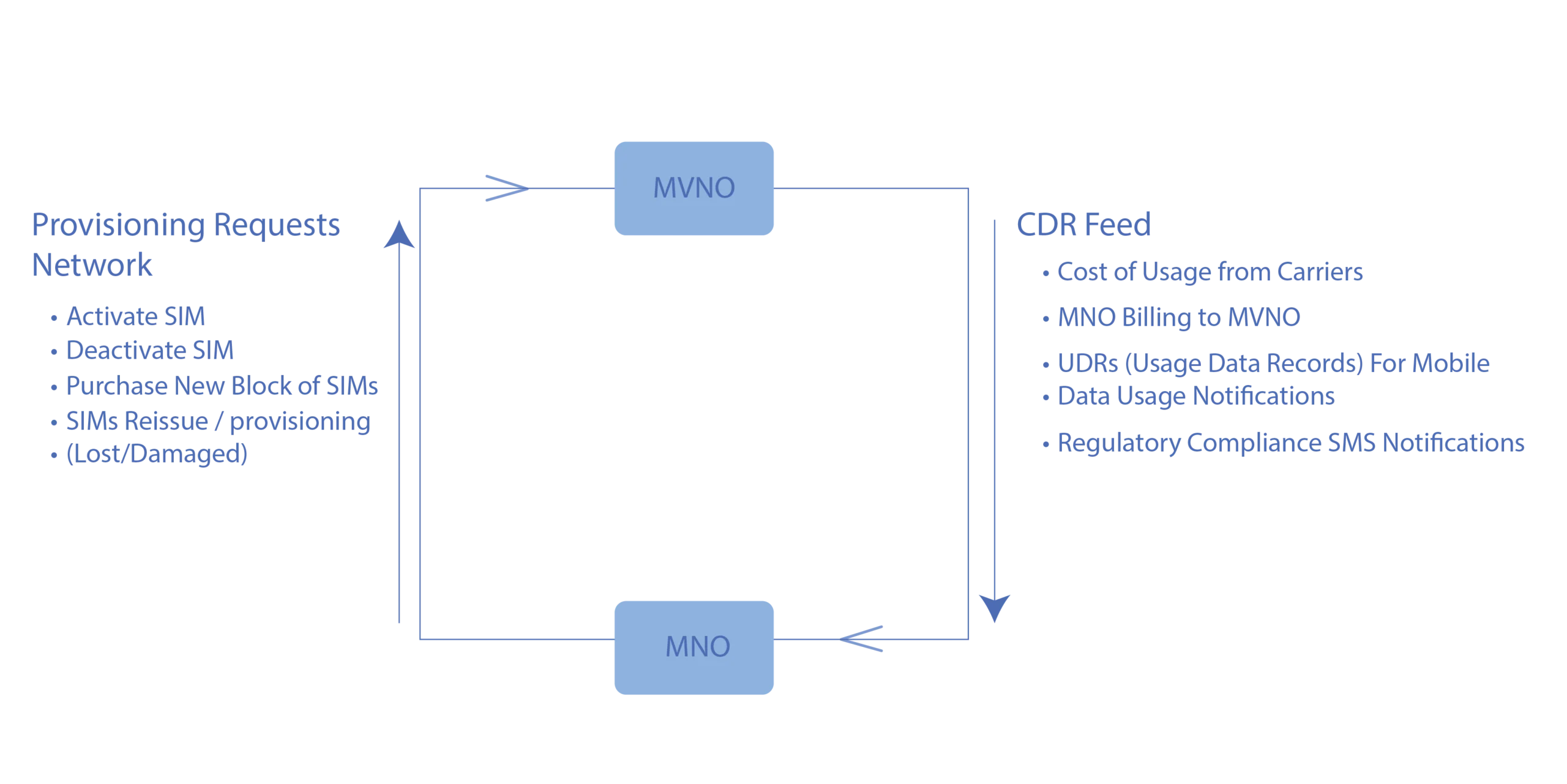
The above diagram portrays a MVNO billing landscape with the most important billing modules showcased here. As it can be seen from the diagram, an MVNO may partner with multiple carriers for enabling itself with various service options.
What specialised features should MVNO billing solutions include?
Tracking Carrier Costs
MVNOs need that the CDR processing module not only charges the usage consumption fees to the end customers, but also tracks the cost that it has to pay to the carriers. The CDR processing module needs to have the ability to charge the usage fees as per plan pricing defined by the MVNO, but at the same time use the CDRs to calculate the cost involved which needs to be paid to the carrier.
The cost involved in each mobile call, data session or SMS/MMS is charged to the MVNO by the carrier in a monthly or a quarterly bill (as per their agreement). Having a pre-calculated usage cost sheet helps the MVNO reconcile the charges received from the carrier. This helps settle payable balances without disputes and any discrepancies can be handled via interconnect billing options.
Interconnect Billing
The interconnect Billing module allows MVNOs to track, manage and verify the charges applied by the carriers in their invoices to the MVNO. As the carriers are providing the underlying infrastructure and network for mobile services to the MVNO, they charge the MVNO for all the usage consumption that uses their network. If the bill charged by a carrier does not match the usage charges calculated by the MVNO by a large margin, then an interconnect billing module is used to carry out the reconciliation at the CDR level.
The MVNO requests the carrier to send all CDRs backing their invoice for the given period. These CDRs are processed through the CDR mediation module and fed to the interconnect billings reconciliation option. The reconciliation option compares the vendor bills with the CDRs with the original CDRs which were sent by the MVNO to calculate the cost internally. The differences at the CDR level are highlighted and shared with the carrier. This helps reconcile the differences with the carrier and helps settle the issue.
Bulk Upload of Rate Cards
An MVNO would have arrangements with multiple carriers. Each carrier could be providing different services, or covering different geographies. They are required to maintain a number of rate cards belonging to various underlying carriers who are the infrastructure providers behind their services. The rate cards could be very complex mapping between tariff codes and outlets and pricing based on such mapping. Each tariff code sheet from the carrier could contain tens of thousands of records.
The MVNO billing software should have convenient rate card generation utilities and options to upload the rate cards into the system. If an MVNO offers hundreds of plans with a combination of different carriers, the resultant rate cards would be a combination of rates from various rate cards defined for all the carriers. The MVNO billing software should have the ability to generate and upload rates in bulk for different combination of plans and carriers and have the ability to make independent pricing decisions on all such combinations.
Pricing Changes
Another reason for rate card updates is when a carrier changes usage charges. Even if the MVNO is not adding a margin to the usage charges as part of a business strategy, they would not like to absorb cost on account of their customers. Any price changes by the carrier need to be immediately propagated onto the customers. Of course there needs to be good communication to the customers in this regard following all the regulatory requirements.
However, the MVNO billing system needs to have a pricing planner and coordinator that can ensure that there is no revenue leakage or additional cost absorbed, at the same time ensures customer satisfaction and continuity of business. The rate card upload and rate card update are crucial options that the MVNOs rely on in order to keep tabs on its usage consumption charges.
Mediation Rating and Increment Management
An MVNO billing software needs to provide good options for mediation rating and increment management. Mediation rating and charging is generally well understood. It is charges applied for the usage consumption of a service. Increment Management refers to allowing configuration of duration increments that can decide how the duration of time can be charged.
For example, a telco may decide to charge any call duration of less than 30 seconds be charged as 30 seconds and any call duration more than 30 seconds up to 1 minute is charged as a 1 minute call. Let's look at another example.
If a telco decides initial increment is 1 second, meaning the call will be charged as per its actual duration without any increment applied. In this kind of scenario, the initial increments and subsequent increments is a configuration in the MVNO billing software gives an edge to the MVNO. The business can fine tune its increments for various types of services and maximize their revenue. They could make a strategy where a highly competitive market such as niche, like revenue can be maximized without increasing the rates higher than the competition.
Network Provisioning with Multiple Carriers
The MVNO billing platform should have easy-use configurable options to send provisioning requests and commands to the carriers' networks. Also, if the platform can have the audit logging ability for each provisioning request and response, it helps with the traceability to investigate any service activation or deactivation issues.
How does an MVNO billing platform improve revenue management?
The above sections listed some of the usual telecom billing software features and some others that are specialized features related to a MVNO Billing software. A full fledged Telecom Billing and Revenue Management Platform like EarnBill, powers an MVNO by covering them for the core "business as usual" or BAU aspects with the standard features, and at the same time ensuring that the MVNO can use the power of the specialized MVNO billing solutions to maximize their revenue.
The MVNO billing software helps track revenue from inception (customer on-boarding) to the fulfilment (recurring payments for services). It provides workflows and capabilities that can capture the end to end flow of a business scenario, starting from tracking customer subscriptions, service orders and on-boarding a customer, creating a service orders, provisioning the customer service on the live network, enabling and measuring customer's subscriptions and usage, calling and measuring managing bundle costs and then the features that mediation rating and increment management platform and interconnect billing help with maximizing the revenue possibilities.
The MVNO billing system helps an MVNO to track these day to day flows through the system providing automation to complex rating and charging, to the complex workflows, and allows integrations amongst systems such as the CRM, the BRM and the customer portal. The system can also handle hundreds or thousands of requests per day that pertain to a telco consumer life cycle, such as change of plan (upgrade or downgrade), request for additional service or quota, cancellation of an existing service and so on.
Summary
The MVNO billing software allows MVNOs to manage their business effectively and efficiently. This system is at the heart of the MVNOs business operations and all systems rely heavily on the transactions taking place in the system. The Best MVNO Billing Platform is the one that allows smooth revenue management for telecom requirements – both functional and operational.
EarnBill BRM is one of the best MVNO billing software around with a good mix of standard and specialized revenue management features. EarnBill helps with an easy carrier integration, management of multiple carriers for network provisioning and usage consumption charging, tracking and monitoring carrier costs and then the features that mediation rating and increment management and interconnect billing help with maximizing the revenue possibilities.
Check out our MVNO billing system page to know more about EarnBill's MVNO capabilities and features.
Key Features for Best MVNO Billing Software
Ready to Power Your MVNO Business?
See how EarnBill's MVNO billing system handles real-time OCS, CDR mediation across 12+ formats, and N-level reseller hierarchy on a single platform.