

If you are leading an AI startup, scaling an LLM platform, or integrating generative capabilities into an enterprise product, your biggest operational challenge isn't prompt engineering, it's unit economics.
The way you charge for AI now determines whether growth compounds your profit or your losses. The billing model most software teams inherited was designed for a world where usage was effectively free to serve, and that assumption no longer holds for AI.
The Margin Crisis in AI Workloads
Unlike traditional software-as-a-service (SaaS), where serving the 10,000th user costs practically the same as serving the 10th user, AI software carries heavy, variable marginal costs. Every API call to an LLM, every fine-tuning job, and every multi-step autonomous agent workflow consumes real compute power, memory, and energy.
Yet, many software leaders still rely on the standard SaaS playbook: flat-rate monthly subscriptions per seat.
"Price is what you pay. Value is what you get." — Warren Buffett
In the artificial intelligence sector, when your customers receive unlimited value while paying a fixed price, your profit margin bears the full burden. Flat subscriptions in AI are infamous margin-killers. A single "power user" integrating your API into an automated enterprise workflow can make millions of calls in a week, generating thousands of dollars in underlying cloud compute costs while paying a modest flat fee of $49 per month.
To maintain profitability, satisfy investors, and fund continuous model innovation, executive teams are shifting away from rigid seat-based subscriptions toward usage-based billing (UBB), a strategy that directly links your revenue to your real-time infrastructure costs.
Why Legacy Billing Systems Fail Modern AI Products
Transitioning to metered billing is not simply about sending an invoice at the end of the month based on a database counter. It represents a fundamental shift in how billing infrastructure operates. Most legacy billing platforms, engineered in the early 2010s for traditional recurring seat subscriptions, break when confronted with the velocity and scale of modern AI workloads.
Legacy systems suffer from critical bottlenecks:
- Batch Processing Lags: They aggregate usage daily or weekly, creating massive blind spots where usage spikes outpace user credit limits.
- Inflexible Metric Engines: They struggle to differentiate between cheap input tokens and expensive output tokens, or to combine compute time with API call counts.
- Rigid Code Dependencies: Every pricing adjustment requires engineering bandwidth to rewrite internal database queries and custom billing code.
- Lack of Cost Transparency: They fail to provide real-time cost visibility to users, leading to customer disputes, churn, and chargebacks.
Modern AI monetization requires a system engineered from the ground up to process massive event streams in real time, apply complex rating rules instantly, and deliver total cost visibility to both provider and consumer.
The Math of AI Pricing: Flat Rates vs. Hybrid Models
To understand why the transition to usage-based billing is so critical, let's look at the financial math contrasting traditional pricing with a modern hybrid billing approach.
Scenario A: The Flat-Rate Trap
Imagine an AI-powered document analysis platform charging a flat $50 per user per month.
- Standard User: Processes 50 documents/month. Generates $3 in LLM API expenses. Gross Margin: 94% ($47 profit).
- Power User: Automates their entire corporate repository, processing 15,000 documents/month. Generates $320 in LLM API and compute expenses. Gross Margin: -540% ($270 loss).
If just 10% of your user base falls into the "Power User" category, your overall product margin collapses into negative territory.
Scenario B: The EarnBill Hybrid Pricing Strategy
Instead of pure flat pricing or pure pay-as-you-go (which can scare off risk-averse enterprise buyers), EarnBill enables a sophisticated Hybrid Billing Model.
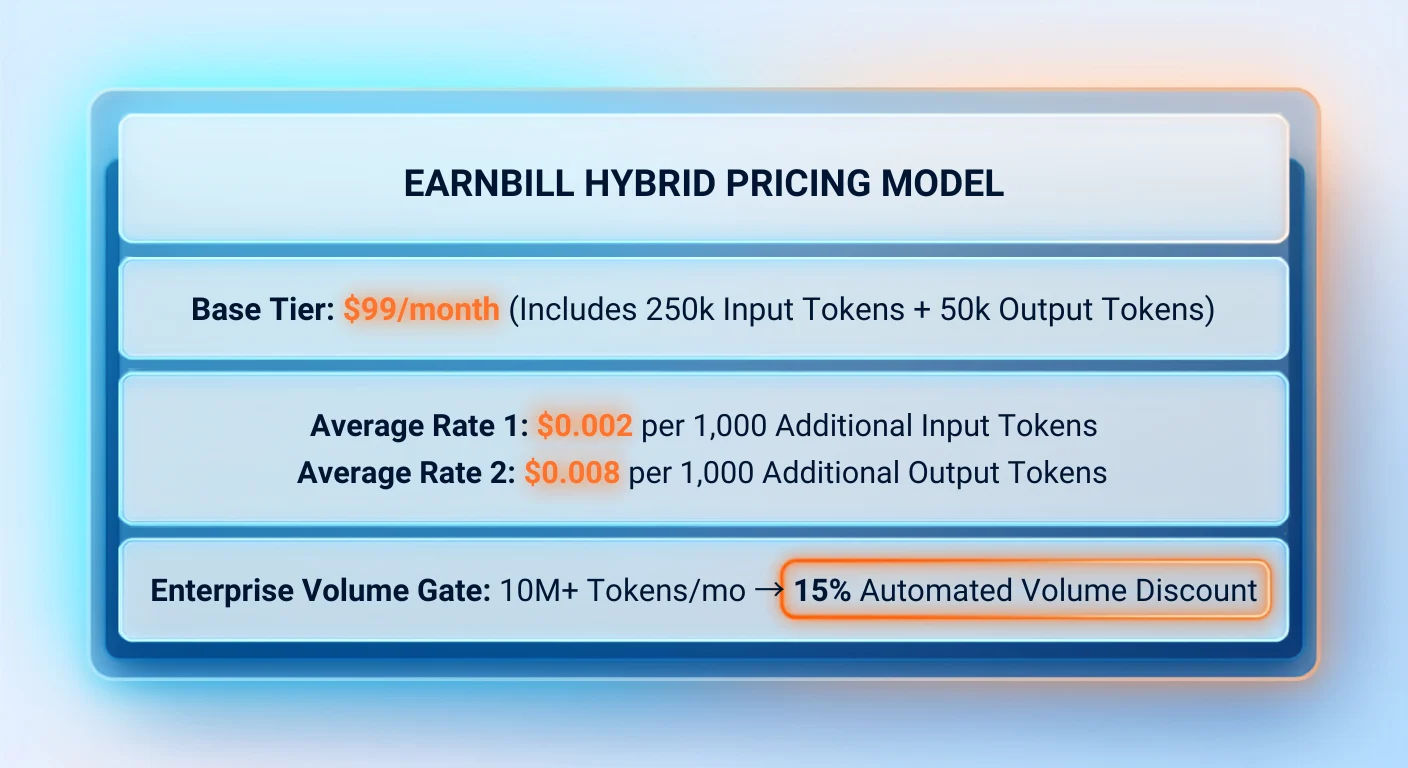
Under this hybrid approach:
- Predictable Baseline Revenue: The $99 monthly fee guarantees baseline Monthly Recurring Revenue (MRR) that pleases board members and investors.
- Margin Protection: Standard usage is covered within the base allowance.
- Automated Upsell on Power Users: High-volume usage automatically triggers overage charges rated instantly by EarnBill's rating engine. The power user who consumes $320 in compute now generates $550 in total revenue, preserving a healthy 41%+ gross profit margin.
A Step-by-Step Blueprint for a Successful Transition
Transitioning your platform to metered billing requires alignment across finance, product, and engineering. Here is how modern platforms can execute this strategy using EarnBill:
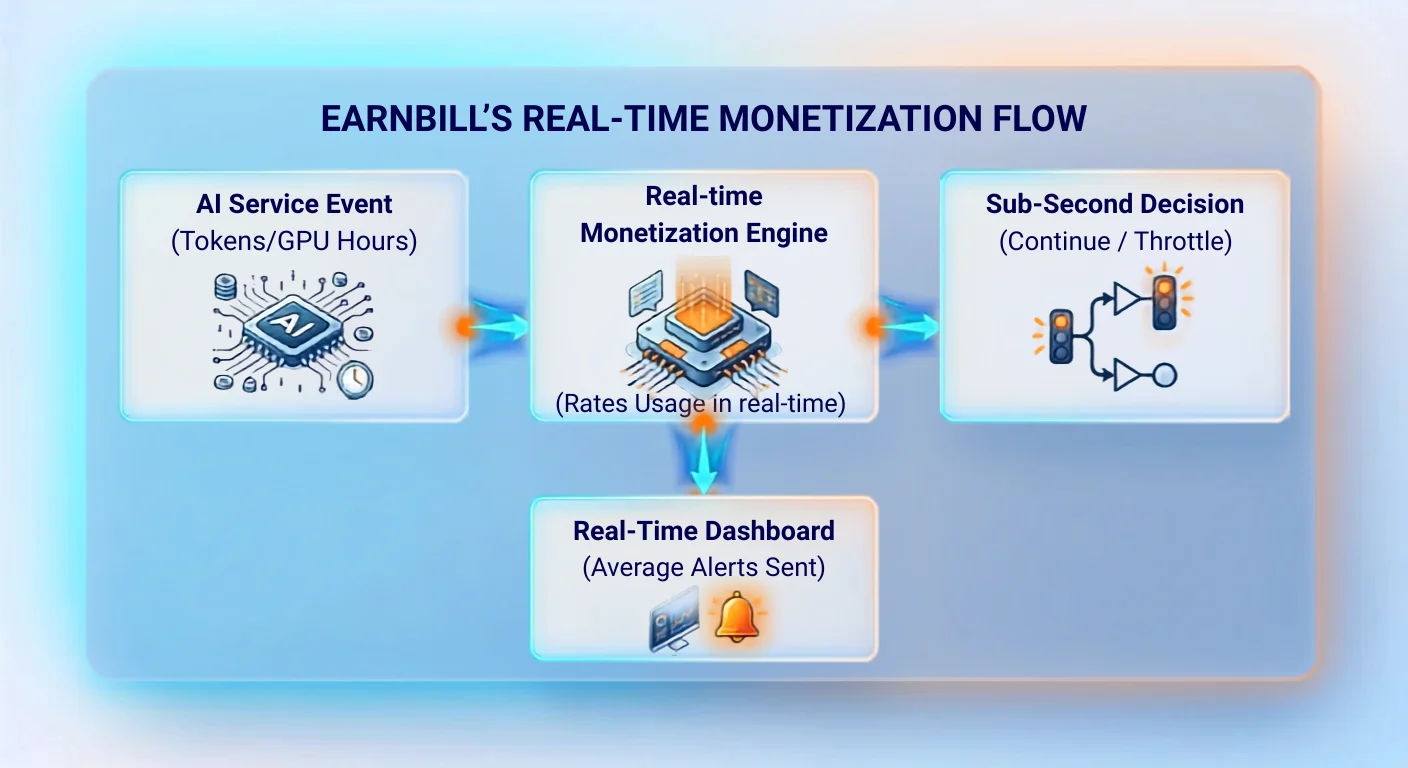
Step 1: Discover Your True Value Metric
You must bill for what actually drives value in your product while reflecting underlying costs. EarnBill's Flexible Metering Engine captures any raw event metric generated by your system:
- LLM Applications: Input tokens, output tokens, context window size, model tier (e.g., GPT-3.5 vs. GPT-4 vs. Claude 3.5 Sonnet).
- AI Infrastructure & Compute: GPU server hours, CPU execution seconds, RAM usage, storage space.
- Autonomous Agents & Tools: Completed tasks, successful web browsing actions, custom business API execution units.
EarnBill allows you to combine multiple metrics on a single, unified customer invoice, eliminating the need to maintain separate billing systems for software access and underlying infrastructure.
Step 2: Establish Credit Bundles and Automate Deferred Revenue
One major obstacle in metered billing is revenue recognition accounting under ASC 606 / IFRS 15 guidelines. When customers prepay for usage credits (e.g., buying a $500 monthly token pool), you cannot recognize that cash as earned revenue until the tokens are consumed or expire.
EarnBill natively automates deferred revenue accounting and credit lifecycle tracking. Unused monthly credit roll-overs, expiration dates, and recognized revenue schedules are tracked automatically by the billing engine, removing manual accounting tasks for your finance team.
Step 3: Enforce Real-Time Quotas to Prevent Revenue Leakage
Batch processing usage once every 24 hours creates significant revenue leakage. If a customer's automated script loops endlessly overnight, they can run up to thousands of dollars in usage before legacy billing systems even notice.
EarnBill solves this with a real-time credit and balance engine, a rating technique proven at high-volume telecom scale, known in that world as an Online Charging System (OCS). This engine rates incoming usage streams with sub-10-millisecond latency. When a user hits their allocated credit balance or safety limit, EarnBill sends an instant policy response to your API gateway, allowing your infrastructure to throttle or notify the user before unbillable compute costs accumulate.
Step 4: Eliminate "Bill Shock" with Customer Self-Service
Unexpected bills are the primary cause of churn and dispute tickets in usage-based pricing models. When enterprise buyers do not know what their invoice will look like at the end of the month, they hesitate to expand usage.
To prevent this friction, EarnBill provides a white-labeled, embeddable customer portal that delivers real-time usage metrics, itemized cost breakdowns, and automated overage alerts directly to your end-users. Customers can set custom monthly spend caps and receive proactive threshold notifications (e.g., "You have reached 80% of your included token quota"), transforming billing transparency into a competitive retention advantage.
Overcoming the Migration Risk
When executive teams consider changing their billing infrastructure, the primary concern is operational risk. Changing a live billing engine can feel like replacing an airplane engine mid-flight. Engineering leaders fear months of delayed roadmaps, lost subscription records, and system downtime.
EarnBill mitigates this operational risk by offering parallel run and phase-wise migration. The phase-wise migration could be done by migrating a batch of accounts in one-go, ensuring that the rating and charging is working accurately and then migrating more batches. EarnBill provides migration reports which make it easy to verify balances, quotas and history records.
Instead of a multi-quarter engineering effort, EarnBill offers an average launch timeline of four to eight weeks. You do not need to rewrite your schemas or re-architect your application backend.
EarnBill's schema-less ingestion API accepts raw JSON usage events directly from your application or API gateway. Additionally, EarnBill provides multi-gateway payment orchestration across 15+ payment processors globally. This means you can route transactions through local gateways to optimize authorization rates and lower credit card fees without rewriting any billing code or risking vendor lock-in.
To ensure zero risk during launch, EarnBill includes a complete sandbox environment where your engineering team can run parallel billing tests, simulating real-world usage patterns against production data before going live.
Agility at Scale: Real-Time Pricing Experiments
The AI sector moves faster than any previous technology cycle. Underlying LLM provider costs drop rapidly, new fine-tuned models are released monthly, and competitors adjust pricing constantly. If your billing platform requires engineering intervention every time you test a new pricing tier, your business will fall behind.
EarnBill empowers product and commercial teams to design, launch, and test brand-new pricing strategies directly from the administrative web portal without writing custom code.
Want to test a tiered discount for customers using over 5 million tokens? Want to launch a holiday promotional bundle combining base subscriptions with free GPU compute hours? With EarnBill, product managers can configure and launch these variations in hours, run targeted tests on specific user cohorts, and scale changes instantly based on real-world feedback from user groups.
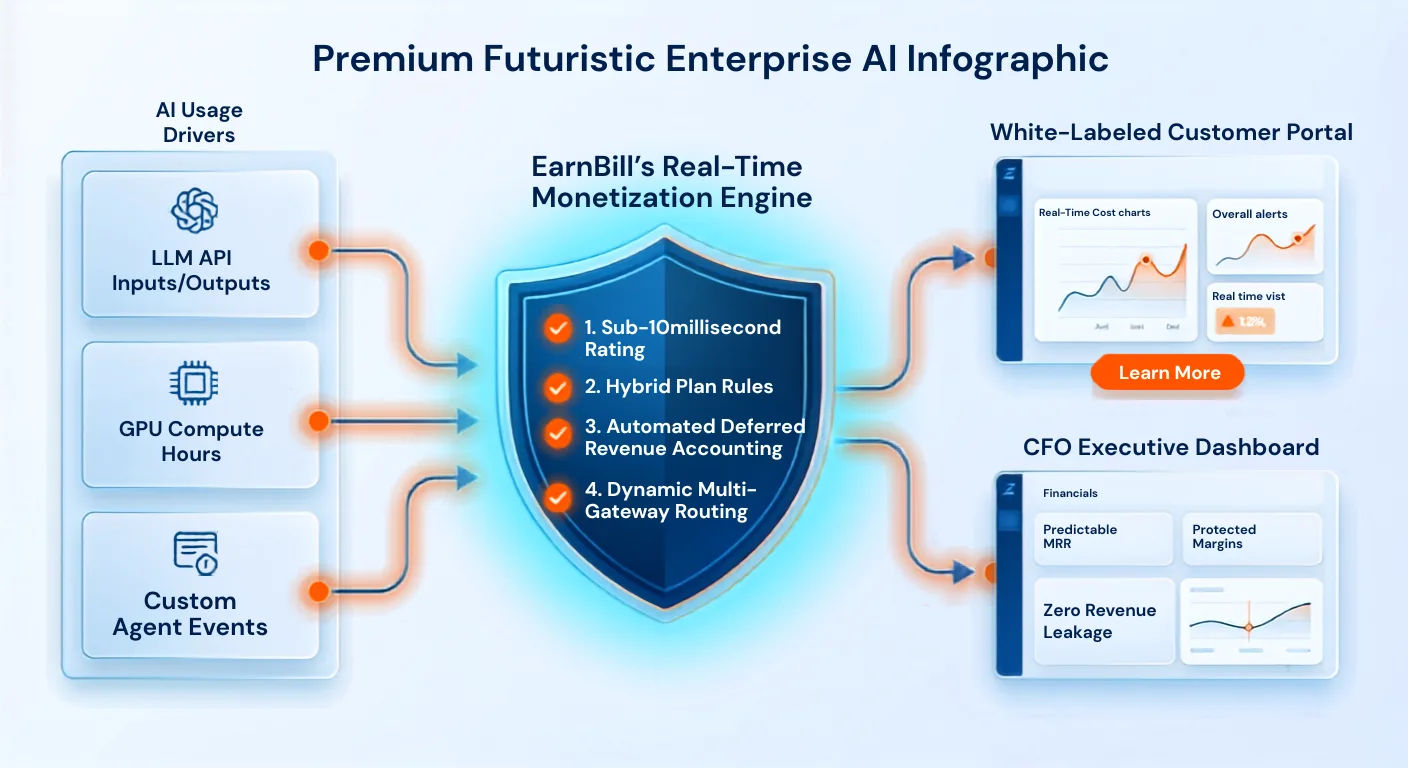
Strategic Advantage: Built for High-Volume AI Monetization
When evaluating platforms to support your monetization strategy, it is essential to distinguish between legacy billing tools adapted for subscriptions and a dedicated metering and rating engine engineered for high-volume consumption.
EarnBill stands out by offering:
- Enterprise-Grade Scalability: Built on a battle-tested real-time rating engine capable of processing millions of event spikes overnight without drop-offs or processing delays.
- True Hybrid Versatility: Complete freedom to mix recurring subscriptions, metered usage, prepaid credit packs, and negotiated enterprise contracts within a single account.
- Schema-Less Ingestion: The freedom to capture any custom value metric your AI engineering team invents tomorrow without altering underlying billing database schemas.
- Full Financial Compliance: Built-in SOC 2 Type II, ISO 27001, and PCI DSS compliance with automated tax calculation across global jurisdictions.
Most importantly, EarnBill delivers an undeniable financial return. By replacing expensive home-grown billing engineering with a ready-to-deploy platform, EarnBill serves as a trusted operational backbone that delivers a 10x ROI on 50% of the Total Cost of Ownership (TCO) compared to building and maintaining a custom billing infrastructure internally.
FAQs
To assist C-suite leaders and product teams evaluating a transition to usage-based monetization, here are answers to common strategic questions:
What is usage-based monetization for AI, and why does it matter?
Usage-based monetization (UBB) ties your revenue directly to your real-time infrastructure costs, billing for the events that actually drive value, such as input and output tokens, GPU compute hours, and completed agent tasks, instead of a flat monthly seat fee. It matters because AI software carries heavy, variable marginal costs: every API call, fine-tuning job, and multi-step agent workflow consumes real compute, so a flat subscription leaves your margin exposed whenever a power user consumes far more value than they pay for.
Why do flat-rate seat subscriptions hurt AI product margins?
Unlike traditional SaaS, where serving the 10,000th user costs about the same as the 10th, AI carries heavy variable costs per request. A single power user automating an enterprise workflow can make millions of API calls and generate thousands of dollars in compute while paying a modest flat fee. In a worked example, a standard user yields a 94% gross margin while a power user processing 15,000 documents a month runs a negative 540% margin. If just 10% of your base are power users, overall product margin can collapse into negative territory.
What is a hybrid monetization model for AI?
A hybrid monetization model combines a predictable subscription base fee with metered overage on top. The base fee guarantees baseline Monthly Recurring Revenue (MRR) that investors expect and covers standard usage within an included allowance, protecting margins. High-volume usage automatically triggers overage charges rated instantly by the rating engine, so a power user who consumes $320 in compute can generate $550 in total revenue while preserving a healthy 41%+ gross margin. This avoids both the margin risk of pure flat pricing and the buyer hesitation of pure pay-as-you-go.
How long does it take to transition to usage-based billing with EarnBill?
EarnBill offers an average launch timeline of four to eight weeks rather than a multi-quarter engineering effort. Its schema-less ingestion API accepts raw JSON usage events directly from your application or API gateway, so you do not need to rewrite your schemas or re-architect your backend. EarnBill also mitigates migration risk with parallel run, phase-wise account migration, migration reports to verify balances and history, and a full sandbox environment for running parallel billing tests against production data before going live.
Conclusion: Protect Your Margins and Scale Your AI Vision
Continuing to rely on flat-rate seat subscriptions while paying variable, usage-driven compute costs exposes your platform to severe margin risk. Transitioning to usage-based billing is essential for long-term profitability and sustainable AI growth.
By adopting a flexible, hybrid monetization model, you preserve the predictable monthly recurring revenue (MRR) that investors expect while ensuring that every query, compute hour, and token processed yields a healthy gross margin.
EarnBill delivers the technology, flexibility, and real-time execution needed to make this transition seamless, secure, and swift. It creates a win-win scenario for every stakeholder: your investors, your business as an AI solution provider, and your customers. Ultimately, this positions your platform for long-term sustainability while laying a strong foundation for future innovation.
Ready to Protect Your AI Margins and Scale Your Revenue?
Move from margin-killing flat seats to usage-based monetization. See how EarnBill's real-time metering, hybrid plans, and sub-10ms rating protect gross margins on every token, API call, and compute hour, with a four-to-eight-week launch.