
If you are leading technology, finance, or product strategy at an AI platform, you face an immediate economic decision: how do you monetize your product to maximize Gross Margin and Net Revenue Retention (NRR) without eroding your margins or alienating your users?
Unlike traditional software platforms where computing resources are effectively fixed overhead and gross margins sit comfortably at 70%–80%, artificial intelligence workloads draw heavily on variable Infrastructure-as-a-Cost (COGS). A single user query can trigger anything from a lightweight lookup to a massive, multi-step LLM inference chain or an hours-long GPU training job. This introduces unprecedented margin volatility and cost unpredictability.
"Compute is the fundamental currency of the future." — Sam Altman
Margin Volatility in Modern AI Systems
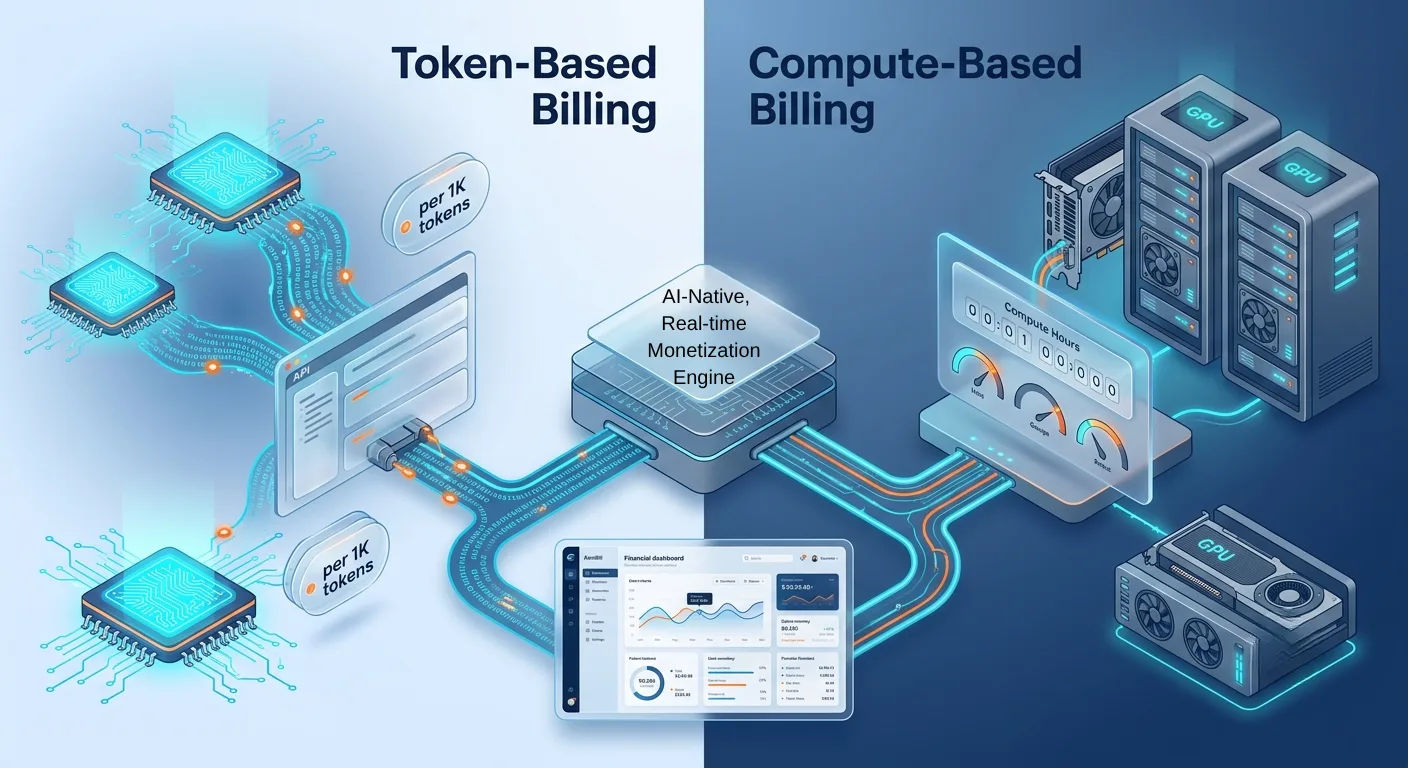
Because compute is the currency powering your product, your monetization engine must capture its exact commercial value. Today, C-suite software leaders are caught between two dominant billing paradigms: Token-Based Billing (charging by text/data volume processed by models) and Compute-Based Billing (charging by hardware usage such as GPU hours, instance types, or execution time).
Choosing the wrong metric or forcing your platform into an inflexible billing model creates severe revenue leakage, exposes your business to volatile COGS, and stalls go-to-market speed.
Token-Based vs. Compute-Based: A Strategic & Financial Evaluation
To make an informed decision, executive teams must evaluate how each model aligns with customer expectations, development workflows, gross margins, and long-term revenue predictability.
| Monetization Model | How It Works | Gross Margin Profile | Revenue Predictability | Primary Financial & Operational Risks | Ideal Enterprise Use Cases |
|---|---|---|---|---|---|
| Token-Based Billing | Charges per 1K/1M tokens (words/sub-words) processed by an LLM or generative model. | High margin risk if input/output ratios drift; highly profitable for short prompt-to-response workflows. | Low to Moderate (usage fluctuates unpredictably with user prompt behavior). | Margin leakage on long generations; unpredicted context window overhead; billing disputes over token counting algorithms. | Text generation, natural language processing, chat interfaces, code generation APIs. |
| Compute-Based Billing | Charges per GPU/CPU hour, execution second, or instance hardware tier. | 100% Margin Protected (directly tracks underlying cloud/infrastructure cost). | High for infrastructure providers; Moderate for software buyers. | High churn risk due to customer bill shock from unoptimized code, idle time, or failed processing runs. | Model fine-tuning, image/video rendering, custom model hosting, bare-metal GPU clouds. |
Deep Dive into Token-Based Billing: Unit Economics and Margin Risks
Token-based billing has emerged as the standard for Large Language Model (LLM) providers. Because tokens represent the fundamental unit of data processed by neural networks, billing by the token feels intuitive to users or developers consuming APIs.
Cost Asymmetries in Token Ecosystems
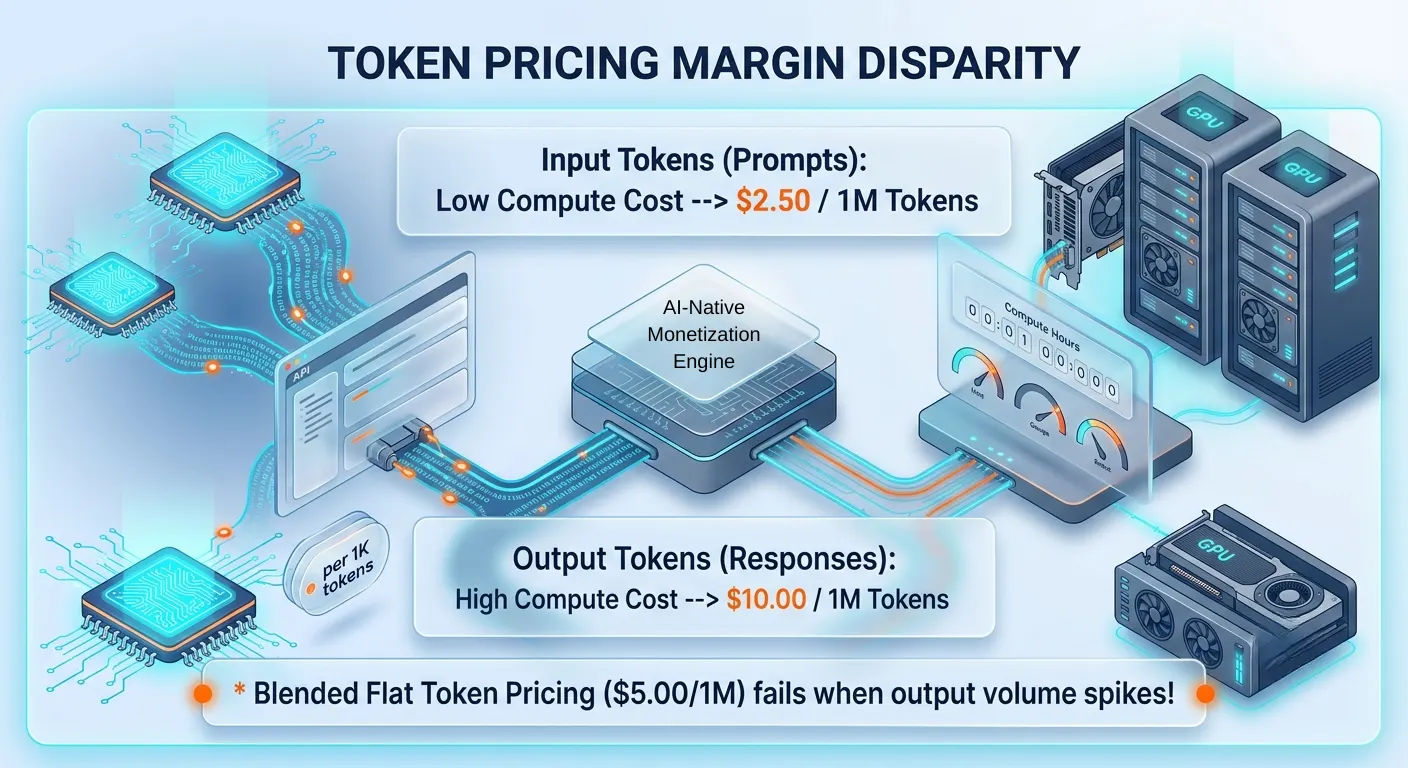
However, token billing presents severe financial pitfalls if not architected correctly. A critical unit-economic nuance that many legacy billing tools fail to address is the cost difference between input tokens (prompts sent to the model) and output tokens (responses generated by the model).
Processing output tokens requires significantly more compute power, memory bandwidth, and time than processing input tokens. Consequently, AI infrastructure providers typically pay 3x to 4x more in COGS for output generation.
- Input Tokens (Prompts) → Low Memory/Time Overhead → Lower COGS ($)
- Output Tokens (Generations) → High Memory Bandwidth → 3x–4x Higher COGS ($$$)
If your platform uses a simple "blended token rate" (charging a flat rate per 1,000 tokens regardless of direction), a user who submits massive system prompts with brief outputs will generate high profits, while a power user who submits short prompts that trigger long multi-page code generations will silently drive your gross margins into negative territory.
Deep Dive into Compute-Based Billing: Infrastructure Protection vs. Customer Friction
For platforms offering dedicated infrastructure, specialized model training, or heavy computer vision pipelines, token billing breaks down. When a customer runs an open-source model fine-tuning job on an NVIDIA H100 cluster, token counting fails to reflect memory overhead, matrix operations, or bandwidth consumption.
The Financial Trade-Off: Protecting COGS vs. Customer Retention
Compute-based billing charges for hardware utilization:
- GPU Hour Metering: Billing based on the specific GPU class assigned (e.g., $1.50/hr for an A10G vs. $4.50/hr for an H100).
- Fractional Instance Rating: Billing down to the millisecond or execution second for serverless GPU workloads.
- Storage & Bandwidth Add-ons: Metering dataset hosting, checkpoint storage, and data egress alongside compute execution.
While compute-based billing protects your cloud margins with near 100% accuracy, it shifts cloud efficiency risk entirely onto your customers. If a customer's code loops infinitely, hangs, or executes inefficiently, they receive an astronomical bill for wasted hardware. This creates immediate billing disputes, bad debt, and high customer churn.
Why You Shouldn't Choose: Unlocking Growth Through Strategic Hybridization
The most successful enterprise AI platforms do not restrict themselves to either token billing or compute billing; they combine both into a unified monetization framework that expands Average Revenue Per User (ARPU) while safeguarding margins.
Real-World Hybrid Scenario: Enterprise AI Copilot Platform
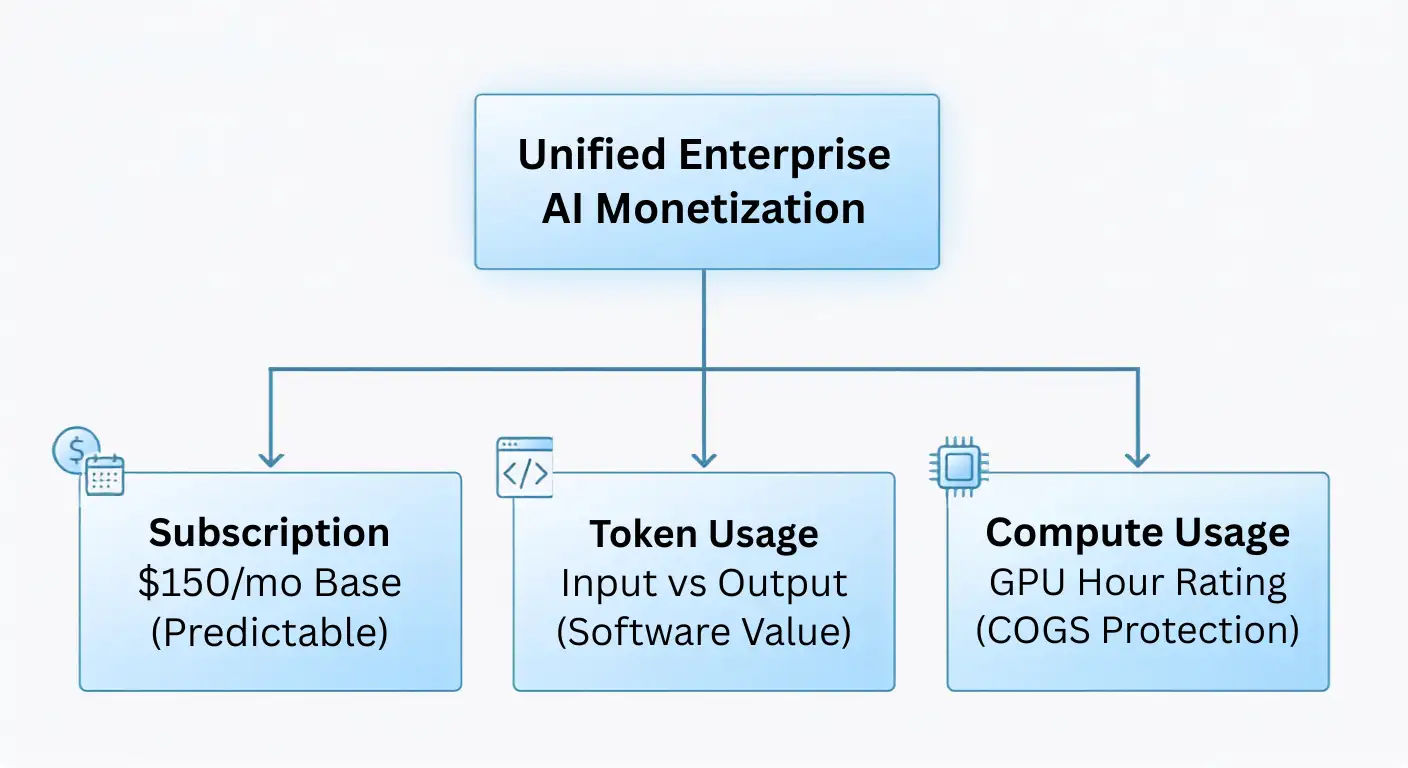
Consider an enterprise AI platform that offers both an interactive assistant and custom model training:
- Interactive Assistant: Billed on AI token-based billing (e.g., $0.005 per 1K output tokens).
- Dedicated Fine-Tuning & Custom Models: Billed on GPU hour metering (e.g., $3.20 per active GPU hour).
- Workspace & Platform Access: Billed as a predictable monthly SaaS base fee ($150/month per team).
This multi-axis monetization model captures baseline predictable revenue via subscriptions, monetizes software usage via tokens, and passes through dedicated infrastructure costs via compute meters, delivering optimal gross margin health and maximum NRR expansion.
The Build vs. Buy Equation: The True Total Cost of Ownership (TCO)
When enterprise leadership considers implementing complex, multi-metric AI monetization, engineering teams often propose building an internal metering and billing system. For C-suite executives, evaluating this choice requires analyzing the true engineering TCO versus adopting an AI-native monetization platform.
| Cost Factor / Dimension | Building In-House (Custom Metering Engine) | AI-Native Monetization Platform |
|---|---|---|
| Direct Engineering Headcount | 3 to 4 dedicated Senior Engineers (Backend, Data Infrastructure, Billing Integrations) = $600,000–$800,000/year in fully loaded compensation. | Zero dedicated billing engineers required. Simple API integration completed in 2 to 4 weeks. |
| Time-to-Market for New Pricing | 3 to 6 weeks per pricing change (requires schema migration, pipeline refactoring, and code deploy). | Instant configuration via no-code administrative catalog (< 2 days). |
| Infrastructure & Database Overhead | $30,000–$75,000/year in high-throughput event logging database clusters, Kafka queues, and multi-region synchronization. | Fully managed, enterprise-grade cloud streaming architecture included in platform fee. |
| Financial Reconciliation & Risk | High risk of revenue leakage, uncaptured overages, dual-write sync failures, and audit friction during finance closes. | Automated dual-write state reconciliation, sub-second real-time balance enforcement, and automated audit logs. |
| Opportunity Cost | 5,000+ engineering hours diverted away from core proprietary AI model features, capabilities, and UX. | 100% of internal engineering focus remains on core AI innovation and product velocity. |
AI-Native Monetization Architecture: Enterprise Scale, Speed, and Reliability
For a CTO or CIO, a monetization platform must be evaluated on architectural integrity, event throughput, sub-second execution, and zero-trust reliability.
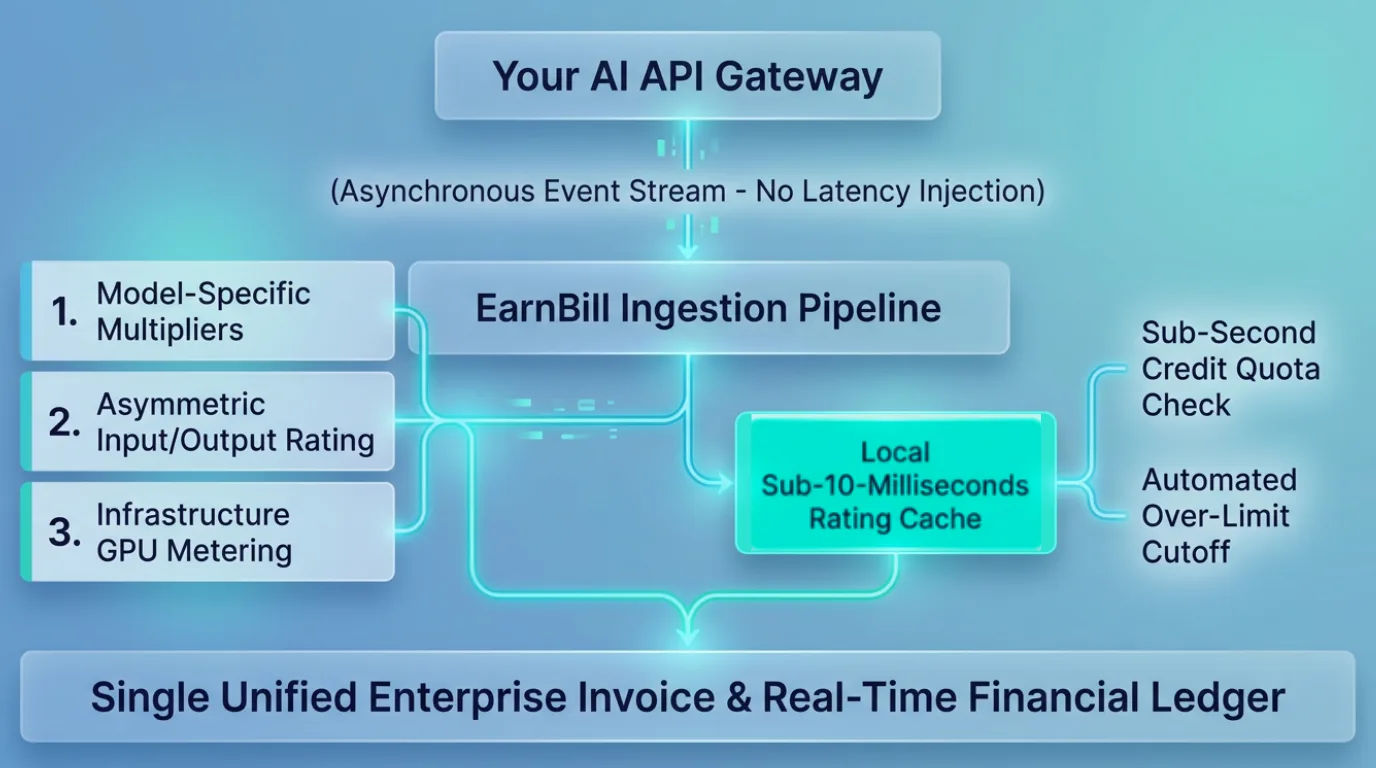
To eliminate the TCO and engineering burden of building in-house, modern platforms rely on purpose-built billing infrastructure. EarnBill adapts a telecom-grade, asynchronous event-streaming pipeline designed specifically for high-throughput AI workloads. Unlike standard billing tools that rely on blocking database locks or slow batch processing, EarnBill processes high-frequency token streams in real time without introducing API latency.
Architectural Specifications & Guarantees
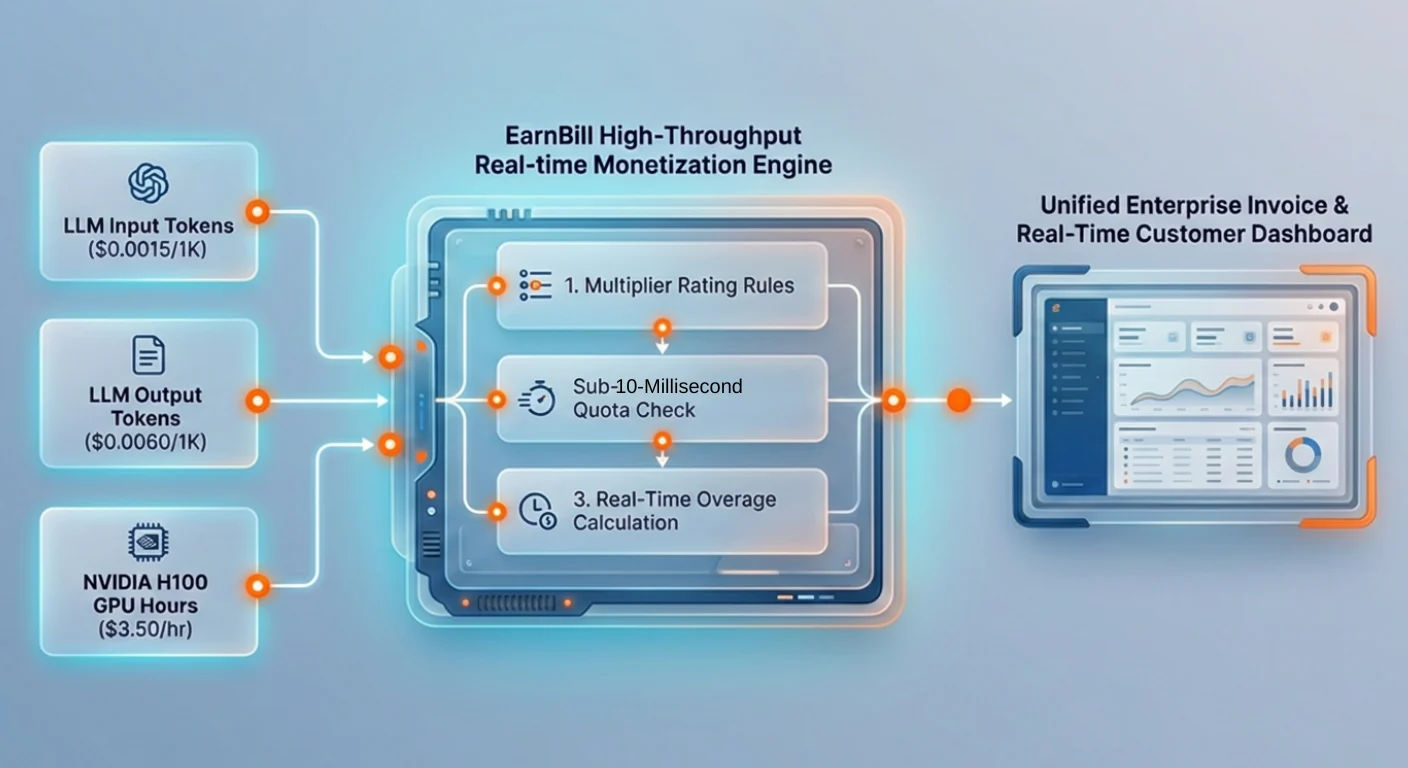
- Sub-Millisecond Rating Engine: Usage is rated in real time (< 10ms) against a localized rating cache, allowing instantaneous authorization and balance validation before model inference begins.
- Zero Latency Injection: Billing events stream asynchronously via low-overhead collectors. Your customer's LLM inference stream experiences zero added latency.
- High-Volume Scale (10M+ Event Spikes): Effortlessly ingests overnight multi-million-event spikes through distributed event queues and auto-scaling processing nodes.
- Failure Handling & State Recovery: Features dual-write state reconciliation, local offline buffering, and automated re-try protocols to guarantee zero lost usage events, even during major cloud availability zone outages.
Unpacking the 10x ROI at 50% TCO
How does EarnBill deliver a 10x ROI at 50% of the TCO?
- TCO Reduction: Building and maintaining a resilient billing stack costs in excess of half a million dollars in year one and at least a quarter of the initial investment annually thereafter. These would be conservative estimates. EarnBill cuts overall operational cost by 50% by eliminating dedicated backend engineering drag, dedicated database infrastructure overhead, and ongoing pipeline maintenance.
- 10x ROI Generation: EarnBill generates financial return by:
- Eliminating Margin Leakage (5%–15% Margin Recovery): Automatically enforcing asymmetric input/output token pricing prevents negative-margin query execution.
- Preventing Overuse & Bad Debt: Sub-second credit depletion checks instantly halt non-paying high-volume usage before runaway GPU charges hit your cloud bill.
- Accelerating GTM Velocity: Launching enterprise hybrid plans in hours instead of months unlocks immediate expansion revenue and enterprise contract closing speed.
How EarnBill Solves the AI Billing Dilemma
EarnBill was purpose-built to solve these monetization challenges for high-growth AI platforms. Instead of forcing you to adapt your product to rigid billing software, EarnBill provides a flexible infrastructure designed specifically for complex AI metrics.
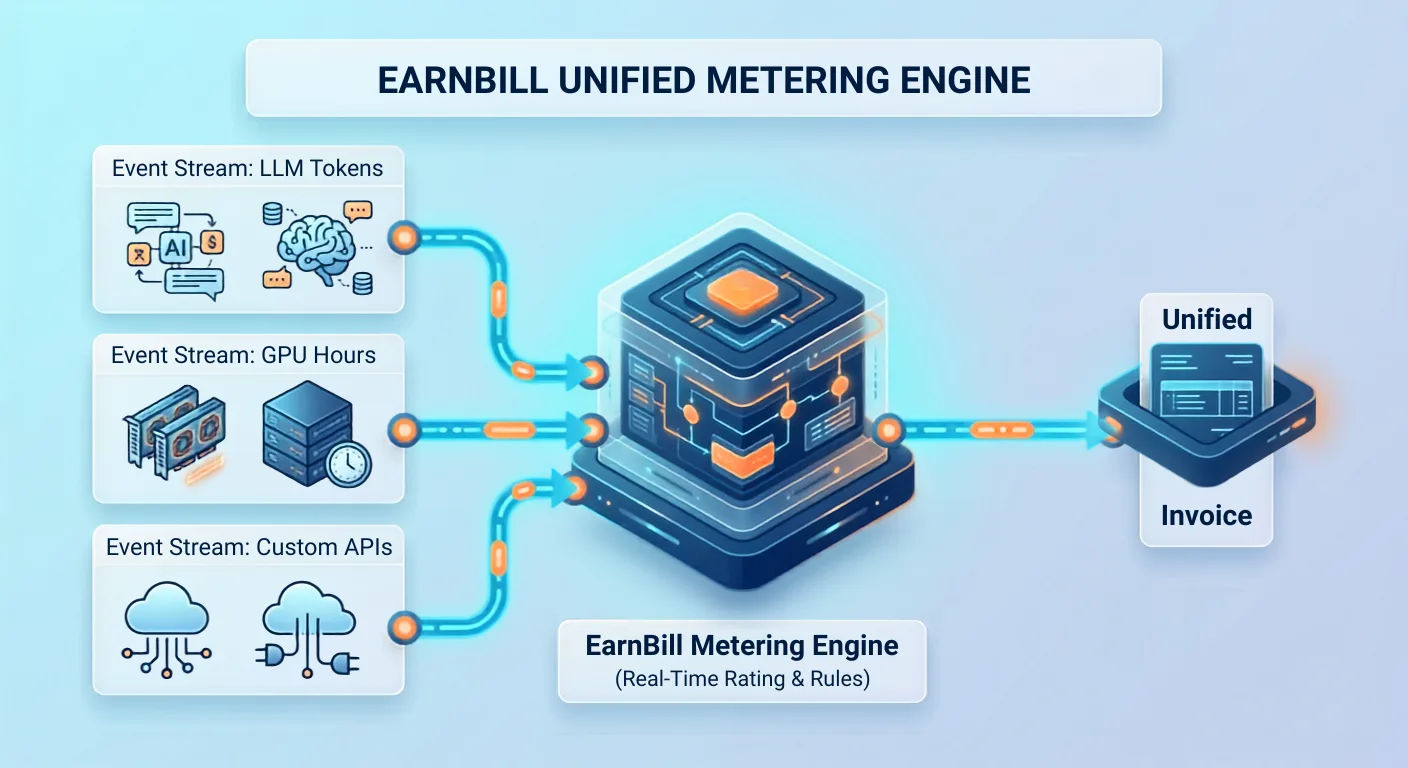
Feature 1: The Flexible Metering Engine
EarnBill's Flexible Metering Engine can ingest, rate, and combine any metric your AI stack generates. Whether you are tracking token volume, GPU execution seconds, dataset storage in gigabytes, or custom business logic events, EarnBill processes all of these streams through a single ingestion engine.
EarnBill allows you to process both token metrics and compute metrics simultaneously on the same unified invoice, removing the need to manage separate billing systems for software access and underlying compute infrastructure.
Feature 2: Automated Input vs. Output Token Differentiation
While competing billing platforms require developers to build complex pre-processing routines to split token categories before sending them to the billing system, EarnBill handles this natively.
EarnBill natively supports input and output token differentiation out-of-the-box, allowing you to set model-specific pricing multipliers (e.g., rating GPT-4 output tokens at 3x input tokens) directly inside the product catalog without writing custom backend code.
Feature 3: Hybridizing Software Tokens with Infrastructure Compute
Your product strategy will evolve as you launch new capabilities and move upmarket to enterprise buyers. You might start with pay-as-you-go tokens today and introduce dedicated GPU clusters tomorrow.
With EarnBill, you can effortlessly combine token-based billing for software usage with compute-based GPU hour metering for dedicated infrastructure under a single contract, giving product teams complete freedom to pivot value metrics without re-engineering the billing pipeline.
Addressing the High-Volume Scale Debate
When technical leaders consider adopting a third-party metering platform for high-frequency token usage, a common question arises:
"If our API processes tens of millions of token events per day, won't sending every event to an external billing tool add latency and run up massive event-processing charges?"
Let's address this concern directly. In traditional SaaS billing tools built on batch database locks, high-frequency event ingestion can indeed create latency and expensive data processing costs. However, EarnBill is built on a high-throughput Real-time Monetization architecture, adapted in concept and design from high-volume telecommunications infrastructure.
EarnBill's high-scale Real-time Monetization Engine is designed specifically to process 10M+ overnight token spikes with sub-10-millisecond response times. By utilizing asynchronous event streaming and local rating caches, EarnBill rates usage in real time without adding latency to your API or running up computational overhead.
Strategic Monetization vs. Primitive Metering
Most billing options force software companies into a compromise: adopt a rigid payment gateway (which lacks complex usage rating engines) or deploy a generic usage-billing tool built for standard API calls. EarnBill provides an enterprise-grade AI-native monetization engine.
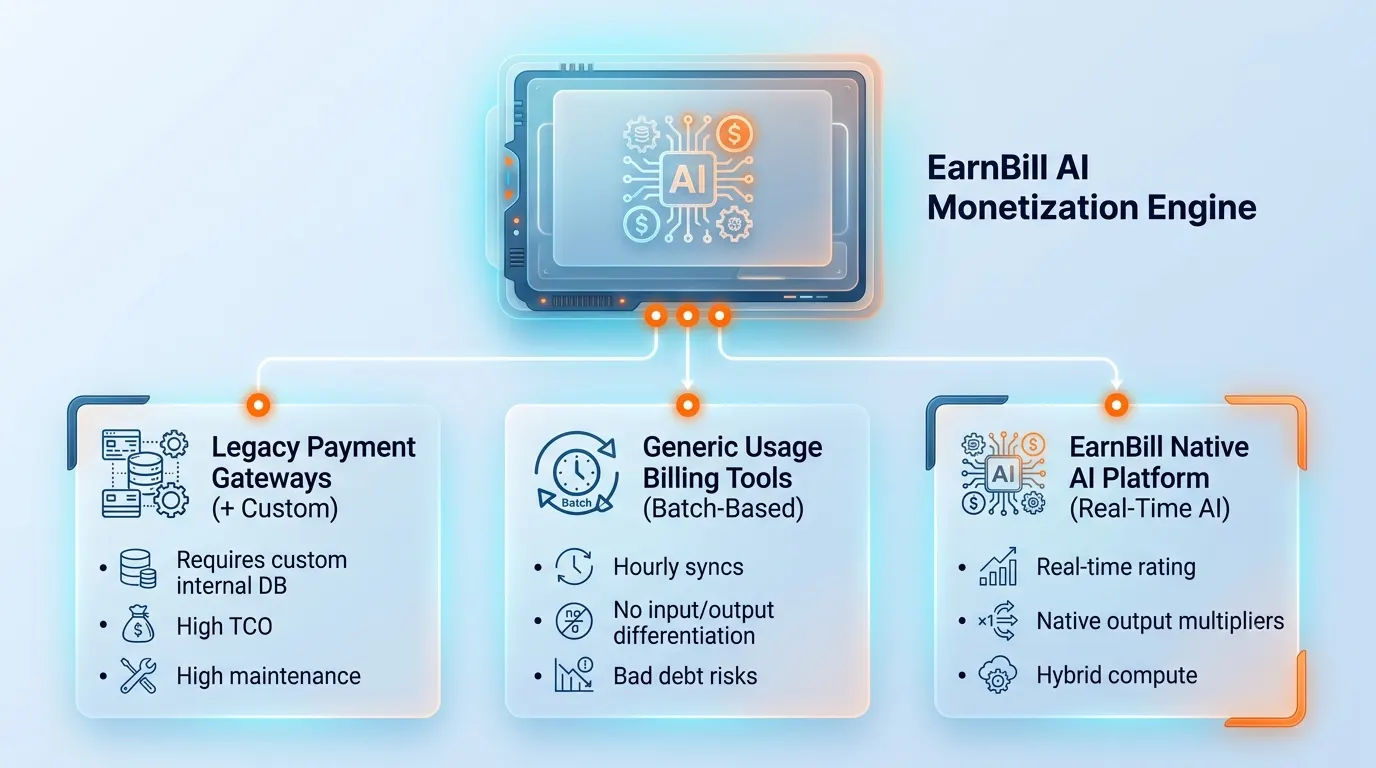
Sharper differentiation across enterprise dimensions:
- AI-Native Product Catalog vs. Hardcoded Application Logic. The legacy way hardcodes pricing multipliers (e.g., GPT-4 output = 3x input) directly inside backend application code, so any price change requires an engineering deployment. The EarnBill way lets non-technical commercial teams adjust model multipliers, tiering thresholds, and custom discounts directly inside the product catalog instantly, with zero code changes.
- Sub-Second Credit Depletion Enforcement vs. High-Risk Batch Syncs. The legacy way processes usage in hourly or nightly batch jobs; if an enterprise customer runs away with thousands of dollars of H100 execution at 2:00 AM, standard tools don't notice until hours later. The EarnBill way rates usage continuously, automatically halting requests or sending overage warnings the moment a prepaid balance hits zero.
- Unified Hybrid Metering vs. Disjointed Siloed Billing. The legacy way manages two separate billing systems, one for SaaS token APIs and another for dedicated cloud GPU infrastructure, resulting in split invoices and confused enterprise customers. The EarnBill way blends tokens, GPU execution hours, storage, and recurring enterprise platform fees onto a single, clear, fully audited invoice.
Measurable Business Outcomes: Enterprise Scenarios
Scenario A: Margin Leakage Prevention
An enterprise LLM previously billed customers at a flat blended rate of $0.004 per 1,000 tokens. As customer usage shifted toward complex multi-page code generation, output tokens expanded to 75% of total volume, driving gross margins down to 12%.
By implementing EarnBill's automated input vs. output token rating, the platform can institute an asymmetric $0.0015 input / $0.0060 output rate, instantly restoring gross margins to 68% without losing price-sensitive users.
Scenario B: Enterprise Deal Velocity & Expansion
A fast-growing AI Agent startup struggles to close Fortune 500 contracts because legacy billing tools cannot accommodate hybrid pricing (annual base subscription + included credit pools + overage GPU metering).
With EarnBill, the sales team can configure custom enterprise contracts in minutes, reducing sales cycle length by 40% and increasing Net Revenue Retention (NRR) by 28% within two quarters.
Most billing tools focus solely on basic token counts or fixed subscription tiers. Here is how EarnBill provides complete operational coverage:
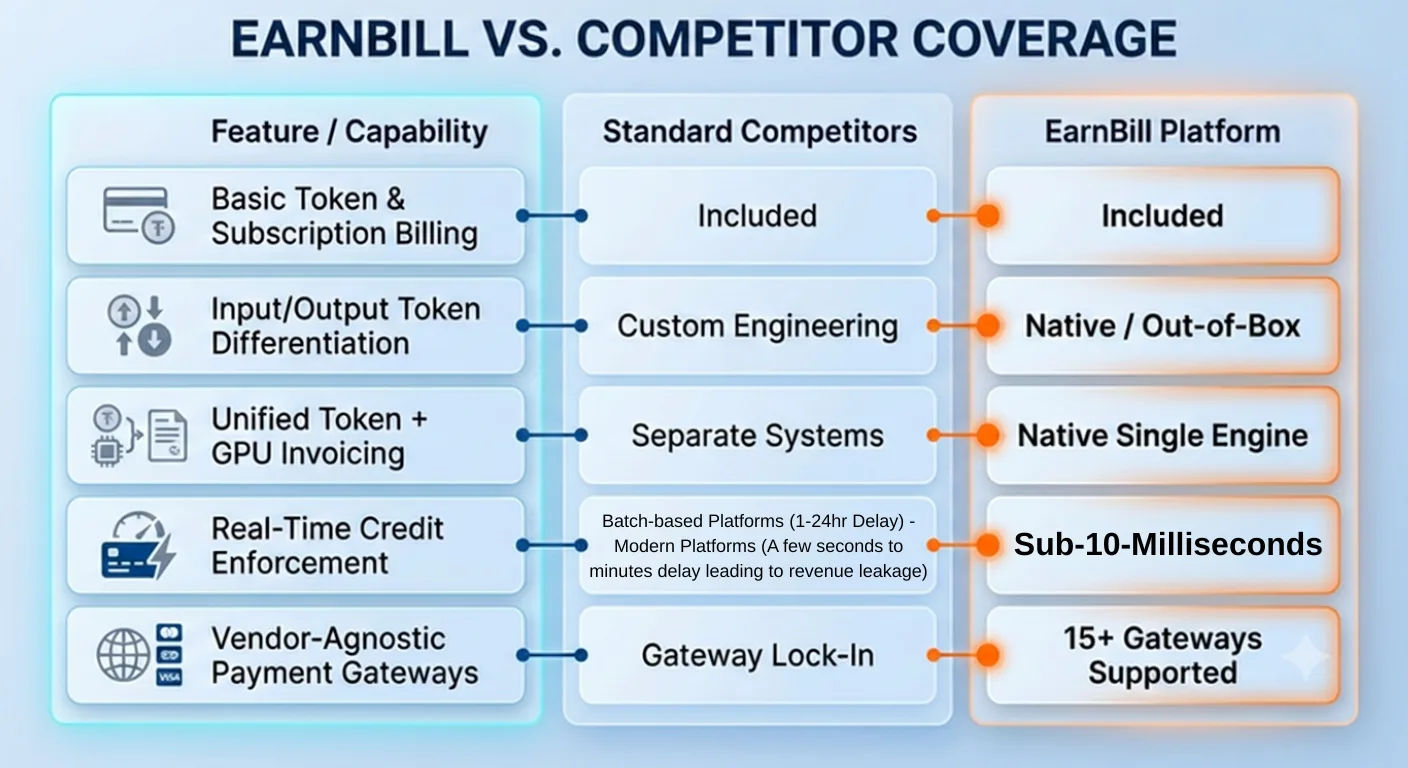
Automated Model-Specific Multipliers. Other billing systems could require you to hardcode model pricing rules inside your application. EarnBill manages model-specific rates (e.g., GPT-3.5 vs. GPT-4 vs. custom Llama 3 deployments) directly inside a flexible Product Catalogue, allowing non-technical managers to update pricing instantly.
Real-Time Credit Depletion Limits. Most platforms calculate usage in hourly or daily batches. If a customer exhausts their prepaid token balance at 2:00 AM, standard tools won't notice until the next sync cycle. EarnBill's sub-second rating engine checks balances instantly, protecting your compute budget from unauthorized usage.
FAQs
To help product, finance, and engineering leaders evaluate their AI monetization strategy, here are answers to common questions about token-based vs. compute-based billing.
What is the difference between token-based and compute-based AI pricing?
Token-based billing charges per 1K/1M tokens (the words or sub-words) processed by an LLM or generative model, which is intuitive for text, chat, and code-generation APIs. Compute-based billing charges for hardware utilization such as GPU/CPU hours, execution seconds, or instance tiers, and directly tracks underlying cloud cost, so it suits model fine-tuning, rendering, and custom model hosting. Token billing is easy for developers to reason about but exposes margin risk if input/output ratios drift; compute billing protects margins near 100% but shifts efficiency risk onto the customer.
Why should output tokens be priced higher than input tokens?
Processing output tokens requires significantly more compute power, memory bandwidth, and time than processing input tokens, so AI infrastructure providers typically pay 3x to 4x more in COGS for output generation. A flat blended token rate lets short prompts that trigger long generations silently push gross margins negative. Applying asymmetric input vs. output token pricing, for example rating output at 3x input, restores margin health without alienating price-sensitive users.
What is a hybrid AI monetization model?
A hybrid model combines a predictable monthly subscription base fee, token-based billing for interactive software usage, and compute-based GPU hour metering for dedicated infrastructure on a single invoice. This multi-axis approach captures baseline recurring revenue, monetizes software value through tokens, and passes through infrastructure cost via compute meters, expanding ARPU and Net Revenue Retention while safeguarding gross margins.
Should we build or buy an AI usage-based billing platform?
Building an in-house metering engine typically requires 3 to 4 dedicated senior engineers ($600K–$800K/year), $30K–$75K/year in event-logging infrastructure, and 3 to 6 weeks per pricing change, while diverting 5,000+ engineering hours from core AI features. An AI-native monetization platform needs no dedicated billing engineers, integrates in 2 to 4 weeks, allows no-code pricing changes in under two days, and includes managed streaming infrastructure, delivering a 10x ROI at roughly 50% of the total cost of ownership.
How does a real-time monetization engine prevent margin leakage and bad debt?
A real-time monetization engine rates usage in under 10 milliseconds against a local rating cache, enforcing asymmetric input/output token pricing to prevent negative-margin queries and running sub-second credit depletion checks that halt non-paying high-volume usage before runaway GPU charges hit your cloud bill. Unlike batch tools that reconcile hourly or nightly, it catches balance depletion instantly, protecting both gross margins and compute budgets.
Conclusion: Future-Proof Your AI Monetization Stack
The decision between token-based billing and compute-based billing isn't an either/or choice. As your AI platform scales, your enterprise buyers will demand custom pricing, your engineering team will introduce new model architectures, and your underlying cloud costs will shift.
Relying on rigid billing tools or trying to build a custom internal solution forces your engineering team to spend valuable sprint time maintaining payment pipelines instead of improving your AI capabilities. You risk margin erosion, slow GTM execution, and high TCO.
You need an enterprise-grade real-time monetization platform that protects gross margins and accelerates growth. EarnBill provides the technology, scale, and flexibility required to charge by the token, by the compute hour, or through any hybrid model your business demands. Designed to be relied on, EarnBill delivers a 10x ROI at 50% of the Total Cost of Ownership (TCO) compared to custom internal billing development or competitive platforms. You preserve your engineering resources, protect your gross margins, and gain the commercial agility needed to win in the fast-moving AI market.
Ready to Transform Your AI Unit Economics?
Blend tokens, GPU hours, and subscriptions on a single real-time invoice. See how EarnBill's AI-native monetization engine eliminates margin leakage, prevents bad debt, and lets you launch enterprise hybrid plans in hours, not months.