
Mobile Virtual Network Operators (MVNOs) operate in one of the most margin-sensitive, fast-moving segments of the telecommunications industry.
Over the last decade, the MVNO market has evolved from simple reselling of Mobile Network Operator (MNO) voice and SMS bundles into a sophisticated ecosystem offering multi-play digital services, international roaming packages, Internet of Things (IoT) connectivity, and flexible enterprise fleets.
However, as business models have diversified, the underlying Business Support Systems (BSS) have frequently failed to keep pace. Many MVNOs still rely on legacy billing architectures designed in an era when prepaid and postpaid subscriber bases were strictly separated into different operational silos.
For MVNO Chief Technology Officers (CTOs) and Chief Executive Officers (CEOs), maintaining these fragmented systems presents a growing threat to profit margins and market agility. Operating separate software engines and databases for real-time prepaid charging and offline postpaid billing introduces technical friction, balance synchronization delays, revenue leakage, and redundant software licensing costs.
Achieving true competitive advantage requires moving away from patchwork billing stacks toward a unified convergent billing architecture. Merging a real-time Online Charging System (OCS) and postpaid Call Detail Record (CDR) mediation onto a single software engine establishes a foundation for low-friction growth, modern service delivery, and streamlined operational control.
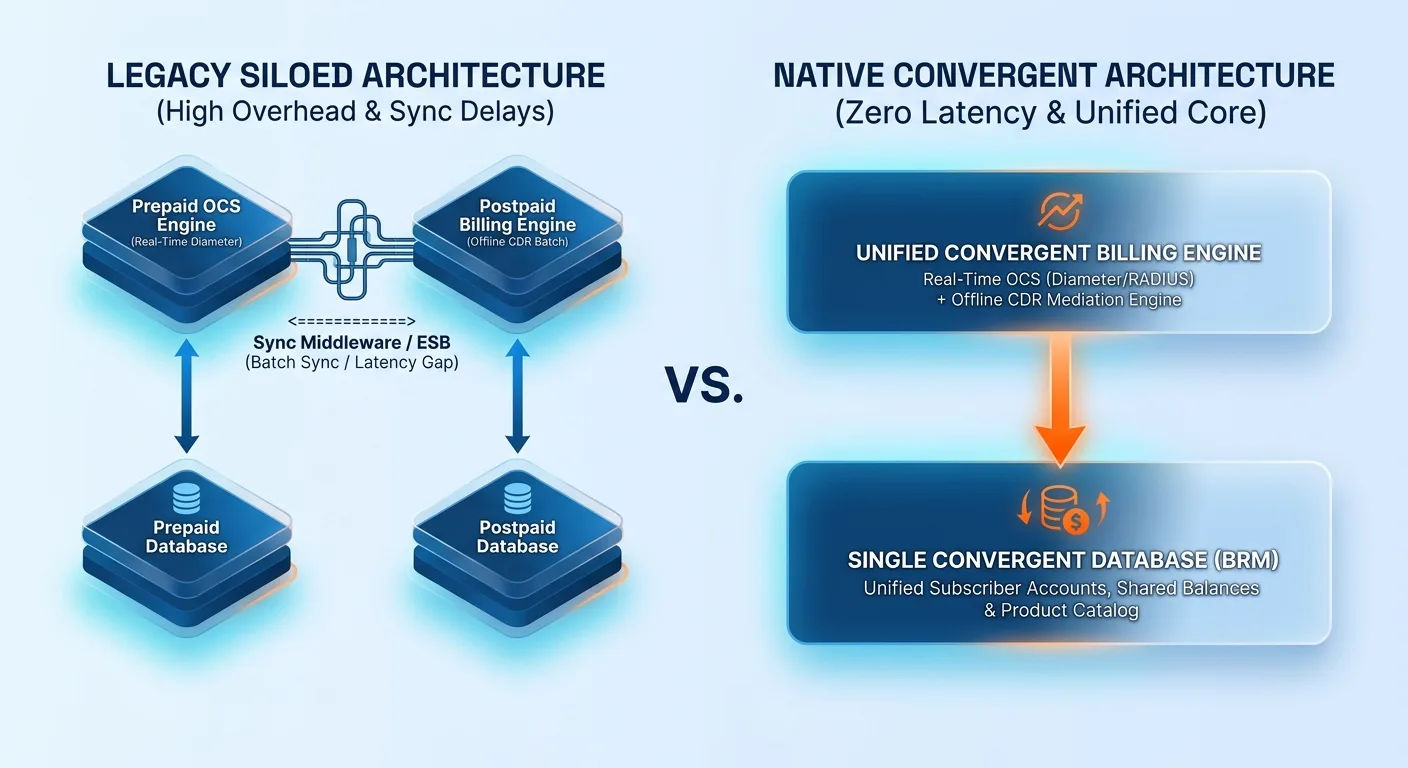
The Architecture Divide: Legacy Silos vs. Native Convergence
To understand why telecommunications billing infrastructure is changing, we must analyze the structural mechanics of legacy BSS stacks versus modern convergent platforms.
Historically, telecommunications networks separated subscribers based on payment timing:
- Prepaid Charging: Handled by an OCS in real-time. Network elements interact with the OCS to check balances, reserve quotas, and authorize sessions before and during service delivery.
- Postpaid Billing: Handled by offline billing engines. Network elements generate usage logs (CDRs), which are periodically collected via file transfer protocols (FTP/SFTP), mediated, normalized, rated, and aggregated into end-of-month invoices.
Because these core functions relied on fundamentally different data processing models: real-time transactional processing versus asynchronous batch processing; vendors built them as separate software applications running on distinct database instances.
The Operational Drag of Siloed Systems
When an MVNO operates separate engines for prepaid and postpaid lines, it incurs significant operational overhead:
- Synchronization Latency: To give customer service representatives (CSRs) or end-users a view of their overall account status, data must constantly sync between the prepaid OCS database and the postpaid billing database using middleware or Enterprise Service Bus (ESB) layers. These sync routines often lag, leading to race conditions where balances do not reflect actual network usage.
- Revenue Leakage: When sync delays occur, subscribers may exhaust their credit limits or prepaid balances while the network continues to authorize sessions. This window of latency is a primary cause of unrecoverable bad debt and unauthorized usage.
- Redundant Licensing and Maintenance Costs: Maintaining two billing environments means paying twice for vendor support, infrastructure hosting, database licenses, and specialized IT support teams.
- Static Product Catalogs: Launching a hybrid product such as a postpaid plan with prepaid add-on bundles, requires configuring the offer in two separate product catalogs and mapping the logic between them, slowing down time-to-market.
A native convergent billing system eliminates these structural barriers. By processing real-time OCS requests and offline mediation files within a single engine connected to a single, unified database, the system processes usage from any payment source directly against the subscriber's master balance profile without intermediate synchronization steps.
Deep Technical Mechanics: Real-Time OCS and Postpaid Mediation
Processing complex telecom billing requires managing two distinct network data streams simultaneously: high-frequency real-time authorization requests and heavy volumes of asynchronous usage records.
1. Real-Time OCS Engine Mechanics
For prepaid services, top-ups, and hard-cap data limits, the billing system acts as a real-time gatekeeper. Network nodes communicate with the OCS using standard telecommunications protocols:
- Diameter Protocol (Gy / Ro Interfaces): Used extensively in 4G LTE and 5G networks for real-time Session Based Charging (SBC) and Event Based Charging (EBC). When a subscriber opens a data session, the Packet Data Network Gateway (PGW) or User Plane Function (UPF) sends a Diameter Credit-Control-Request (CCR-Initial) to the OCS.
- RADIUS Protocol (AAA): Frequently utilized in legacy networks, enterprise Wi-Fi, and specialized MVNO data configurations for Authentication, Authorization, and Accounting.
- 5G CHF / Nchf: In 5G Standalone environments, charging increasingly uses the 3GPP Charging Function (CHF) and service-based Nchf interfaces. A convergent MVNO billing architecture should therefore support both modern 5G charging interfaces and Diameter/RADIUS-based charging used across LTE, legacy and enterprise environments.
When an authorization request arrives, the OCS must execute a series of operations within a strict sub-second window (typically under 50 milliseconds):
- Identify the subscriber and authenticate the service request.
- Query the subscriber's wallet structure (main balance, data allowance, promotional voice units).
- Calculate the rating for the requested destination, quality of service (QoS), or time band.
- Reserve a specific quota of units (e.g., 50 MB of data or 10 minutes of voice time).
- Return a Diameter Credit-Control-Answer (CCA) authorizing the network node to grant service.
- Monitor ongoing CCR-Update heartbeats, deducting quota dynamically, and trigger a CCR-Terminate or session teardown if the balance hits zero.
2. Offline Mediation Engine Mechanics
For postpaid services with monthly invoicing, real-time blocking is not always required. Instead, the focus shifts to ingestion scale, data normalization, and rating precision.
- CDR Ingestion & Parsing: The mediation engine ingests raw usage logs from network nodes (GGSN, PGW, MSC, SMSC) or host MNO file repositories across various formats (ASN.1, CSV, Fixed-Width, XML).
- Normalization & Deduplication: Raw network streams are parsed into standard formats, verified for duplicate records, and validated for data integrity.
- Enrichment & Rating: The engine maps network identifiers (IMSI, MSISDN, IP address) to specific subscriber accounts, calculates rates based on contractual agreements, peak/off-peak rates, and tier structures, and writes the rated items to the billing ledger.
The Convergent Integration Layer
In a convergent engine, these two workloads run on a single processing framework. When a subscriber uses a postpaid line, usage records stream through the mediation engine directly into their main account. If that same subscriber purchases a prepaid data booster, the real-time OCS intercepts subsequent data sessions and deducts quota from the prepaid wallet in real-time.
Both operations update the same subscriber ledger instantly. The system prevents over-spending by ensuring that real-time OCS checks evaluate both prepaid quotas and active postpaid credit limits concurrently.
Unlocking Hybrid Monetization Models
The real-world value of a unified convergent architecture lies in the product flexibility it unlocks for commercial, marketing, and product development teams. Consumers no longer want rigid subscription options; they prefer flexible packages tailored to their actual usage patterns.
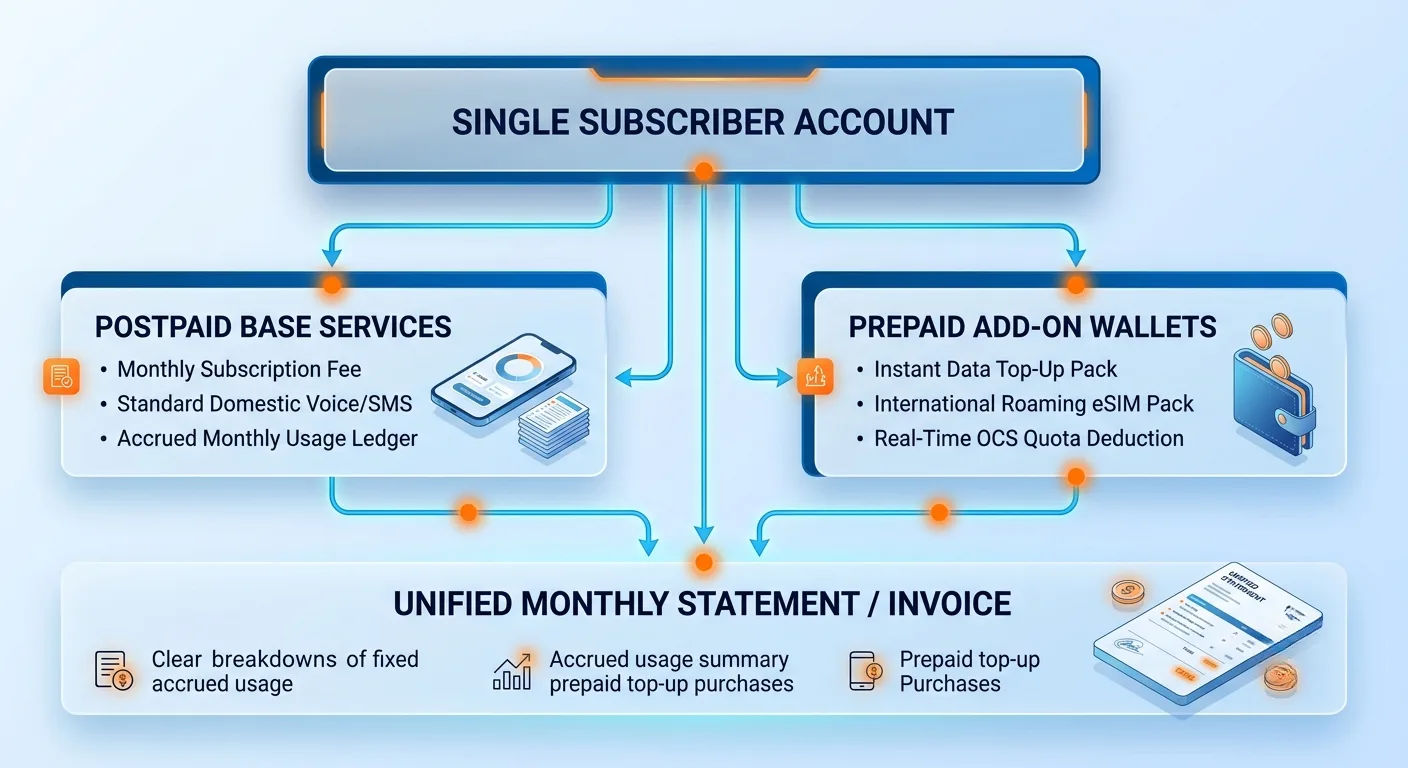
A convergent engine allows MVNOs to blend prepaid and postpaid mechanisms into unified hybrid accounts.
Hybrid Account Mechanics in Action
Consider a standard subscriber scenario: A user maintains a core postpaid plan that includes unlimited local voice calls, SMS, and a baseline tier of 10 GB of high-speed data billed at the end of every month.
Halfway through the month, the user consumes their 10 GB allocation. In a legacy billing framework, the operator faces a dilemma: either automatically bill expensive overage charges (which often leads to bill shock and customer churn) or require the customer to migrate to a higher, more expensive postpaid tier.
In a convergent architecture, the operator offers a third option: an instant, prepaid add-on data booster. The subscriber purchases a 5 GB data pack via a self-service app or SMS trigger. The convergent engine immediately provisions a temporary prepaid wallet alongside the existing postpaid account.
Subsequent data sessions trigger the real-time OCS using the appropriate real-time charging interface, such as Diameter or RADIUS depending on the underlying network and access architecture to check and deduct quota from the prepaid 5 GB wallet. Once that wallet is exhausted, the system smoothly reverts the line back to standard postpaid rating or throttles the connection according to pre-configured policy rules.
The subscriber retains the predictability of their postpaid base plan while gaining the flexibility of prepaid top-ups, all without needing to register a secondary account or manage multiple SIM identities.
The Travel eSIM Use Case: Global Connectivity Without Bill Shock
The growth of eSIM technology has reshaped mobile connectivity, particularly for international travel. Modern smartphones allow users to host multiple active profiles, creating opportunities for MVNOs to capture travel revenue previously lost to local SIM vendors or unexpected roaming charges.
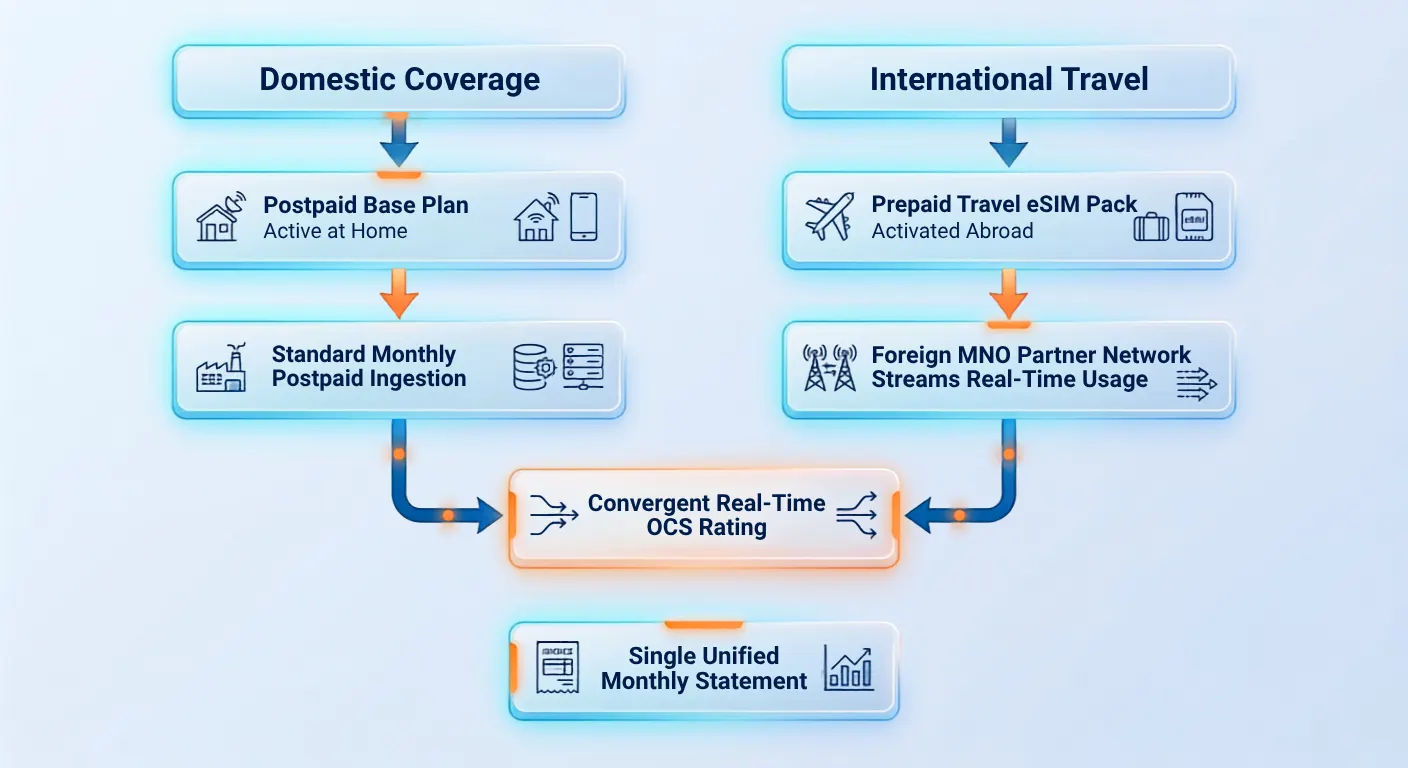
Using a convergent engine, MVNOs can combine domestic postpaid mobile plans with international prepaid travel eSIM offerings into a single user experience.
Technical Implementation of the Travel eSIM Model
- Pre-Trip Acquisition: A subscriber on a domestic postpaid plan decides to travel internationally. Before departure, they purchase a destination-specific data bundle (e.g., 10 GB for European travel) through their MVNO's portal.
- Profile Provisioning: The MVNO provisions an eSIM profile to the user's device. This profile links directly to the subscriber's master account in the convergent billing system, establishing a secondary, travel-specific prepaid wallet.
- Overseas Session Routing: Upon arrival at the destination, the device connects to an overseas partner carrier's network. As the subscriber uses data, the foreign partner network routes authentication and usage sessions back to the home MVNO via international roaming interconnects or direct API data streams.
- Real-Time OCS Deduction: The MVNO's real-time OCS intercept these usage requests. The engine checks the prepaid travel wallet, validates the available balance, and grants access in real time. Usage is deducted live from the travel quota.
- Carrier Independence for commercials and rating: Because the MVNO uses its own convergent engine to rate and track usage, it remains completely independent of the foreign carrier's billing systems. The MVNO can structure custom travel packages, set its own retail pricing, and launch promotional campaigns without waiting for partner MNO configuration changes.
- Unified Billing Presentation: When the subscriber returns home, they do not receive unexpected roaming charges. Instead, their monthly statement clearly itemizes their standard domestic postpaid charges alongside a detailed breakdown of the prepaid travel eSIM usage consumed during their trip.
This hybrid approach replaces bill shock with cost transparency, boosting customer satisfaction and retaining high-value subscribers.
Solving B2B Enterprise Complexity: Multi-Service Hierarchies
While consumer hybrid services drive user retention, enterprise B2B accounts represent high-margin revenue for growing MVNOs. Winning enterprise contracts such as corporate smartphone fleets, logistics tracking, or field service connectivity, requires handling highly complex billing structures.
In developing markets where prepaid services are dominant due to cash-flow dynamics, corporate clients often require a mix of service structures. An enterprise client may manage hundreds of mobile lines across different departments, requiring varying combinations of payment models:
- Executive Staff: Uncapped postpaid lines with monthly consolidated billing.
- Field Operations & Fleet Drivers: Restricted prepaid lines with fixed monthly allowances to prevent budget overruns.
- Remote IoT Gateways: Usage-based telemetry lines rated asynchronously via mediation.
The Nightmare of Legacy Systems for B2B Clients
In a traditional, siloed billing setup, an MVNO cannot easily manage mixed service types under one corporate umbrella. The enterprise finance department receives separate bills for prepaid top-ups and postpaid lines, requiring manual reconciliation across multiple account portals.
The Convergent B2B Solution
A convergent billing platform solves this by applying a unified account hierarchy:
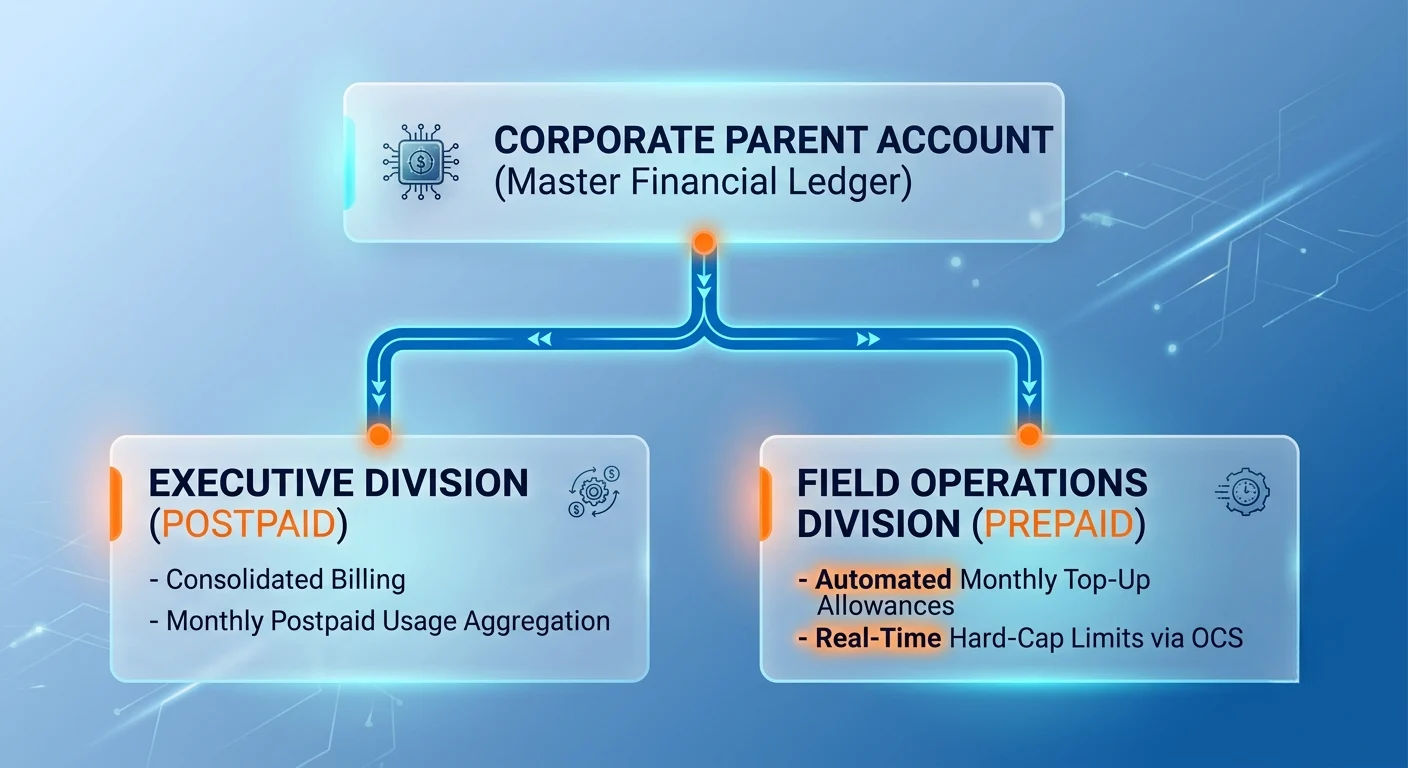
Under this model:
- The corporate entity exists as a single parent account in the Billing and Revenue Management (BRM) database.
- Sub-accounts are organized by department, cost center, or location.
- The system applies appropriate rating rules; postpaid mediation for executive lines, real-time OCS constraints for field staff, while aggregating all financial transactions into a single master ledger.
- At the close of the billing cycle, the system generates a single invoice or statement of account detailing charges across every line, itemized by service type, user, and subscription model.
This level of administrative clarity gives enterprise finance teams tight control over telecommunications spend while significantly reducing operational churn for the MVNO. For the MVNO, the commercial advantage is equally important: one account hierarchy can support multiple payment models, services and cost centers without requiring separate billing platforms or manual reconciliation processes.
Invoicing Transparency: Translating Data into Customer Value
For both B2C and B2B subscribers, the invoice is the primary touchpoint with an MVNO. Unclear invoices lead to increased customer support volume, disputed charges, and higher churn rates.
A convergent engine treats the invoice as a key customer retention tool by consolidating diverse transaction types into an organized summary:
| Billing Category | Included Line Items & Data | Value to Subscriber / Enterprise |
|---|---|---|
| Subscription Services | Fixed recurring charges or Monthly Recurring Charges (MRC) for base plans, add-on features, and device leasing fees. | Clear predictability of fixed monthly commitments. |
| Real-Time Prepaid Logs | Itemized top-ups, instant data quota purchases, and roaming bundle activations. | Complete visibility into advance payments and balance usage. |
| Postpaid Usage Breakdown | Mediated CDR items including out-of-bundle voice minutes, premium SMS, and international calls. | Transparent auditing of variable, usage-driven costs. |
| Financial Adjustments | Applied credits, promotional discounts, service-level agreement (SLA) penalties, and tax breakdowns. | Clear verification of billing disputes and applied credits. |
Providing a single, itemized view across every line item removes billing ambiguity, lowers call center volume, and builds trust with subscribers.
Modern Convergent Architecture in Action
As MVNOs look to replace fragmented BSS setups, deploying a platform built for native convergence is essential to avoiding legacy technical debt.
This is where EarnBill comes in. Developed specifically to meet the demands of modern MVNOs, systems integrators, and digital service providers, EarnBill provides a native convergent billing platform that handles real-time OCS functions and postpaid CDR mediation within a single software engine.
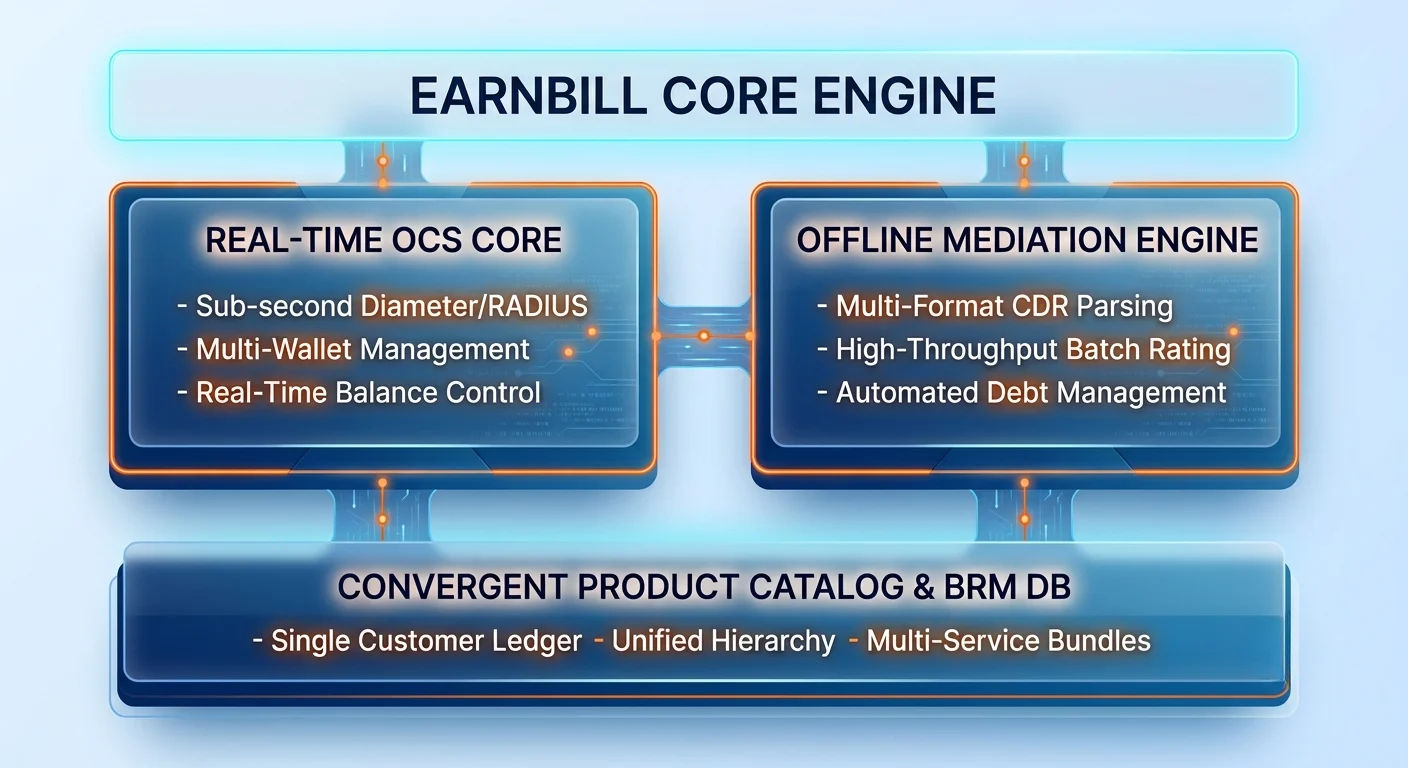
Rather than linking disparate software tools through API layers, EarnBill was engineered from the ground up to eliminate the gap between prepaid and postpaid processing:
- Native Sub-Second OCS: Supporting Diameter (Gy/Ro) and RADIUS protocols out of the box, EarnBill delivers the sub-second authorization response times required to prevent balance overruns on high-speed data networks.
- Unified Balance Engine: EarnBill tracks prepaid wallets, shared family accounts, and postpaid credit limits on a single database instance, removing the need for synchronization between separate prepaid and postpaid balance databases and reducing synchronization-driven revenue leakage.
- Flexible Hybrid Product Catalog: Commercial teams can create complex offers; such as postpaid plans with embedded prepaid roaming packs or multi-line enterprise bundles, in a single administrative console without custom code.
- High-Throughput CDR Mediation: EarnBill ingests, normalizes, rates, and settles heavy volumes of offline usage records asynchronously, ensuring legacy postpaid processing runs smoothly alongside real-time charging routines.
By combining real-time OCS and postpaid mediation into a single platform, EarnBill provides MVNOs with the structural framework needed to reduce IT complexity, scale operations efficiently, and lower Total Cost of Ownership (TCO).
FAQs
To assist technical teams and decision-makers evaluating convergent billing architectures, here are answers to common industry questions:
What is convergent MVNO billing and why is it replacing legacy siloed systems?
Convergent MVNO billing is an architectural model that unifies real-time prepaid charging (OCS) and offline postpaid mediation onto a single software engine and database instance. It is replacing legacy siloed systems because traditional setups rely on separate databases connected by slow middleware pipelines, causing balance synchronization delays, revenue leakage, high licensing fees, and complex IT maintenance. Convergent billing processes all usage in real-time, providing unified account management across all service types.
How does sub-second OCS authorization via Diameter and RADIUS protect MVNOs from overspending?
Sub-second OCS authorization uses high-speed network protocols (Diameter Gy/Ro or RADIUS AAA) to inspect balance profiles, reserve funds, and authorize network sessions before services are consumed. By processing these requests in under 50 milliseconds, the OCS can immediately terminate sessions or downgrade QoS the moment a subscriber's balance or credit limit is reached. This prevents subscribers from consuming unpaid services during network latency windows, shielding MVNOs from unexpected revenue leakage.
Can a single MVNO billing engine handle voice, SMS, data, and VAS bundles simultaneously?
Yes. A native convergent billing engine manages voice, SMS, data, and Value-Added Services (VAS) using a central product catalog and multi-wallet balance structure. The engine tracks different service usage parameters (e.g., minutes, megabytes, event counts) simultaneously, applying real-time rating rules and deducting units from the appropriate prepaid wallet or postpaid ledger in real time.
Strategic Evaluation: Why Telecom Leaders Select EarnBill
For CTOs, CEOs, and systems integrators, selecting a BRM platform is a long-term strategic decision. The infrastructure chosen directly impacts operational efficiency, customer churn, market agility, and overall profitability. For MVNOs, convergence is therefore more than an infrastructure consolidation strategy. It becomes a monetization enabler, allowing operators to combine prepaid, postpaid, roaming, eSIM, IoT and enterprise services within a common commercial and billing framework.
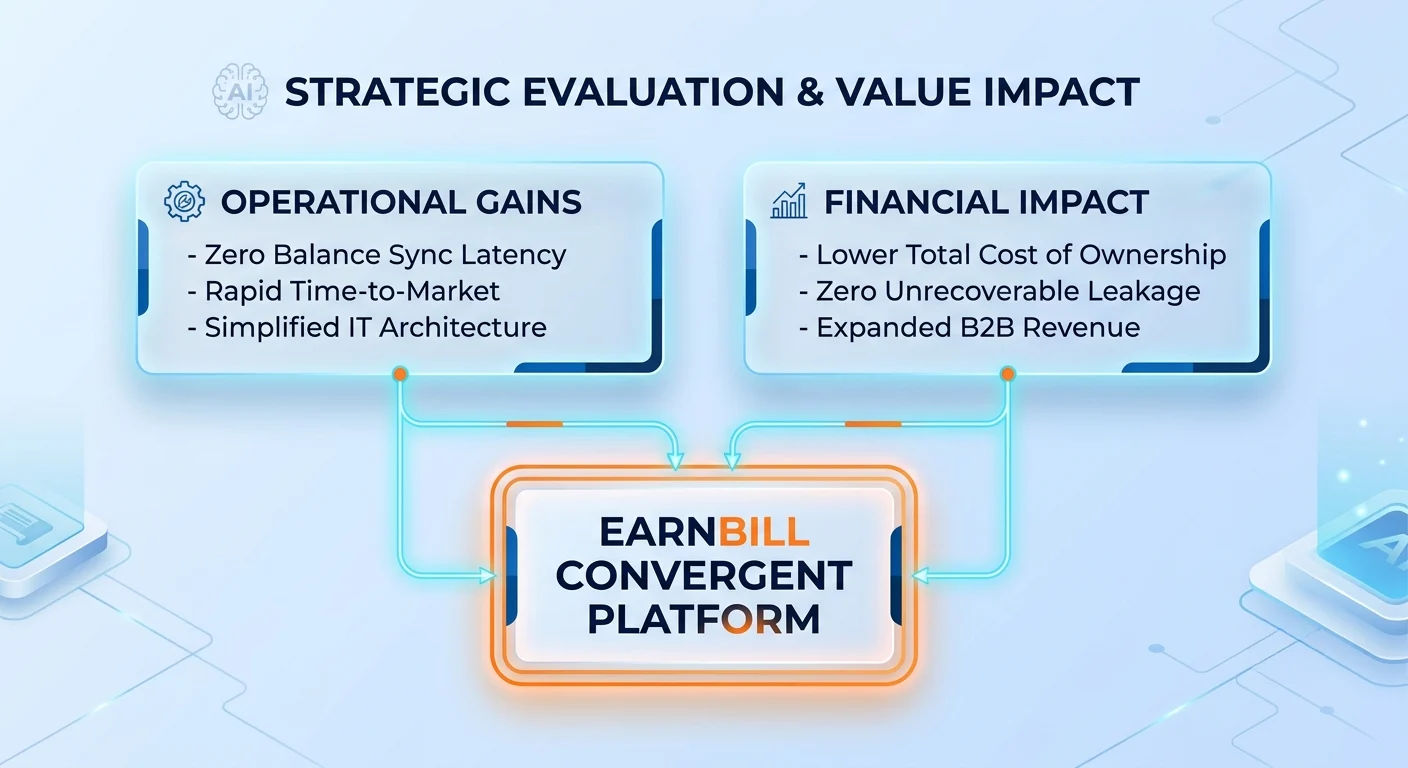
Here is why technical leaders choose EarnBill for their billing & revenue management operations:
1. Measurable TCO Reduction
Running separate prepaid OCS and postpaid mediation systems requires maintaining two database instances, server infrastructure, and vendor support contracts. EarnBill consolidates these tasks onto a single platform, lowering infrastructure costs, simplifying database administration, and reducing total IT expenditure.
2. Eliminating Cross-System Synchronization Delays and Reducing Revenue Leakage
Middleware pipelines connecting separate prepaid and postpaid databases introduce synchronization gaps that lead to unrecoverable usage debt. EarnBill operates on a single database instance, ensuring balance adjustments, quota deductions, and credit limit updates occur instantaneously across all services.
3. Accelerated Time-to-Market for Digital Products
Configuring innovative offers like prepaid travel eSIMs tied to postpaid accounts, shared family data pools, or enterprise fleet allowances, is streamlined within EarnBill's unified product catalog. Products can be launched in days rather than months, giving operators a competitive edge in rapid service rollout.
4. Scalable Architecture Built for Enterprise B2B Growth
EarnBill natively supports complex organizational hierarchies, allowing MVNOs to serve enterprise B2B accounts with customized billing structures, flexible department allocations, and consolidated invoicing. This enables MVNOs to capture high-margin corporate business with full confidence in their billing infrastructure.
5. Carrier Independence in Commercials and Rating with Operational Control
EarnBill allows MVNOs to retain greater control over retail pricing, product configuration and charging policies without requiring every commercial change to be implemented in the host MNO's billing environment.
Ready to Retire Your Siloed Billing Stack?
Eliminate revenue leakage, cut double licensing fees, and launch hybrid services effortlessly. See how sub-second Diameter/RADIUS OCS and real-time postpaid mediation on a single EarnBill engine can lower your TCO and accelerate growth.