
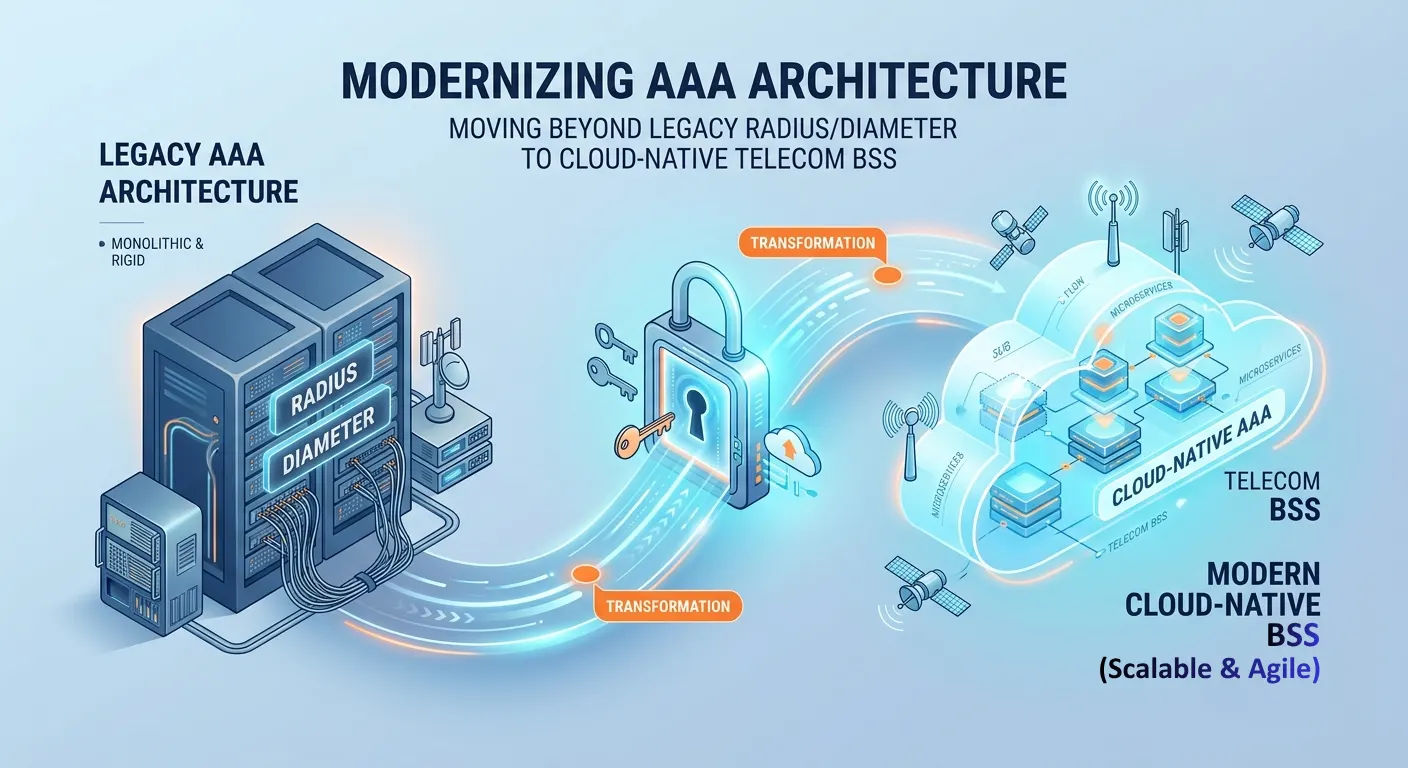
Telecommunications service providers, Mobile Virtual Network Operators (MVNOs), and Mobile Virtual Network Enablers (MVNEs) face a changing landscape. While 5G radios and core networks offer gigabit speeds and sub-millisecond latencies, many operators still rely on backend architectures built two decades ago.
At the center of this tension is AAA (Authentication, Authorization, and Accounting), a critical engine for digital BSS and telecom monetization.
According to industry analysts, telecom operators spend up to 60% of their BSS IT budgets merely maintaining legacy middleware and protocol bridges. Modernizing core authorization and charging can reduce backend platform TCO by up to 40% while stopping real-time revenue leakage.
There is a common misunderstanding in the industry that AAA is an outdated mechanism slated for removal. In reality, AAA as a functional business process will never disappear. Every network from 2G to 5G Standalone, Fixed Broadband, Fixed Wireless Access (FWA), and Private Enterprise LTE with multi-tenant network slicing must authenticate who a user is, authorize what services they are permitted to access, and track usage for real-time accounting and billing.
What is legacy is the physical and software architecture historically used to deliver AAA: monolithic, stateful servers processing RADIUS or Diameter packets through complex, multi-hop mediation chains.
This article breaks down how AAA architecture is evolving, why legacy implementations create financial and operational bottlenecks in 5G environments, how modern cloud-native AAA architecture in telecom resolves these issues, and how platforms like EarnBill help operators modernize cleanly without risking current service revenues.
Key Takeaways for Executive Leadership
- Financial Protection: Legacy 100ms+ AAA latencies in 1 Gbps+ 5G networks lead to unbillable data leakage; modern Converged Charging Systems (CCS) evaluate balances in under 10ms to protect margins.
- Zero Rip-and-Replace Migration Risk: A phased migration allows operators to modernize session authorization without disrupting ongoing legacy revenue streams.
Grounding the Concepts: Function vs. Architecture
To understand why AAA modernization is necessary, we must separate the business requirement from the underlying protocol.
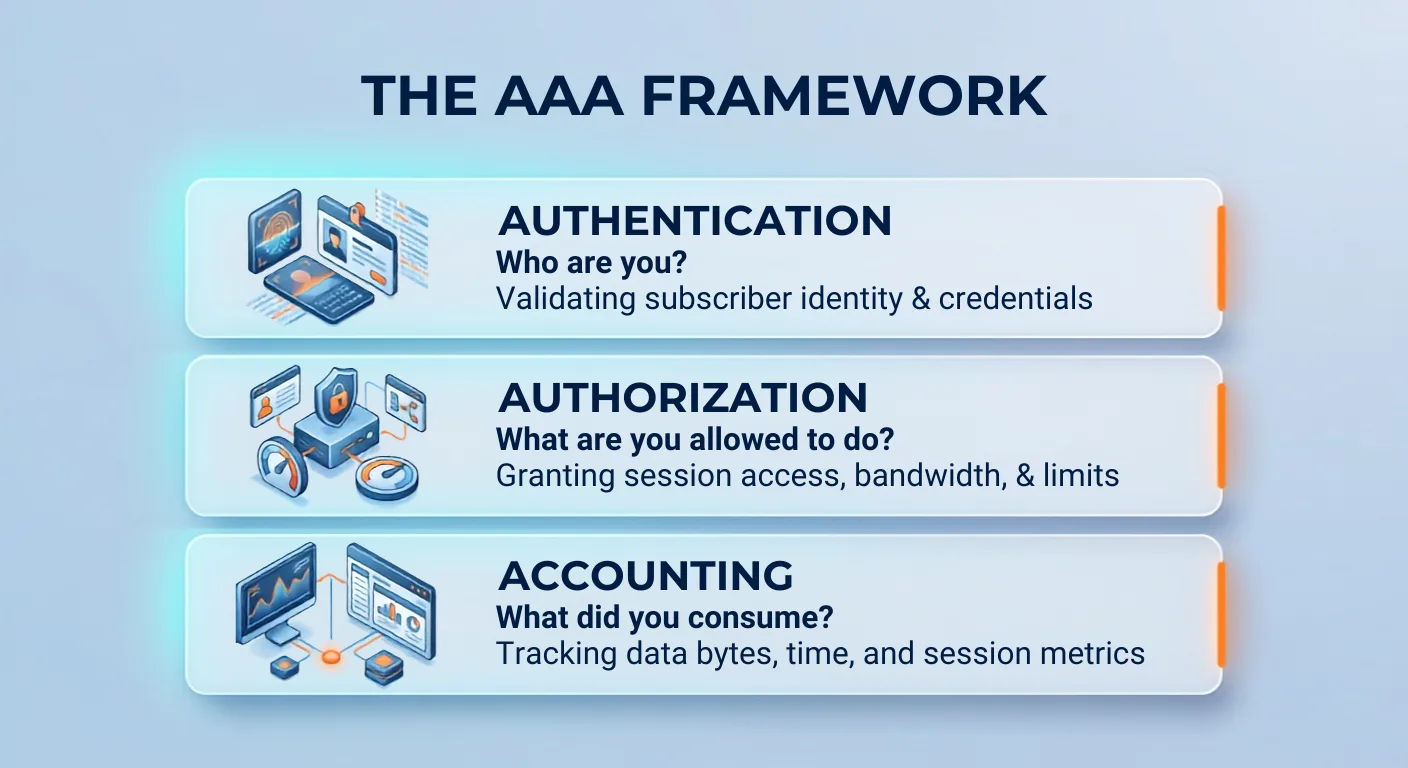
Where AAA Operates Across Network Eras
AAA logic runs beneath nearly every subscriber connection:
- Mobile Networks (2G / 3G / 4G LTE): Validates SIM credentials against home subscriber registries, authorizes dynamic Quality of Service (QoS) rules, and tracks pre-paid or post-paid data quotas.
- Carrier Wi-Fi & Wi-Fi Offload: Uses RADIUS-based protocols (like EAP-SIM) to move mobile devices onto Wi-Fi networks without manual login screens.
- Fixed Broadband & Fiber (FTTH): Authenticates residential routers (via PPPoE or DHCP) and enforces speed tiers (e.g., 200 Mbps vs. 1 Gbps).
- Enterprise Private LTE / 5G: Authorizes industrial IoT devices, enforces zero-trust perimeter access, and measures usage on private network slices.
The Evolution of AAA Protocols
As networks evolved, the protocols used to convey AAA messages adapted to meet higher performance demands:
- RADIUS (Remote Authentication Dial-In User Service): Developed in the 1990s over UDP. Reliable for basic dial-up and Wi-Fi, but lacks native support for complex peer-to-peer failover or rich real-time mobile credit control.
- Diameter: Introduced by the 3GPP for 3G and 4G networks over TCP/SCTP. It brought structured Attribute-Value Pairs (AVPs), built-in state management, and specialized interfaces (such as Gy/Ro) to connect packet gateways directly to Online Charging Systems (OCS).
- HTTP/2 RESTful APIs: The standard for 5G Standalone (SA) Service-Based Architecture (SBA). 5G removes legacy Diameter headers in favor of structured JSON payloads over HTTP/2 transport.
The function remains unchanged: verifying access and managing session state. The protocol, transport layer, and underlying software stack, however, must evolve.
Why Legacy AAA Implementations Stall 5G Growth
If the AAA concept remains vital, why are legacy RADIUS and Diameter servers becoming operational liabilities? The issue lies in structural bottlenecks that emerge when legacy software runs alongside 5G network speeds.
The 5G Data Leakage Problem
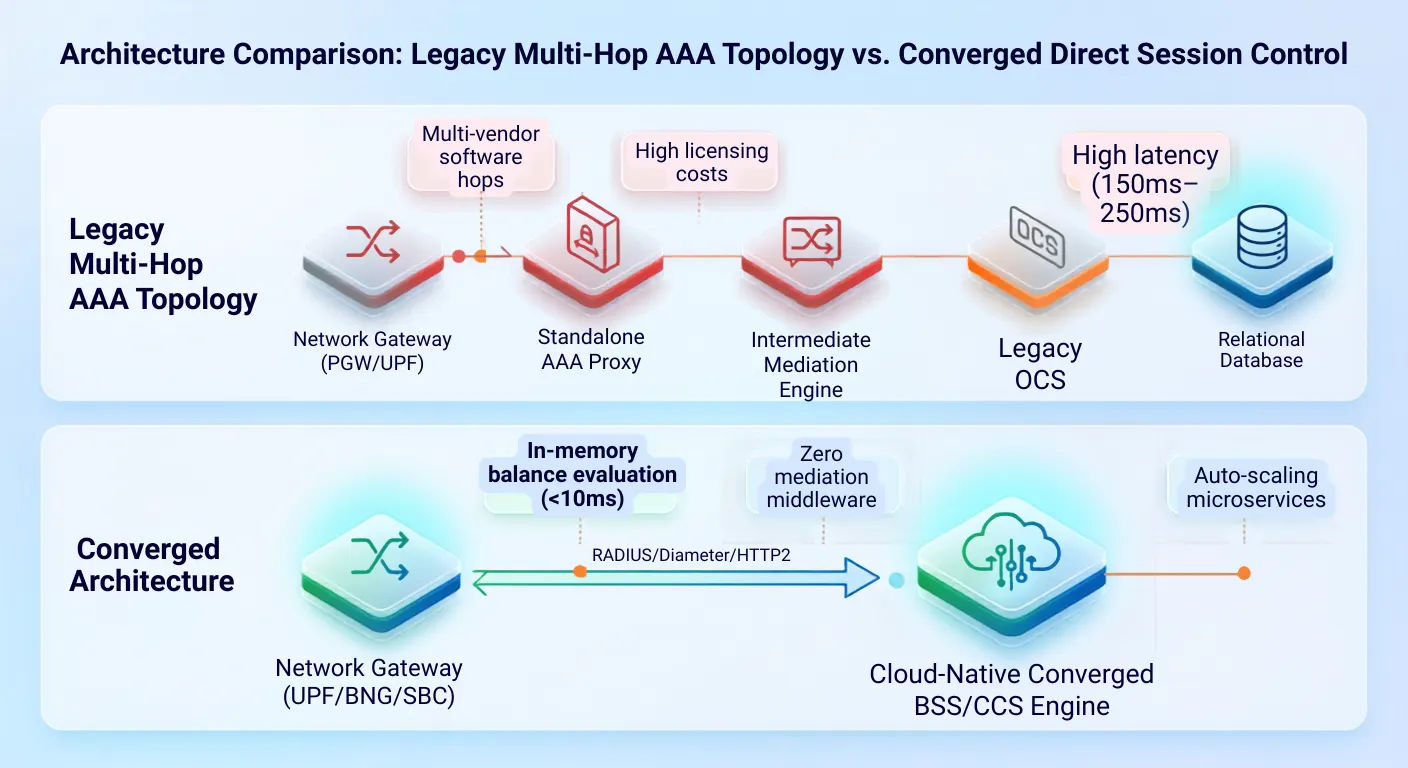
In a 4G environment, a credit control round-trip (requesting balance authorization, verifying account status, and granting a quota) taking 100 to 200 milliseconds was generally acceptable. Average throughput speeds of 20 Mbps meant minimal data flowed during that authorization window.
In a 5G network, speeds routinely reach 1 Gbps to 2 Gbps. At these throughputs, the math behind slow credit control exposes operators to financial loss:
Data Passed During Latency = 1 Gbps × 0.2 seconds = 200 Megabits (25 Megabytes)
If a pre-paid subscriber has run out of account credit, a 200-millisecond delay in receiving a teardown instruction allows the device to process 25 Megabytes of unbilled data.
When multiplied across 500,000 active prepaid sessions processing multiple authorization requests daily, a 25 MB leakage window per session can accumulate terabytes of unbilled data every month. In high-cost roaming scenarios or premium 5G data tiers, this latency gap directly erodes operating EBITDA.
The "Translation Tax"
5G core network functions communicate natively via HTTP/2 REST APIs. When an operator runs a legacy Diameter-based OCS, they must install intermediate protocol converter gateways to translate incoming HTTP/2 JSON calls into Diameter Credit-Control-Requests (CCRs) and back again.
Each conversion layer introduces system overhead:
- Adds 10 to 30 milliseconds of unnecessary network hop latency.
- Requires additional server compute resources.
- Introduces extra software maintenance and licensing costs.
The TPS Licensing Trap
Legacy AAA software pricing models were built around Transactions Per Second (TPS) capacity caps. In a traditional smartphone environment, TPS growth scaled predictably with subscriber count.
In the IoT and enterprise 5G era, millions of connected meters, telematics devices, and smart sensors produce frequent, low-payload authentication and heartbeat checks. If an operator's AAA software license charges high per-TPS tiers, managing IoT endpoints can cause backend software costs to exceed the revenue those endpoints generate.
Stateful Virtual Machines vs. Stateless Containers
Legacy AAA platforms were engineered as monolithic, stateful software packages. Scaling a stateful system during traffic spikes requires deploying large Virtual Machines (VMs), a process that can take several minutes to complete.
In contrast, modern networks require stateless AAA microservices that run in lightweight container orchestrators (such as Kubernetes), auto-scaling worker nodes up or down within seconds to match live traffic demands.
How AAA Operates in 5G Service-Based Architecture
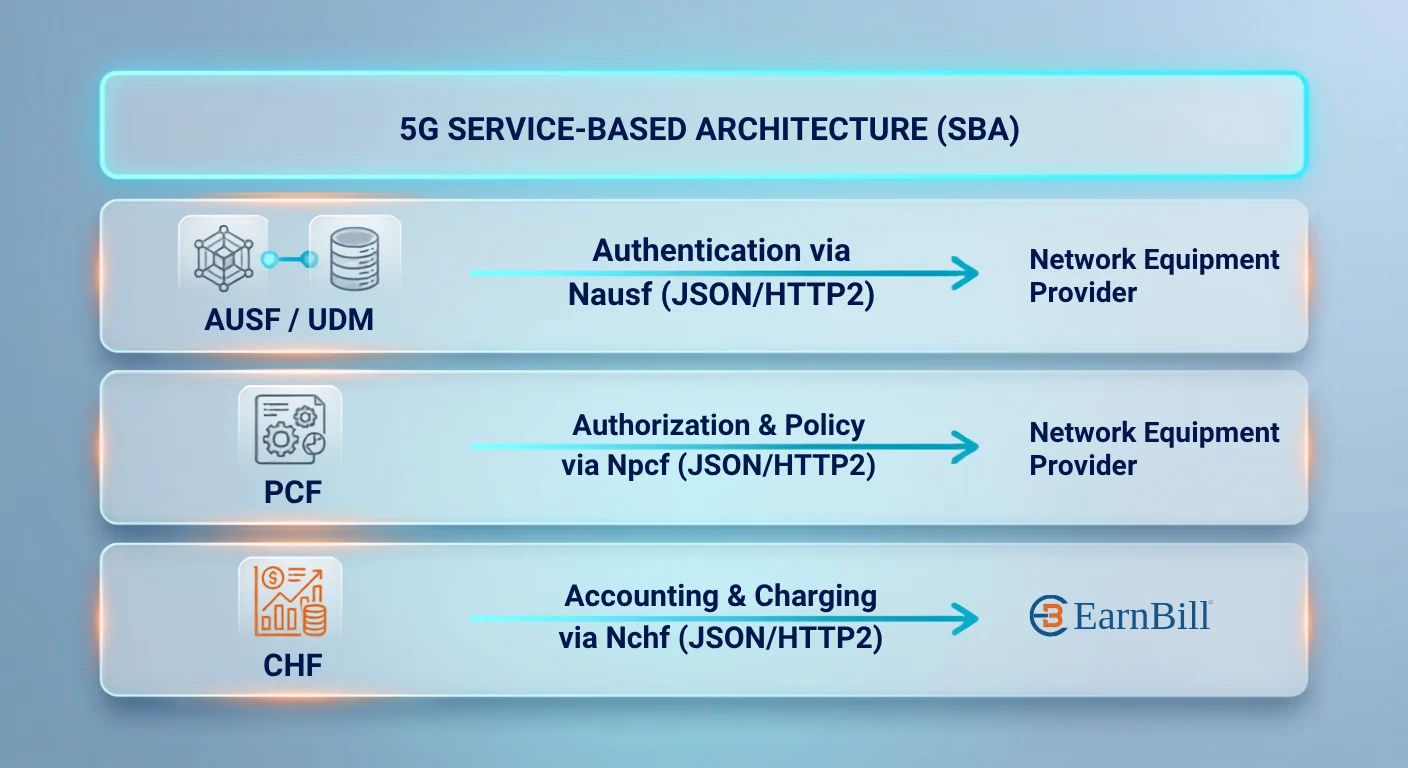
In 5G Standalone (SA) networks, the monolithic AAA server is replaced by modular, cloud-native Network Functions (NFs). Instead of a single box handling every step, AAA responsibilities are divided among distinct microservices within the Service-Based Architecture (SBA):
- Authentication: Handled by the AUSF (Authentication Server Function) and UDM (Unified Data Management), which verify subscriber identity over HTTP/2 interfaces (Nausf).
- Authorization & Policy: Managed by the PCF (Policy Control Function), which evaluates session parameters, QoS profiles, and network slicing permissions (Npcf).
- Accounting & Charging: Handled by the CHF (Charging Function) via the converged charging interface (Nchf), providing real-time session authorization billing and session tracking within a modern Converged Charging System (CCS).
EarnBill is a modern Converged Charging System (CCS) and performs the CHF (Charging Function), whereas the AUSF/UDM and PCF are performed by the network/equipment provider.
The Transition Challenge: Managing Mixed Network Generations
While 5G architecture is straightforward on paper, real-world network operations are more complex. Very few service providers operate a purely 5G network. Most operators must support a hybrid infrastructure that includes 4G LTE Diameter sessions, legacy 2G/3G or fixed-line RADIUS traffic, and incoming 5G HTTP/2 requests simultaneously.
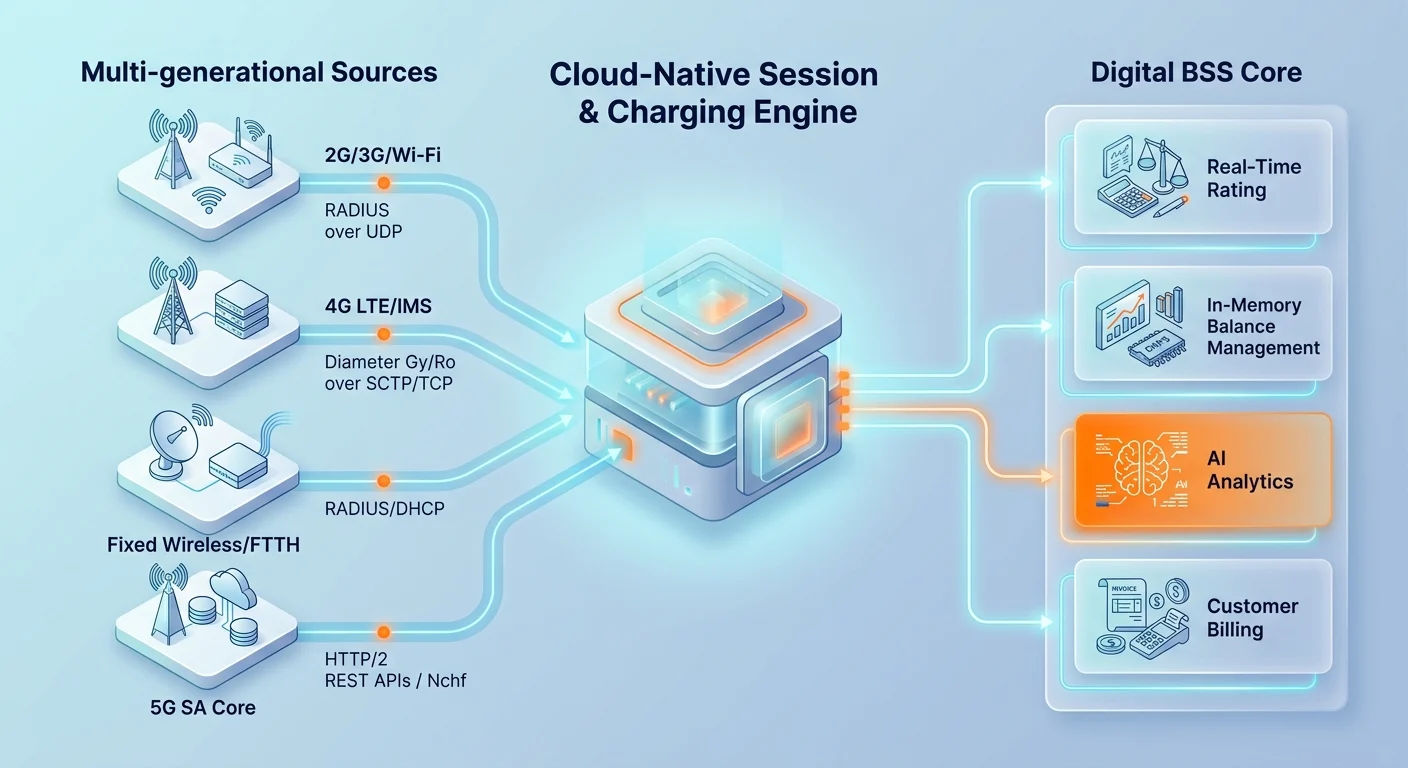
Operators do not need separate, siloed proxy environments for each network generation. A modern converged AAA and charging system ingests raw RADIUS sockets, 3GPP Diameter requests, and 5G HTTP/2 REST calls within a single processing layer, applying consistent business rules across all access networks.
Why Upgrading to Modern BSS/OCS/CCS Systems Is Urgent
Postponing backend modernization creates growing operational expenses. Operating legacy BSS/OCS environments alongside newer network functions forces operators to maintain redundant software layers.
Eliminating the "Mediation Tax"
A common historical inefficiency in telecom billing stack architecture is the reliance on standalone intermediate mediation software. In traditional configurations, network equipment could not communicate directly with the billing system. Operators were forced to deploy third-party mediation engines simply to ingest binary network usage records (CDRs, RADIUS packets, Diameter logs), reformat them, and batch-file feed them into the rating software.
Modern Converged Charging Systems (CCS) eliminate the need for standalone mediation middleware for real-time usage. By terminating raw network protocols directly at the BSS ingestion layer, modern platforms handle parsing, balance checking, and rating within a single memory space.
Strategic Financial & Operational Impact
Upgrading to a unified, modern BSS/OCS/CCS platform provides measurable cost advantages and strategic market positioning:
- Lower Software Capex: Eliminates capital expenses spent on dedicated mediation software, protocol conversion boxes, and specialized proxy licenses.
- Reduced Infrastructure Opex: Containerized microservices require fewer compute resources than heavy, stateful VMs, lowering cloud or data center hosting bills.
- Faster Time-to-Market: Product managers can create and adjust rating models, tiered speed caps, and promotional passes through graphic administrative portals, avoiding month-long vendor customization cycles.
Low-Risk Phased Migration: Modernizing Without "Rip-and-Replace"
Executives often delay BSS modernization due to the fear of operational disruption and revenue risk. A proven, low-risk approach uses the "Strangler Pattern" to migrate traffic incrementally without breaking existing operations:
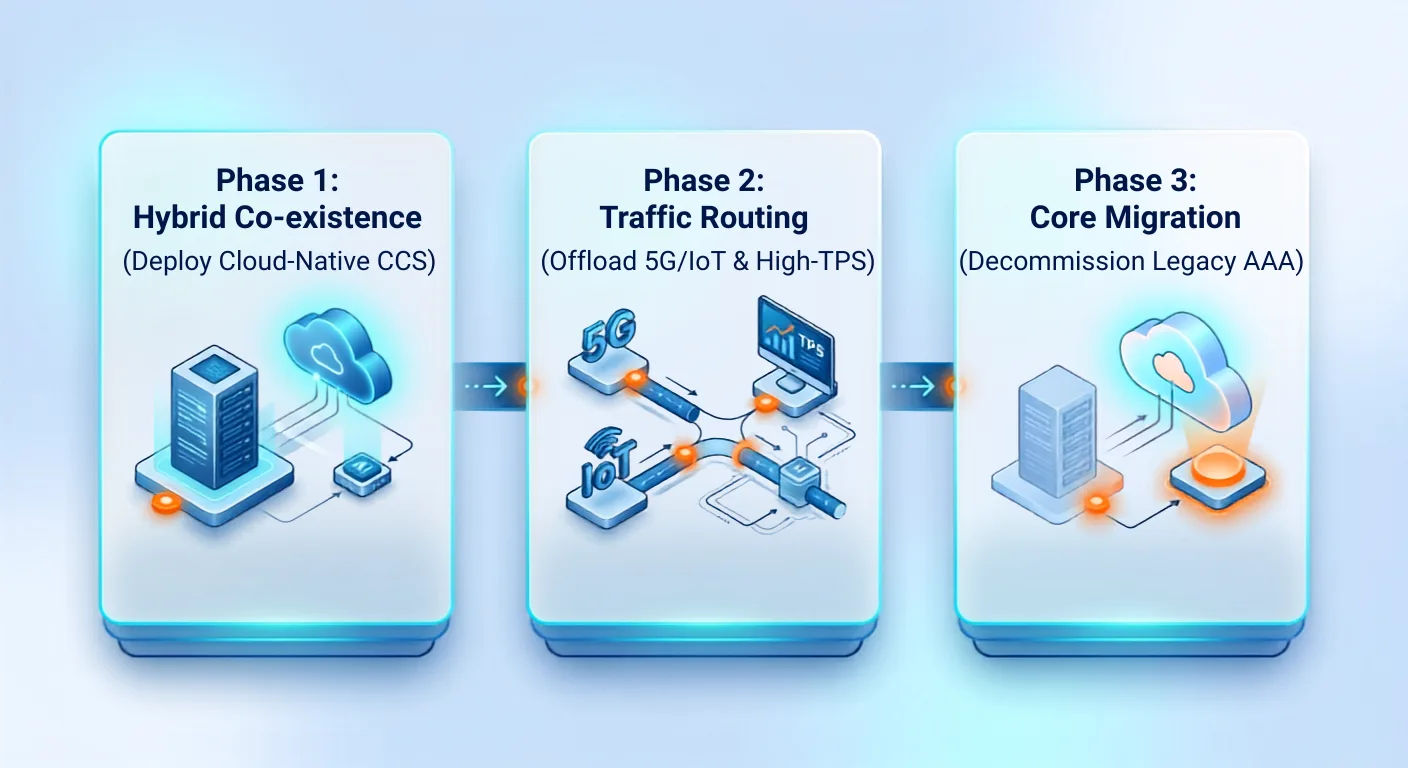
- Phase 1 — Co-existence & Ingestion (Weeks 1–4): Deploy the cloud-native BSS/CCS alongside legacy infrastructure. Connect 5G HTTP/2 (Nchf) and high-growth IoT streams directly to the new engine while legacy systems run uninterrupted.
- Phase 2 — Targeted Protocol Routing (Weeks 5–8): Route select high-cost 4G Diameter or RADIUS traffic (e.g., MVNO brands, Fixed Wireless Access) to the converged engine, validating sub-millisecond balance checks and rating accuracy.
- Phase 3 — Full Migration & Decommissioning (Weeks 9–12): Migrate remaining subscriber databases via automated AI mapping and decommission costly legacy AAA proxies, mediation servers, and OCS software licenses.
EarnBill's Cloud-Native BSS/OCS/CCS Capabilities
As market requirements shift toward converged, low-latency architectures, EarnBill provides a modern BSS/OCS/CCS platform engineered to simplify telecom operations and maximize operating margins. EarnBill combines legacy protocol support with modern, cloud-native performance, helping operators transition smoothly from older architectures without requiring complex system overhauls.
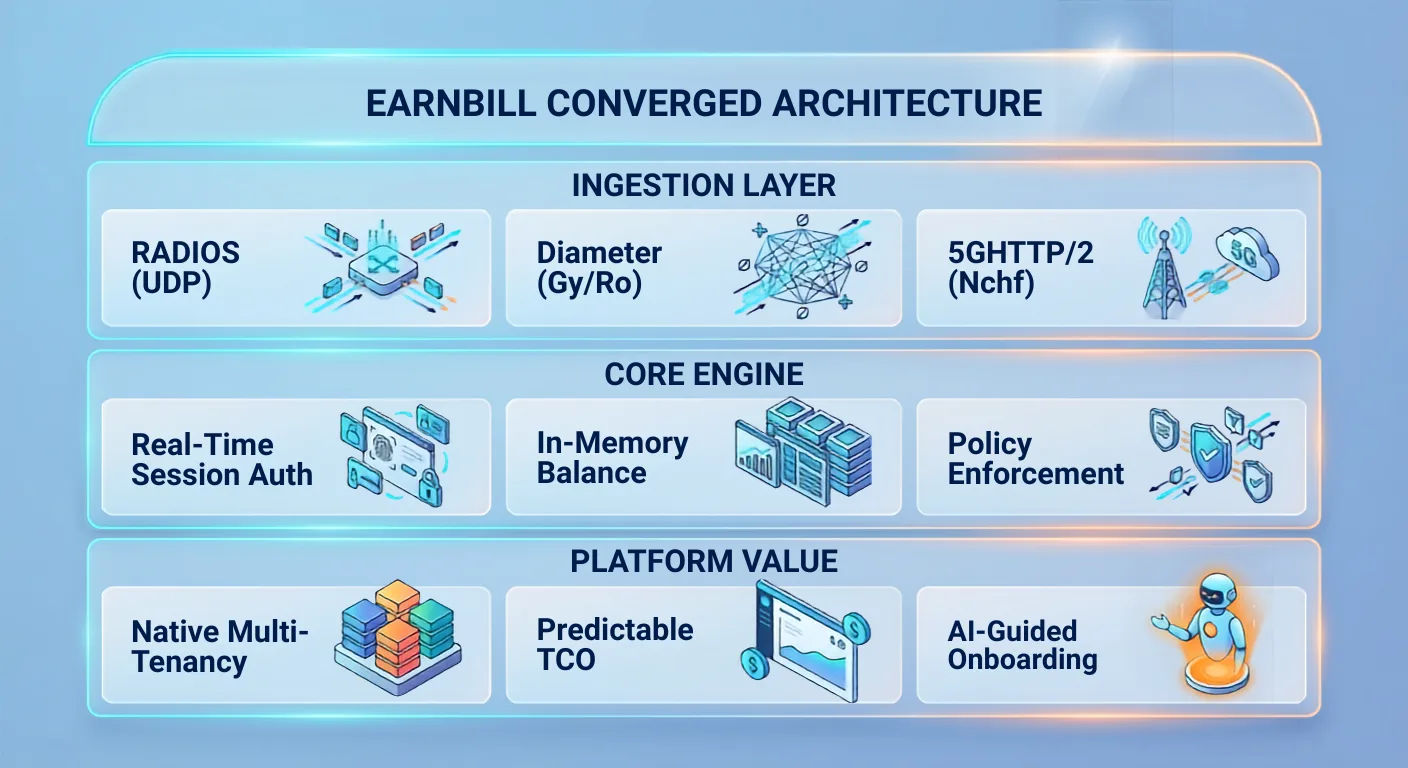
1. Multi-Protocol Engine (2G through 5G)
EarnBill supports RADIUS Diameter 5G HTTP2 transition strategies natively. The system communicates directly with core network elements—such as Packet Gateways (PGW), User Plane Functions (UPF), Broadband Network Gateways (BNG), and Session Border Controllers (SBC)—handling raw protocol interactions without requiring third-party mediation layers. This unified ingestion engine allows operators to manage 4G Diameter credit control alongside 5G HTTP/2 session authorization within one platform.
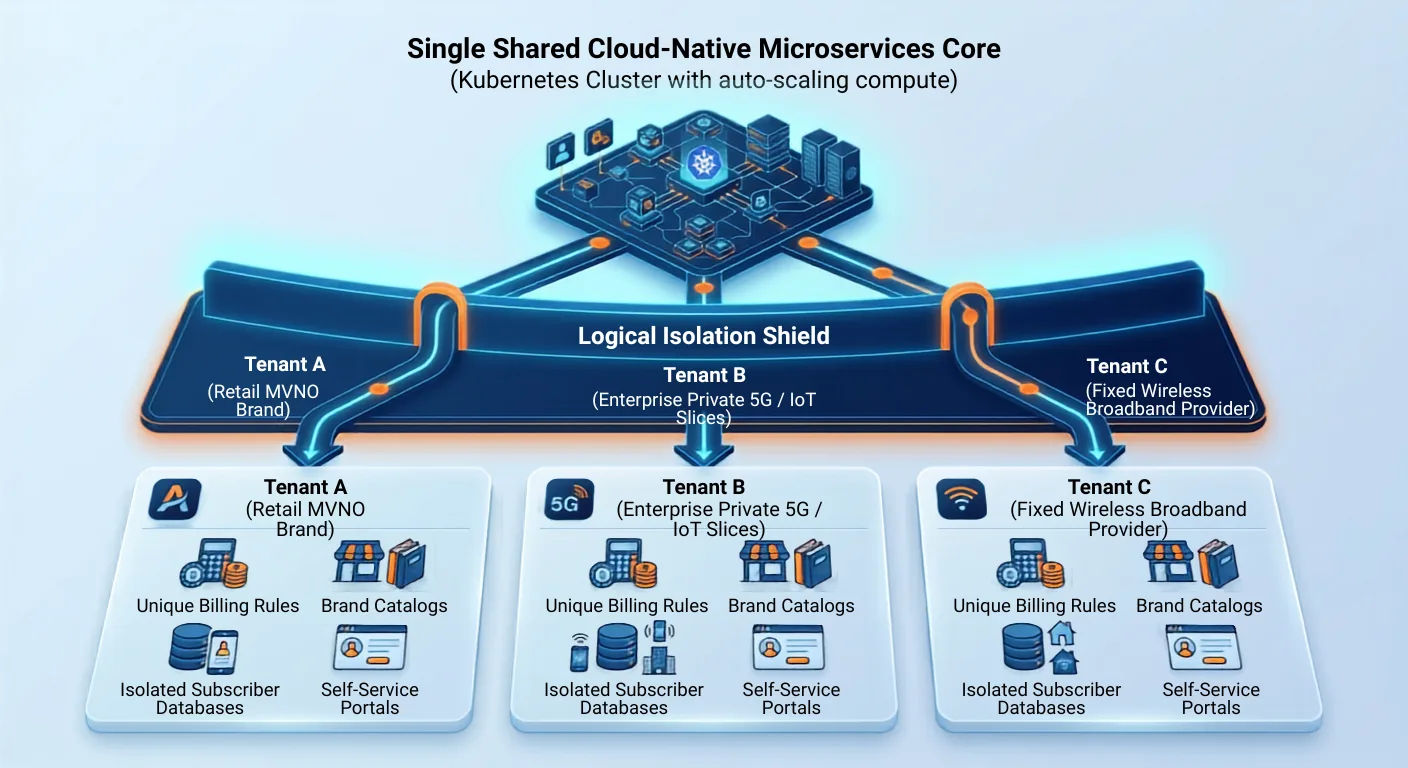
2. Native Multi-Tenancy for MVNEs and Group Operators
For Mobile Virtual Network Enablers (MVNEs) and operator groups managing multiple sub-brands, infrastructure duplication can quickly drive up operational overhead. EarnBill is architected with true native multi-tenancy. A single platform instance can host hundreds of independent MVNO sub-brands or enterprise clients. Each tenant operates within an isolated environment featuring its own subscriber database, rating rules, currency configurations, and brand designs—all running on a shared, cost-efficient cloud compute footprint.
3. Predictable Total Cost of Ownership (TCO)
Many BSS vendors rely on complex pricing structures tied to rigid TPS tiers or hidden module additions. EarnBill uses a transparent, cloud-aligned consumption model that keeps operational costs predictable as subscriber bases grow. By deploying as lightweight containerized microservices, EarnBill scales compute resources directly in response to active subscriber traffic. This approach minimizes upfront Capex while keeping ongoing cloud Opex aligned with actual usage.
4. AI-Assisted Configuration and Implementation
Traditional BSS migrations often run into delays during system setup, catalog configuration, and data mapping. EarnBill uses AI-assisted implementation tools to streamline onboardings. By automating subscriber data transformations, legacy schema mappings, and initial product catalog creation, EarnBill shortens migration schedules from traditional 9-to-12-month roadmaps down to weeks.
5. Proactive Operational Support
Rather than waiting for service tickets to highlight system anomalies, EarnBill incorporates proactive platform monitoring. Continuous automated tracking identifies protocol timeout trends, database latency spikes, or rating errors early, allowing operational teams to resolve potential bottlenecks before they affect subscriber services.
Comparison Matrix: Architectural Frameworks
To help executive teams evaluate their options, the following table compares legacy AAA environments, standard modern BSS platforms, and EarnBill:
| Feature / Capability | Legacy AAA + BSS Stack | Standard Modern BSS/OCS | EarnBill Converged BSS Platform |
|---|---|---|---|
| Protocol Ingestion | Siloed servers per protocol (RADIUS or Diameter) | Supports 4G/5G; often requires proxies for legacy RADIUS | Native converged ingestion (RADIUS, Diameter & HTTP/2) |
| Mediation Requirements | Mandatory standalone mediation middleware | Optional or partially integrated | Direct protocol ingestion (no standalone mediation tax) |
| Session Control Latency | High (100ms–250ms due to multi-hop calls) | Low to medium (30ms–80ms) | Sub-millisecond (in-memory balance evaluation) |
| Multi-Tenancy | Multi-instance duplication (high cost) | Virtualized / siloed environments | Native multi-tenancy (single engine, logical isolation) |
| Implementation Timeline | 9 to 18 months | 6 to 9 months | Rapid onboarding (AI-assisted mapping) |
| Deployment Footprint | Heavy, stateful Virtual Machines | Containerized microservices | Stateless microservices (cloud-agnostic auto-scaling) |
| Vendor Lock-In Risk | High (proprietary stacks & high TPS fees) | Medium (module-based licensing) | Low (open APIs, cloud-aligned consumption) |
| Operational Complexity | High (multiple silos & proxies) | Moderate | Low (unified single-pane management) |
Executive Summary: Preparing Your Architecture for What's Next
Modernizing your AAA architecture is not about replacing an established functional process; it is about updating the underlying software design to match the demands of modern networks. Continuing to run legacy RADIUS and Diameter servers alongside 5G infrastructure leads to higher operational costs, unbilled usage risks, and slower product rollout cycles.
By adopting a cloud-native, converged AAA and charging architecture, telecom operators, MVNOs, and MVNEs can:
- Protect Operating Margins: Eliminate unnecessary mediation software, lower proxy licensing fees, and reduce server compute footprints.
- Prevent Revenue Leakage: Process real-time balance authorizations at sub-millisecond speeds to stop unbilled data usage during high-speed 5G sessions.
- Accelerate Product Launches: Empower commercial and marketing teams to roll out new pricing models and dynamic service tiers through flexible administrative controls.
- Scale Operations Efficiently: Leverage native multi-tenancy to host multiple brands or enterprise clients on a lean infrastructure stack.
Modernization does not have to mean a risky rip-and-replace project. Platforms like EarnBill provide a practical path forward, allowing you to unify legacy 2G/3G/4G session controls with native 5G capabilities on a single cloud-native architecture.
Frequently Asked Questions
Why can't legacy Diameter OCS platforms effectively handle 5G Standalone (SA) charging?
Legacy Diameter OCS systems rely on SCTP/TCP transport and binary AVPs, whereas 5G Core functions communicate via HTTP/2 REST APIs and JSON payloads. Connecting 5G to Diameter requires protocol conversion gateways that introduce network latency (10–30ms), elevate server costs, and cause severe revenue leakage during high-speed 5G sessions.
What is the difference between CHF (Charging Function) and a Converged Charging System (CCS)?
The CHF is a specific 3GPP 5G Network Function responsible for processing Nchf REST requests. A Converged Charging System (CCS) is a broader, cloud-native monetization platform that combines CHF capabilities with real-time rating, in-memory account balance management, and multi-protocol ingestion (RADIUS, Diameter, HTTP/2) across 2G, 3G, 4G, 5G, and fixed networks.
How does cloud-native AAA microservices architecture prevent data leakage?
Cloud-native AAA microservices utilize stateless containerized logic paired with in-memory balance evaluation. By responding to network credit control requests in under 10 milliseconds (compared to 100ms–200ms in legacy stacks), the platform halts unbilled sessions instantaneously when a subscriber's balance reaches zero, completely eliminating data leakage.
How does modernizing AAA impact network slicing monetization?
Network slicing requires dynamic session authorization, real-time quota management, and targeted Quality of Service (QoS) enforcement per slice. A modern converged AAA and charging system dynamically tracks usage across enterprise private slices, allowing operators to charge based on bandwidth, latency guarantees, and active device density.
Partner with EarnBill as Your Strategic Transformation Ally
Is legacy system latency affecting your 5G unit economics? Discover how EarnBill streamlines session authorization, eliminates mediation costs, and lowers your total cost of ownership.