

Streaming Services
Internet Radio: Usage-Based Billing
Consumption billing for 400+ radio stations with UDR mediation
Read Case Study →How a US-based Infrastructure as a Service provider with global presence across 12 countries achieved revenue assurance, multi-level reconciliation, operating margin tracking, and complete billing automation on a single customised platform.
 US, Europe, Asia, Middle East, Australia

A US Based Infrastructure As A Service provider company with global presence and clients across countries. The client provided a host of cloud computing services such as the VMs, the VPCs, storage devices, memory, different computing processors (CPUs), different operating systems with licenses, different databases, their cluster services, load balancing services and different high availability options etc.
The company operates in the B2B segment, mainly focused on B2B services, serving enterprise clients across 12 different countries across the globe, with the same products offered in different currencies worldwide.
Complex IaaS Billing
A Flexible Cloud Billing Software
jBilling (On Premise) was deployed as a Customised Cloud Billing Solution. The implementation included:
The diagram below pictorially shows the end-to-end workflow of how the IAAS Billing system was implemented.
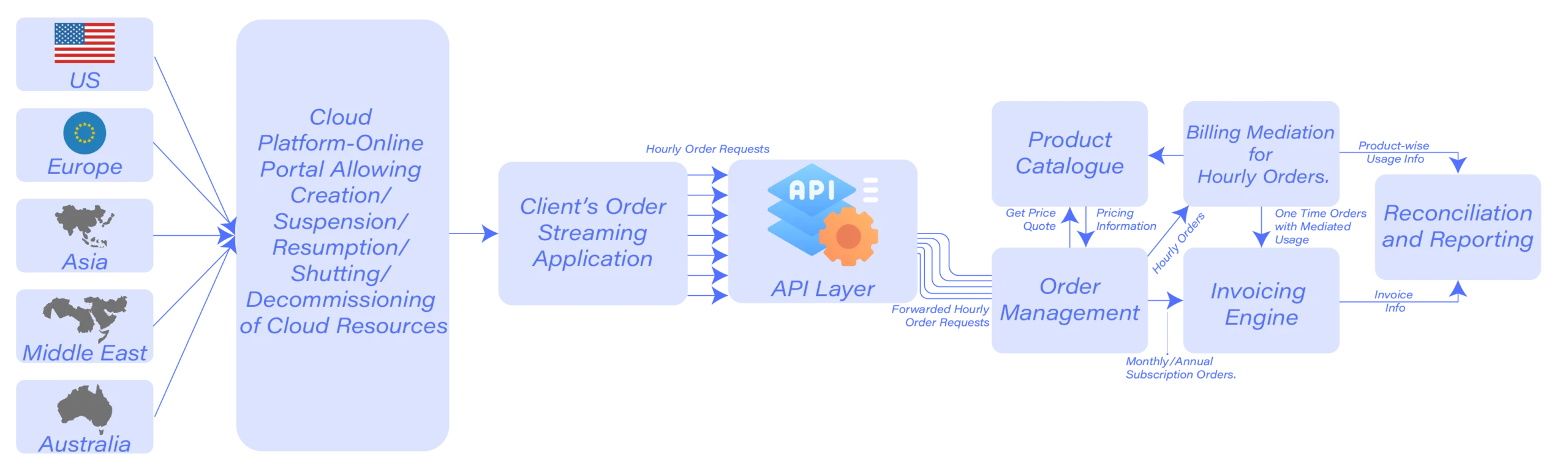
End-to-end workflow of the IaaS Billing system implementation
The client's cloud platform consists of an online web portal through which their customers could access the account and manage their own cloud resources. For example, the customers could add or commission new VMs, new VPCs, new storage devices and so on. They could take several actions through this portal such as adding new resources, suspending existing resources, resuming the suspended services, shutting down a certain resources, decommission existing resources and modify existing resources by re-configuring their attributes, such as upgrading a VM instance with more memory, or downgrading a database instance by using a lower grade CPU, and so on.
The client's cloud platform consists of an online web portal through which their customers could access the account and manage their own cloud resources. The customers could add or commission new VMs, new VPCs, new storage devices and so on. They could take several actions through this portal such as adding new resources, suspending existing resources, resuming the suspended services, shutting down a certain resources, decommission existing resources and modify existing resources by re-configuring their attributes, such as upgrading a VM instance with more memory, or downgrading a database instance by using a lower grade CPU, and so on.
The invoicing module usages the charges applied by the billing mediation module and generates the monthly invoices for customer accounts. There are two tenants (or companies) created in the system. The parent company represent the HO (or the Head Office) which defines the product pricing such that it represents the operational costs for all the cloud resources. The second tenant or company is the reseller company (or Sales Office) where the Product Pricing is defined as per the Selling Price of the cloud resource.
The invoice generated in the Head Office company represents the operational cost of the cloud, whereas the invoices generated in the Sales office company represent the client's revenue.
This way both the operational cost and revenue are clearly available for each month from the system. The difference between the two values provides the operating margin. This provide the client a very tight control on their financials and product margins.
The data generated from the invoices is used to reconcile with other systems, mainly the totals drawn from the primary billing system and from the Order Streaming application. This allows reconciliation amongst systems and early capture of any discrepancies in a critical business system.
The financial reports are fetched based on the revenue data generated, mainly the invoice lines carrying the information from the Product Catalogue. There is an easy to use Product Upload option that allows to update the various product parameters. Each product is created and maintained in 12 different currencies, owing to business being run in 12 countries. A csv based product upload option makes it easy to manage pricing changes on the products.
A customised cloud billing software that met the following 4 KRAs:
Implemented quite easily. The revenue totals can be checked each day between two systems and differences investigated and fixed easily. Revenue leakage is caught before it affects the business.
One reconciliation report provides the differences amongst systems easily and avoids end client impact in billing and charging. Discrepancies are caught and resolved before reaching customers.
Validated on a monthly basis, validating the pricing mechanism. Giving business inputs so that decisions regarding price revisions can be made and communicated to customers proactively.
Encompassing the billing mediation job and a bill run job that does the bulk of work and provides a complete system automation. Reliable, scalable and requires minimal manual intervention.
Additionally, a Reduced Capex and Opex for the cloud billing software; the benefits increasing with the growth of business over a period of time.
See how EarnBill handles multi-currency cloud billing, revenue assurance, reconciliation, and operating margin tracking on a single platform.