

Business Communications
Managing 20+ Brands on One Platform
US communications company unifies billing across multiple brands
Read Case Study →How a US-based MultiLine mobile app provider automated complex B2B billing. Handling multi-level org hierarchies, CDR-based mediation, prorated subscription charges, and multi-country operations across the US, UK, and Singapore on a single platform.
 US, UK & Singapore

This is a case study of a US Based MultiLine mobile app service which provides a second, secure business number for voice, text, and WhatsApp conversations. The service is targeted for B2B use , offering additional mobile numbers to employees of an organisation without having to add new SIMs, thus avoiding personal number use for official business.
The service also avoids costs associated with purchasing of new mobile devices for the client companies. The additional number provided by this multi-line service can be used on the existing SIM card of the user. Which may be from a different mobile service provider. All that the user has to do is install the client's mobile app on their device and configure it. The user can then share the additional number for business purposes and make and receive calls using this additional number via the mobile app.
The client has agreements with telecom service providers in different geographies to provide this "over-the-top" service (or OTT). The mobile app depends on the underlying SIM card provided by one of the mobile service providers with whom the client has the tie-up. The client would block the SIMs and the associated numbers with the mobile service providers. The service would not require the actual SIM to be provided to the subscriber or user. Only the additional number would be provided as part of the service.
"We evaluated several billing and mediation platforms. None would provide the flexibility and extensibility we were looking for in our business. Those that seemed like meeting everything, were completely out of our budget."
Various companies (basically the clients) bulk-buy such additional numbers as part of contracts with our client. They would share these numbers with their employees for official use. Each employee using such an additional number configures the mobile app on his or her device and starts using the new number for the company's official work.
"We clearly needed a system which can support on-boarding new carriers with ease. We were in discussion with so many mobile companies all across the world. We needed a system that can easily accommodate termination charges from our new tie-ups."
The business model involved 3 types of charges: subscription, origination and termination charges. Out of these the origination charges and termination charges were applied from the telecom service providers for the actual service (such as calls, data usage, international calls etc), whereas the subscription charges are from the client side and this provides the source of revenue for this client.
To apply the termination charges from the telecom network provider where the calls or usage is terminated for the usage of various mobile services, the CDR files received from the mobile companies need to be processed. The client needed the flexibility to apply the origination and termination charges as-is without any additional margin. As well as introduce margin in future if required. The rate changes needed to be handled separately by the system when triggered.
The client chose the Enterprise jBilling platform as their billing system because of the flexibility the platform offers with billing and mediation and also prorating of subscription and origination charges.
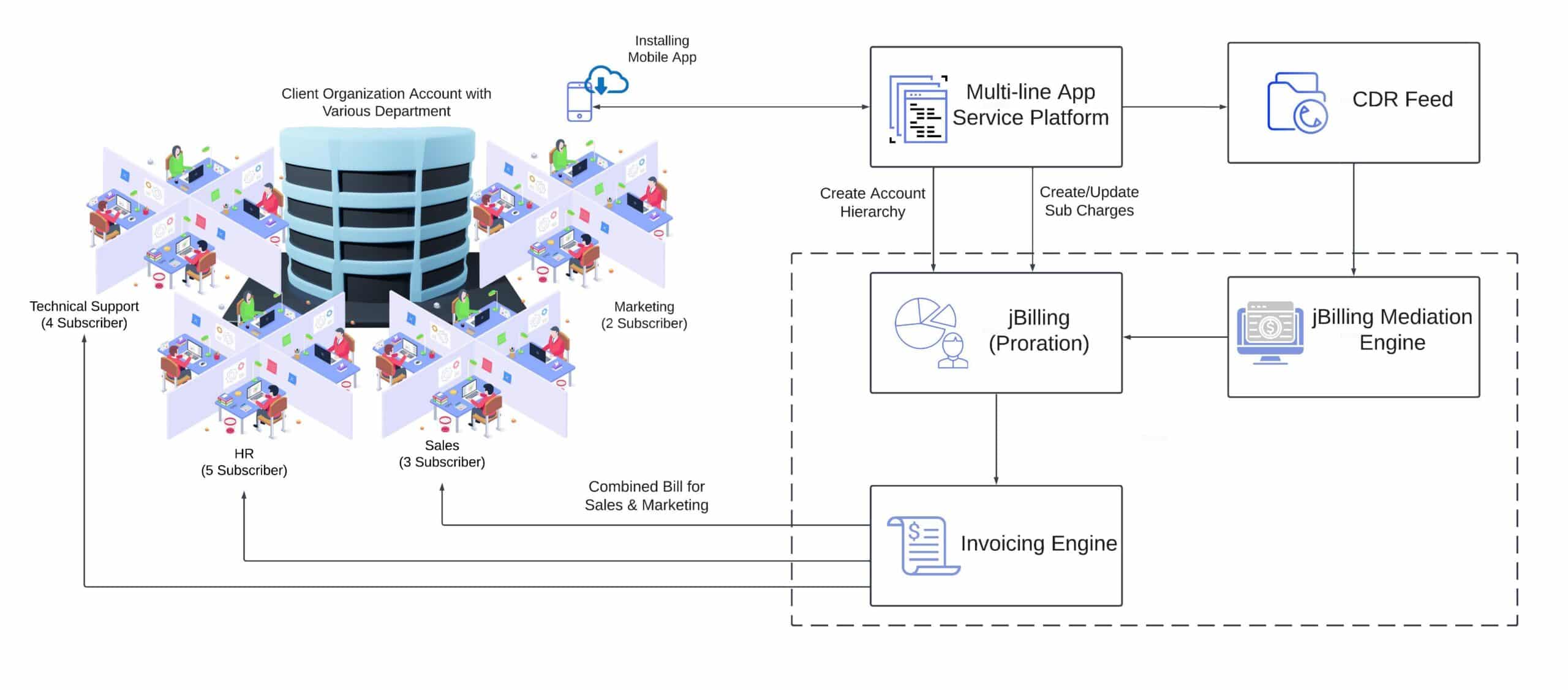
Full System Architecture, Multi-line App Platform, jBilling Mediation Engine & Invoicing
As it can be seen in the solution diagram above, when a client organisation signs a contract, the organisation is on-boarded to the client platform. The client platform comprises the mobile app (client) connected to the Multi-Line App Service hosted by the client on the Cloud. The client company users subscribe to the mobile app by downloading and installing it on their device. This app allows them to configure their second-line number with the existing SIM card.
The Multi-line App Service platform is integrated to the jBilling system and it sends the account hierarchy of the client organisation to jBilling. The client company is created in jBilling, along with the subscription and origination charges. This includes the list of mobile numbers subscribed to.
The system processes various feeds through automated scheduled jobs. These jobs handle processing of subscription, origination and termination charges for the client companies. Tracking changes to subscriptions and mobile numbers inventory ensures that all additions and removals are recorded. The jobs also handle charging the increase or decrease in number of additional mobile numbers per company on a pro-rata basis, depending on the period those numbers were active in the month.
The company hierarchy feature is also used to create multiple sub-entities to talk with customer system instances in various countries.
Applying recurring charges such as subscription charges and origination charges involved creating these charges through the integration channel. The client's systems send these charges as the users subscribed to their various plans. The jBilling system received API calls for creating recurring subscription and origination charges. The client system also sent any updates to the number of subscriptions bought by a company in separate API calls.
The jBilling system tracks the changes in number of subscriptions bought by a client company. For example, if an Organisation ABC has 50 subscriptions on Jan 1 for a particular year, and they decide to buy 10 more numbers on Jan 16, the system applies the charges for 50 numbers from Jan 1 to Jan 31 and then applies the prorated subscription charges for 10 additional numbers from Jan 16 to Jan 31.
Suppose their plan charges $5 subscription charges for each number:
| Subscription Charges Jan 1–Jan 31 | Qty=50 | Price=$5/number/month | Amount=$250.0000 |
| Subscription Charges Jan 16–Jan 31 | Qty=10 | Price=$5/number/month | Amount=$23.8064 |
| Total Amount Charged | $273.8064 | ||
The prorated billing calculation from Jan 16 to Jan 31 is: Prorated Amount for 16 days, Qty 10 and Price=$5/number/month = 16/31 × $5 × 10 = $25.8064.
Continuing the above example, if the Company ABC reduced 5 numbers on Feb 25, the following lines would be charged in the bill for the month of Feb (considering 28 days):
| Subscription Charges Feb 1–Feb 24 | Qty=60 | Price=$5/number/month | Amount=$257.1429 |
| Subscription Charges Feb 25–Feb 28 | Qty=55 | Price=$5/number/month | Amount=$39.2857 |
| Total Amount Charged | $296.4285 | ||
It can be seen from the prorated calculations above the flexibility the platform provides in applying various charges with configurable rules and applying an easy extension to the functionality.
The diagram below shows the Organisation Hierarchy Chart. Where a client company has departments like Technical Support, HR, Sales and Marketing.
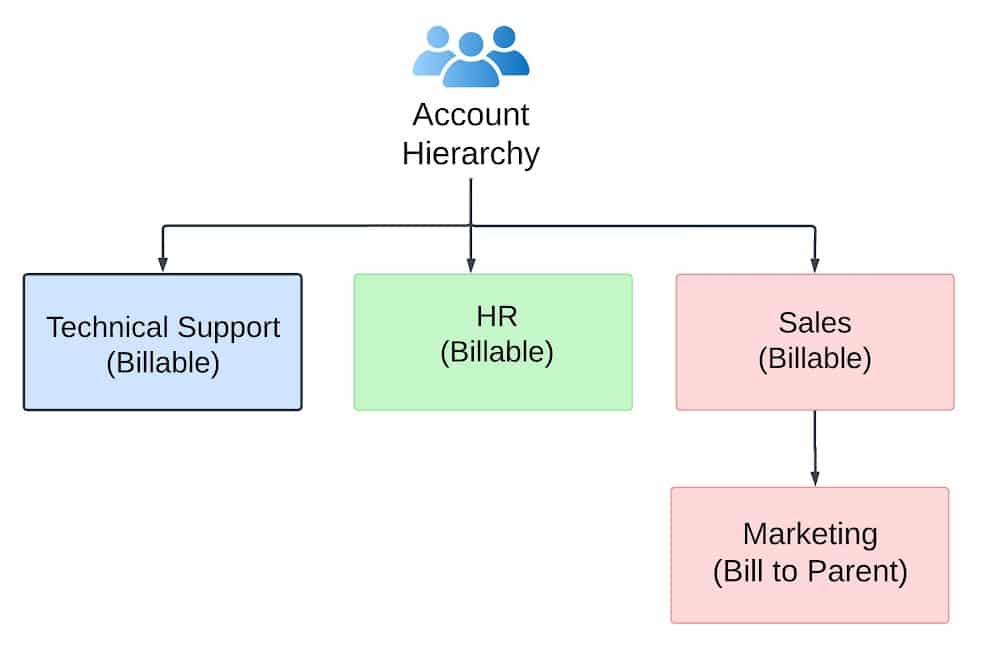
Organisation Hierarchy, Department-Level Billing Configuration
The jBilling system provides the customer account hierarchy with an account–sub-account feature that allows our client to create an organisation structure under each client company. With simple configuration, it is possible to select which departments would pay their own bill and where the parent department would pay the bill.
For some client organisations, the hierarchy goes up to 4 levels, with complexity in some cases that 3rd and 4th level departments did not pay their bills, but 2nd level pays their own as well as their child departments. In some cases, all levels in the hierarchy pay their own bills.
The billing process job refers to the organisation hierarchy maintained in this structure and accordingly generates the bills and sends them to the paying department.
"This was exactly what we needed! The entire requirement was met out of the box with this feature, it just fit like a glove!"
The client platform is responsible for receiving the usage records or Call Data Records (CDRs) from the carriers (or various Mobile Service Providers), parsing the call records and then feeding them to the billing engine. The client platform also sends the updates to the subscription charges and the origination charges to the jBilling platform.
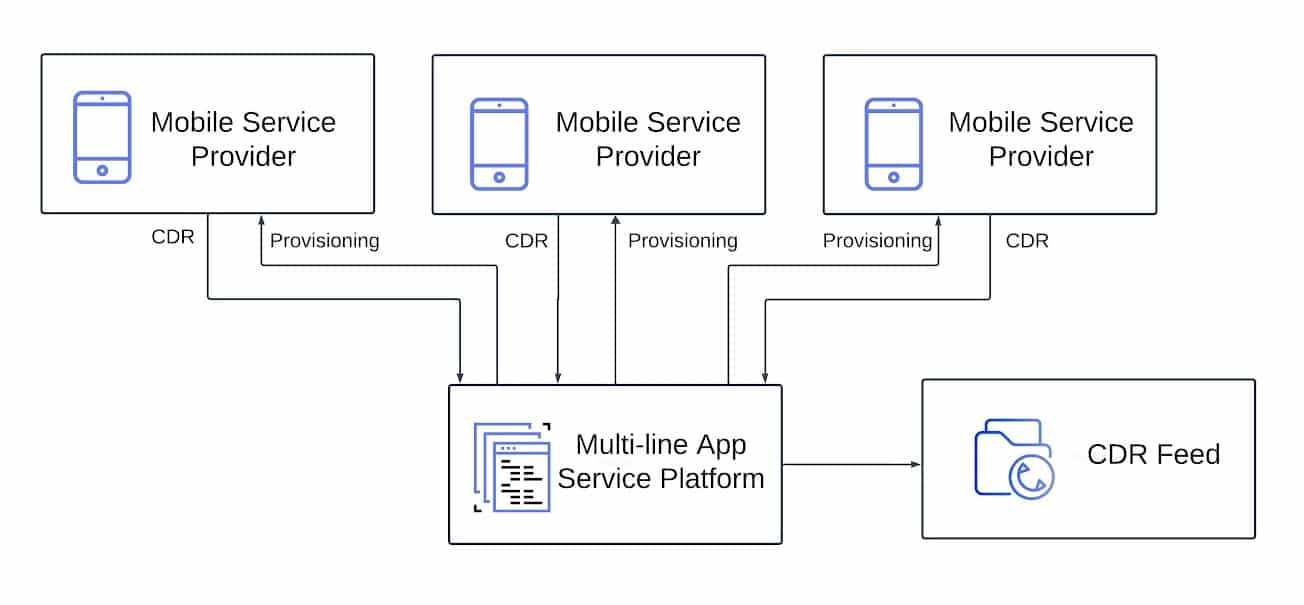
CDR Flow, Mobile Service Providers to Multi-line App Service Platform
The jBilling system then applies the various prorating rules on the subscription and origination charges depending on the mobile numbers subscribed by a client organisation. The rating engine applies rate card on the termination charges (CDRs) and generates bills to be sent to the various billable departments within the client organisation.
The client platform receives the CDR files from the mobile service providers with whom they have a tie up with. The client pays for these services directly to the mobile companies. The CDRs received from the mobile companies can be termed as Cost-CDRs and are processed in the jBilling system to validate the charges coming from these companies as monthly invoices.
For applying the termination charges to the end users, the jBilling system uses the same CDRs received from the mobile service providers. The jBilling platform processes the same set of CDRs in another tenant/company by applying different set of rating and charging rules. These rules are defined in the product catalogue in jBilling using products, plans, bundled products, rate cards and customer special pricing.
Thus, the same set of CDRs are used to validate the bills received from the mobile service providers as well as to charge the bill to the end users (or client companies).
"This ability to give us the cost of the usage charges and at the same time apply the charges to our customers with a custom rate card really took the service to the next level for us!"
The client platform has 3 different business regions. The US, UK and Singapore. Each of these regions/countries has one instance of the client system. The jBilling system provides the multi-tenancy feature that mapped each region as a different company in the system. Thus the 3 instances of the client system mapped to 3 different tenants within the jBilling system and avoided additional licensing.
The jBilling's billing and mediation platform was live within 3 months, provided most of the expected functionality out of the box, and the team was super-flexible with quick turnaround times on the customisations that were required for branding related changes. It was truly a "Value for Money" proposition all the way, with a flexible platform and a responsive team.
Managing business in many countries through a single BSS system deployment. All three regions (US, UK, Singapore) handled through one platform with correct tax rules per country.
The end-to-end revenue tracking and control in a centralised system. Both incoming subscription revenue and carrier termination costs visible on the same platform.
Maximum automation in applying of charges. No manual entries are done. Pro-rata calculations, CDR ingestion, org-level invoicing, and subscription tracking all run on automated scheduled jobs.
Effective reporting and tracking of the various aspects of revenue collection. Reduced Capex and Opex with benefits gradually increasing over the period of time.
See how EarnBill handles org hierarchies, CDR mediation, prorated billing, and multi-country operations on a single platform.