
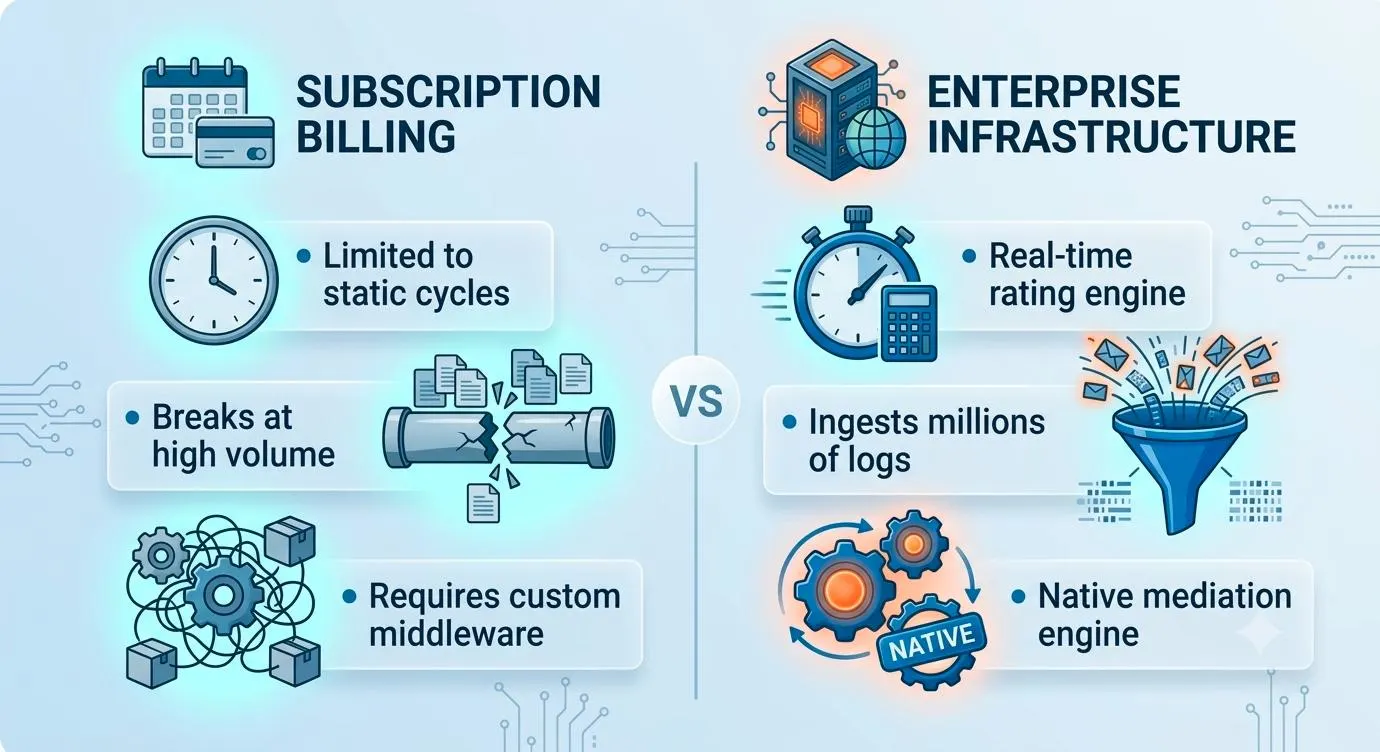
The subscription economy has dominated the business world for over a decade. For standard software companies, recurring billing is simple: a user pays a fixed monthly fee, and the system processes a static charge on the same day every month. It is a predictable, linear transaction.
But when you cross over into high-volume infrastructure industries like telecommunications, internet service providers (ISPs), and massive industrial IoT networks, the standard subscription model completely breaks down.
In these sectors, value is not static. It is dynamic, fluid, and tied directly to consumption. Every time a smart meter transmits utility data, a connected fleet vehicle tracks a delivery route, an eSIM connects to a roaming tower, or a consumer streams a 4K video, a raw data event is generated.
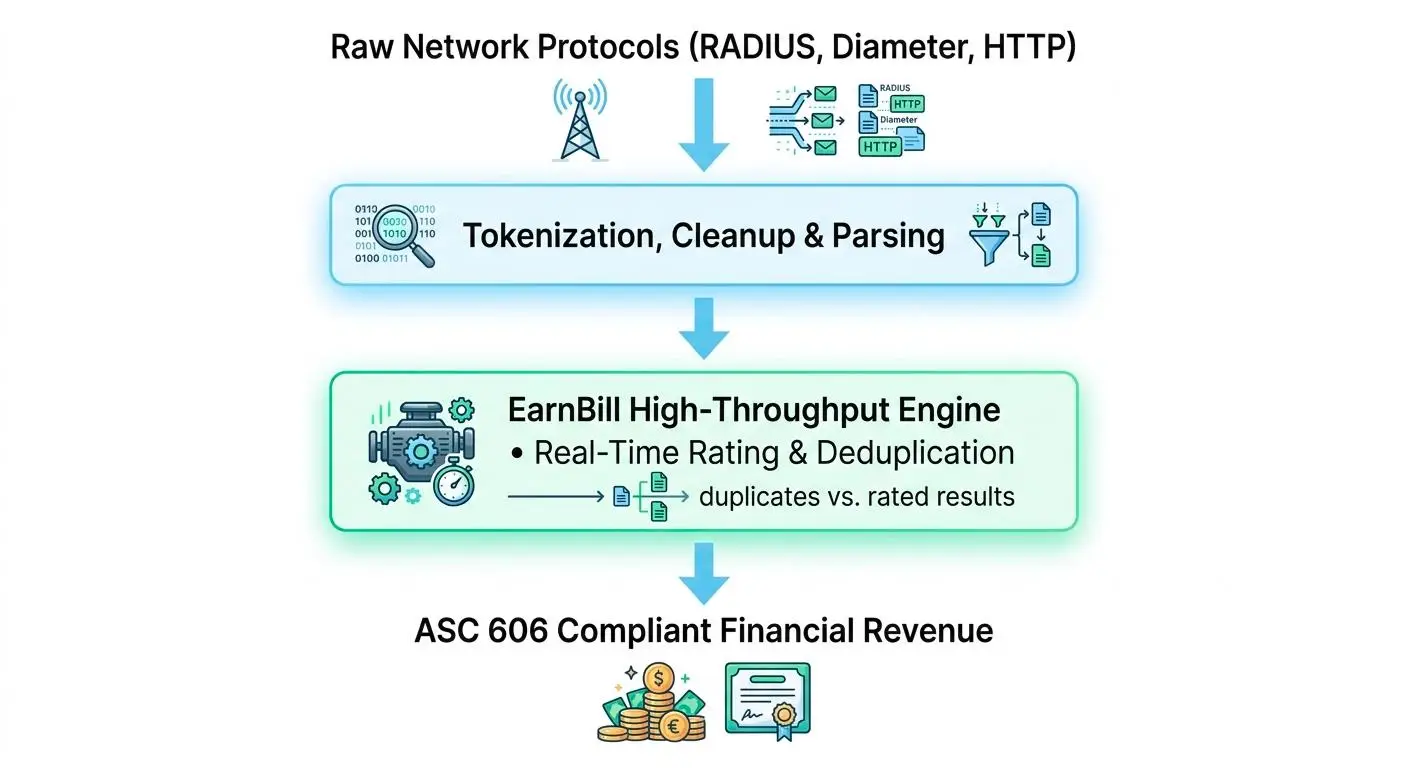
For large-scale infrastructure providers, the real challenge isn't processing a monthly subscription fee; it's capturing, parsing, and pricing millions of these raw events every single day. If your billing architecture cannot scale alongside this explosive data growth, implementing an effective high-volume usage based billing framework becomes an operational impossibility, triggering systemic vulnerabilities across growth, operations, finance, and engineering.
The Systemic Impact of Infrastructure Bottlenecks
When a high-volume business relies on an inadequate billing engine, the technical limitations quickly turn into strategic hurdles. A billing system should function like invisible, efficient plumbing. When it fails to scale, it stalls business growth, causes operational delays, and creates massive financial risks.
Lost Market Agility and Stalled Enterprise Initiatives
From a broad business perspective, an inflexible rating engine slows down market expansion and actively hinders time-to-market. In competitive fields like telecom or enterprise IoT, the ability to launch new product offerings quickly, such as dynamic data packages, complex B2B roaming pools, or hybrid prepaid/postpaid services, is a major differentiator.
If the underlying billing platform requires months of custom coding just to roll out a new pricing tier, the business loses its competitive edge. Sales teams routinely miss out on large enterprise contracts simply because the infrastructure cannot support the intricate, custom consumption agreements required by major corporate clients. Instead of backing up your sales pipeline, a rigid billing architecture forces the business into operational hesitation, stalling international expansion and regional go-to-market initiatives.
High Operational Overheads and Customer Friction
When a data engine struggles to process massive volumes of event data, internal operations become a bottleneck. Systems run slow, batch processing cycles drag on for days, and errors multiply. Operational teams are forced to manually reconcile discrepant data files, patch broken system connections, and handle a flood of billing disputes from frustrated clients.
Delayed or inaccurate invoices create direct friction with enterprise buyers, which ultimately degrades customer trust and drives preventable churn. Instead of focusing on optimizing systemic performance to scale the business, valuable internal resources are entirely consumed by manual troubleshooting and keeping an outdated, overstrained system functioning.
Financial Instability and Invisible Revenue Leakage
For corporate finance teams, high-volume data streams present a severe risk of revenue leakage. In industries operating at a massive scale, a delay of even a few milliseconds in raw data rating can have compounding financial consequences. If an engine fails to process a Call Detail Record (CDR) or network log file in real-time, services are delivered without being accurately tracked or billed.
In high-volume telecom and infrastructure environments, a mere 0.5% revenue leakage due to unrated data drop-offs can easily translate into millions of dollars in unrecovered annual losses. Furthermore, maintaining financial integrity becomes incredibly difficult; creating audit-ready, ASC 606 and IFRS 15-compliant revenue recognition schedules is an uphill battle when your system cannot accurately tie consumption data back to the financial ledger in real-time.
Escalating Technical Debt and Brittle Infrastructures
From an architectural perspective, trying to scale a basic billing platform to handle enterprise network infrastructure creates immense technical debt. Engineering teams are forced to build complex custom middleware, external data staging areas, and custom scripts just to clean and feed data into an engine that wasn't built for high-volume ingestion.
This results in a fragile, over-engineered system that is expensive to maintain, slow to update, and highly vulnerable to database degradation or crashes during peak traffic spikes. Valuable development resources are permanently pulled away from the core product roadmap just to maintain a brittle billing infrastructure, resulting in a highly unpredictable total cost of ownership (TCO).
How EarnBill Architecture Simplifies Consumption Monetization
EarnBill was engineered from the ground up to serve as a high-performance monetization engine for complex, high-volume enterprise environments. Rather than acting as a simple layer on top of a payment gateway, EarnBill functions as a comprehensive telecom billing engine designed to manage massive transaction volumes natively.
Unlike monolithic legacy billing platforms that require multi-million dollar implementation contracts and armies of system integrators just to modify a single rating rule, EarnBill offers agile framework-level flexibility without the enterprise bloat.
1. Unified Billing Mediation Layer
At the core of EarnBill's infrastructure is a powerful billing mediation layer. Raw network logs, event data, and CDRs do not arrive in a clean, organized format. They come from diverse hardware platforms, edge devices, and satellite networks, often arriving as messy, fragmented, or duplicated data streams.
EarnBill's mediation engine automatically ingests, deduplicates, and normalizes these disparate data streams at scale. Whether your network generates millions of events daily or per hour, the mediation layer cleanses and structures the data before passing it to the rating engine, protecting the central database from performance bottlenecks and ensuring that no unrated data drops through the cracks.
2. High-Performance Real-Time Rating
Once event data is cleaned and normalized, it must be priced without causing database degradation or system latency during peak traffic spikes. For businesses managing hybrid models like prepaid data caps, complex enterprise sharing pools, or dynamic usage thresholds, this calculation must happen almost instantly.
EarnBill features a robust, high-throughput real-time rating engine that evaluates incoming events against complex corporate pricing models in milliseconds. The system easily handles intricate, multi-layered pricing structures, enabling true high-volume usage based billing that updates dynamically. This includes:
Tiered consumption rules: Automatically adjustments to the per-gigabyte or per-transaction price as usage crosses specific volume thresholds.
Shared data pools: Seamless aggregation of consumption across thousands of distributed IoT devices under a single corporate umbrella.
Dynamic thresholds: Triggers for automated customer-facing notifications or portal alerts when usage limits are reached, reducing billing disputes to near-zero.
By rating events in real-time, EarnBill eliminates the processing delays common in legacy batch-billing systems, ensuring that actual usage is recorded and billed with total accuracy.
3. Centralized and Decentralized Deployment Flexibility
Modern high-volume enterprises often span multiple brands, geographies, or business units, each requiring tailored data management. EarnBill addresses this complexity by offering native configuration options for both centralized and decentralized billing mediation frameworks.
For organizations running multi-brand or international operations, individual regional sub-entities can run their own localized mediation batches to meet local data residency and compliance rules. Alternatively, companies can choose a centralized structure where a single unified mediation job processes, rates, and records events for all global subsidiaries while routing the final invoices to separate corporate accounts. This operational flexibility is managed directly via configuration, avoiding the need for expensive structural redesigns or database fragmentation.
4. A Scalable, Battle-Tested Foundation
When processing billions of monthly transactions, software stability and horizontal scalability are non-negotiable. Technology leaders need absolute assurance that a platform upgrade will not lead to system downtime or performance degradation during peak processing windows.
EarnBill provides this stability by leveraging a robust architecture derived from the proven jBilling open-source framework. This engine has been battle-tested over 15 years in demanding enterprise environments worldwide. EarnBill combines this core reliability with a modern, high-performance architecture and an extensive suite of REST and SOAP APIs, allowing it to integrate seamlessly into existing ERP and CRM ecosystems.
If a unique enterprise client requires a highly specialized revenue-sharing model or an unusual data-parsing rule, engineering teams can write a custom plugin without modifying the core software stack. This offers the reliability of a proven global engine paired with the total architectural customization of an in-house build.
Future-Proof Your Enterprise Revenue Operations
As your enterprise scales and data volumes continue to grow, your underlying billing infrastructure will become either a competitive advantage or an operational roadblock. Relying on generic, subscription-focused software to handle high-velocity network events is an uphill battle that limits business agility, strains internal resources, and causes hidden revenue leakage.
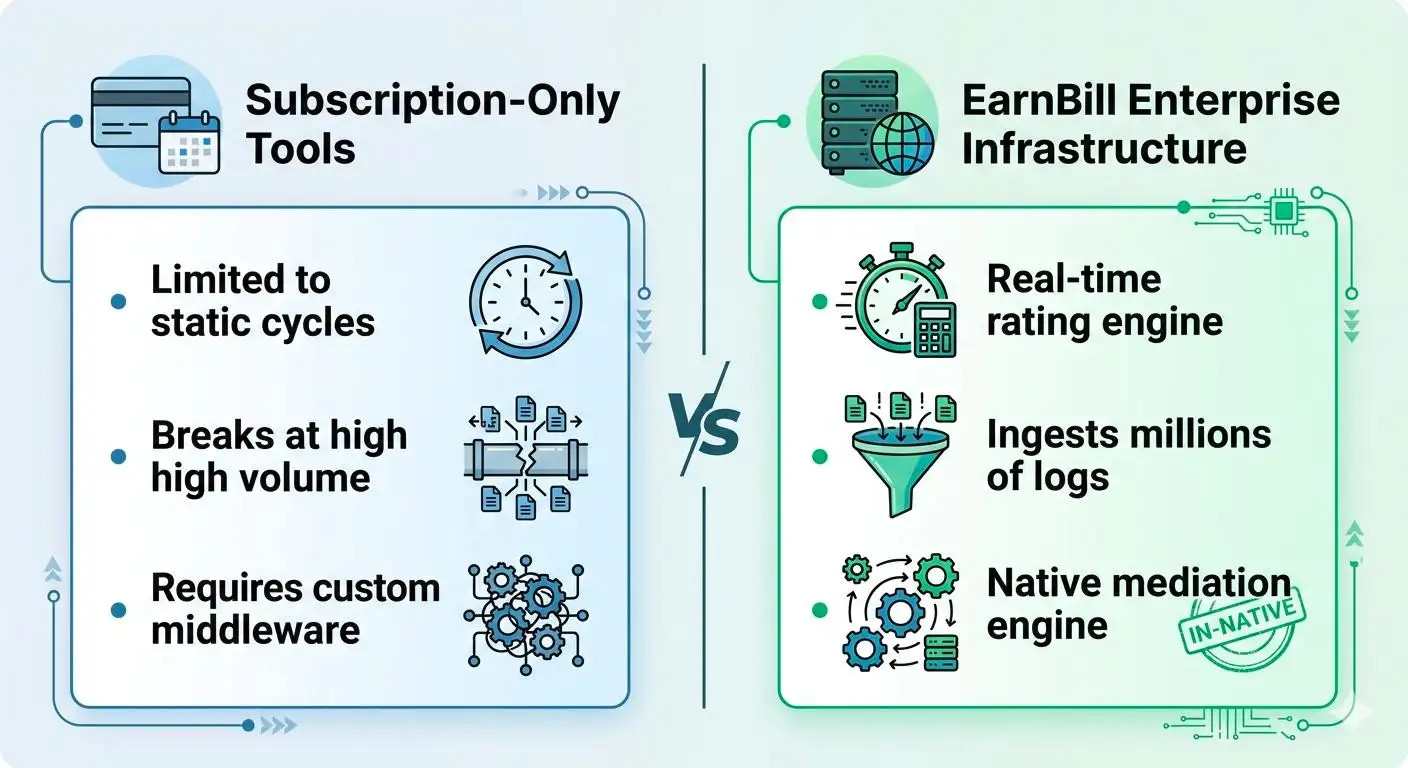
EarnBill provides the performance-driven architectural foundation needed to convert massive data streams into clear, accurate invoices with ease. With its high-throughput billing mediation engine, real-time rating capabilities, and a scalable framework explicitly designed for high-volume usage based billing, EarnBill ensures that no matter how fast your data flows, your business is equipped to track, capture, and secure every dollar of value.
Don't let raw data volume break your billing cycle. Request a proof-of-concept (PoC) to see how our Mediation Engine handles millions of concurrent events seamlessly.
Ready to Scale Your High-Volume Billing?
See how EarnBill's real-time rating engine and billing mediation layer handle millions of concurrent events without revenue leakage.