
Billing Mediation System
Billing Mediation System helps service providers to apply usage-based billing and to charge their customers based on the usage consumption of the given commodity or service. The word 'mediation' comes from the fact that the raw usage data received from various sources is massaged and transformed into data that is understandable by a billing system.
With a mediation software, the Service Providers can start different usage based plans to their subscribers or customers. The usage-based plans entail charging the customers based on their usage consumption levels, not just a flat subscription fee. This type of charging ensures fairness in billing the customers based on their actual usage of the service. It also ensures that the Service Provider is correctly compensated for any losses ensuing from additional usage of the service by the subscriber. The billing mediation system prioritizes the 'Pay As You Go' charging paradigm.
A billing mediation platform consists of various software components that extract or read data from various usage sources, skip the unwanted data, validate the accepted data for business rules, transform and enrich the data to bring it in a state which can be easily consumed by an invoicing system. The invoicing system (or a billing engine) then uses this data and charges it onto customer invoices.
Importance of Billing Mediation System
Many businesses are moving towards usage based charging instead of a fixed fee or a flat subscription. The usage based rating and charging is a more fair way of charging the customers and ensures a win-win scenario for both the service provider and the consumer. Check out blog "New usage billing benefits your business" to understand the clear benefits of usage-based billing.
A billing mediation system is of critical importance to businesses that rely on usage based rating and charging. This system allows your business to measure, rate and charge the consumption usage to your customers based on an agreed usage plan. It also ensures that the resultant charging leads to revenue for your business and assurance to your customers that they are being charged based on their consumption levels. More the consumption, more the charging and vice-a-versa. In a way, this system is a critical player in your business ecosystem.
The billing mediation generates data of charged events which can be shared in a transparent way with your customers. This gives an added confidence to your customers about how your organization is charging them. A lot of businesses make available this data through invoices as well as through customer self service portals. This leads to higher customer retention and greater word of mouth publicity, ultimately ensuring growth for your business.
Key Challenges of Billing Mediation System
Having laid the foundation of why the billing mediation systems are important and how they are used for consumption billing, let us look at the key challenges faced when implementing and supporting these systems for businesses.
Increasing Data Volumes
The usage rating and charging systems deal with a huge amount of data on a daily basis. In certain businesses such as Telecom and Infrastructure as a Service, the billing mediation could deal with hundreds of millions of usage data records on a daily basis. This can easily lead to surge in database and disk space utilization in Terabytes in a few months. It becomes challenging to deal with the increasing data, with regular and expensive maintenance basis becoming the order of the day.
Duplication of Data in Various Systems
The usage data arrives from various sources and gets stored sometimes in multiple systems. For example, after loading and processing through the mediation software, it could be sent to the invoicing system as part of invoices PDFs and stored there as part of invoices. Additionally, it gets stored at the source or entry point in raw usage data format like flat files or csv files. This means the same data gets stored at multiple places causing data duplication of sorts.
Periodic Data Archival and Purging
The increasing data volumes need to be managed through the maintenance activities such as the periodic data archival and purging. The old data needs to be archived outside the primary system at a secured location. Once archived, the data that has been backed up needs to be purged from the primary system in order to keep the system lean and mean, and most importantly efficient and performant.
Higher Infrastructure Costs
An enterprise billing system with a huge data processing mandate is expected to be expensive in infrastructure costs. Whether it is a cloud based infrastructure or on premise servers, the systems dealing with big data processing need to be highly available and scaling in computing resources dynamically as much as possible. This ensures meeting expected business goals of producing customer invoices on time and dispatching them efficiently. The mediation system should be a highly optimized one in terms of usage of the resources such as storage and computing power.
Rating and Charging Errors
This is one of the most critical challenges for businesses. Any overcharging from the data mediation side can lead to customer perception issues and also legal issues. Any undercharging leads to loss of revenue for the business. The systems need to be accurate in rating and charging as per the agreed usage plans. Any small error in pricing and charging can have an impact across a huge subscriber base and leads to loss of reputation for the business and a big reconciliation effort.
Revenue Leakage
A revenue leakage occurs when a rating and charging system such as the billing mediation, keeps undercharging and undercharging the customers for a period of time, without the business noticing such an issue. It is not possible to bill customers backdated for any revenue leakage that occurred in the previous periods. Such revenue is typically lost and is termed as revenue leakage. It is a very challenging proposition for businesses because it can lead to business under performing and not meeting the stated and projected revenue goals.
Limitations of Billing Mediation System
This section builds on the previous section and takes the discussion forward as to how a billing mediation job gets constrained in achieving its goals, through certain limitations of the platform and the overall consumption billing design. Let us look at some prominent such limitations of the platform:
Rating Errors in Billing Mediation
The rating and charging systems keep running 24x7 and on data received from many sources. There will be times when rating errors occur due to external dependencies or through system's internal bugs. The external dependencies could be the integrating systems that supply the raw usage data sending incorrect information, or making changes in the rules that have not been communicated or causing issues in the mediation job. The system internal bugs could be caused due to exposure in production systems to untested use cases or unexpected properties.
Manual Dependency in Data Transfer, Transformation and Upload
Some businesses do not have the ability to automate the data feed to the billing jobs. They depend on highly skilled personnel to source data from various sources, run data transformation routines at the source side and then upload this usage data into a mediation job. This manual dependency can limit the success of the mediation platform, because the system could miss the deadlines to process the data due to delays caused by such manual dependencies. A billing mediation system should be end-to-end automated to reap in the true benefits to the business and be devoid of manual dependencies as much as possible.
Missing out on Timely Upload of Usage Data
This limitation causes a billing delay or in the worst case scenario a revenue leakage. If an external source causes a delay in supplying the usage data, there is not much that a mediation job can do. The mediation platforms need to be dynamically scalable in order to speed up processing of delayed usage data. This can lead to faster catching up of the backlog and ensuring nothing is lost in processing or at least minimizing the loss to a great extent. There need to be direct SLAs on all integrating parties involved in ensuring timely operations.
Lack of Timely Transfer of Data amongst Interconnecting Partners
In the telecom domain, there is exchange of Call Data Records (or CDRs) amongst telecom companies. For example, a telecom company may have national or international roaming partners. The CDR information coming from partners needs to be provided in time and as per the mutual agreements. The delays in transfer of this data can limit the timely operations and cause billing delays, or worst loss of revenue.
Data Mediation Errors Going Unnoticed
The mediation job does its work round the clock but if it is configured or implemented incorrectly and leads to rating errors, it could be hard to find out these errors in a timely manner. This could lead to wrong charging of customers, dissatisfaction and a customer churn. There needs to be an ability in the platform to produce error reports and report potential rating errors as alerts to a billing admin team.
EarnBill's Billing Mediation System overcomes most of these challenges and limitations!
EarnBill's billing mediation system has been explained in the diagram, and is mostly self-explanatory.
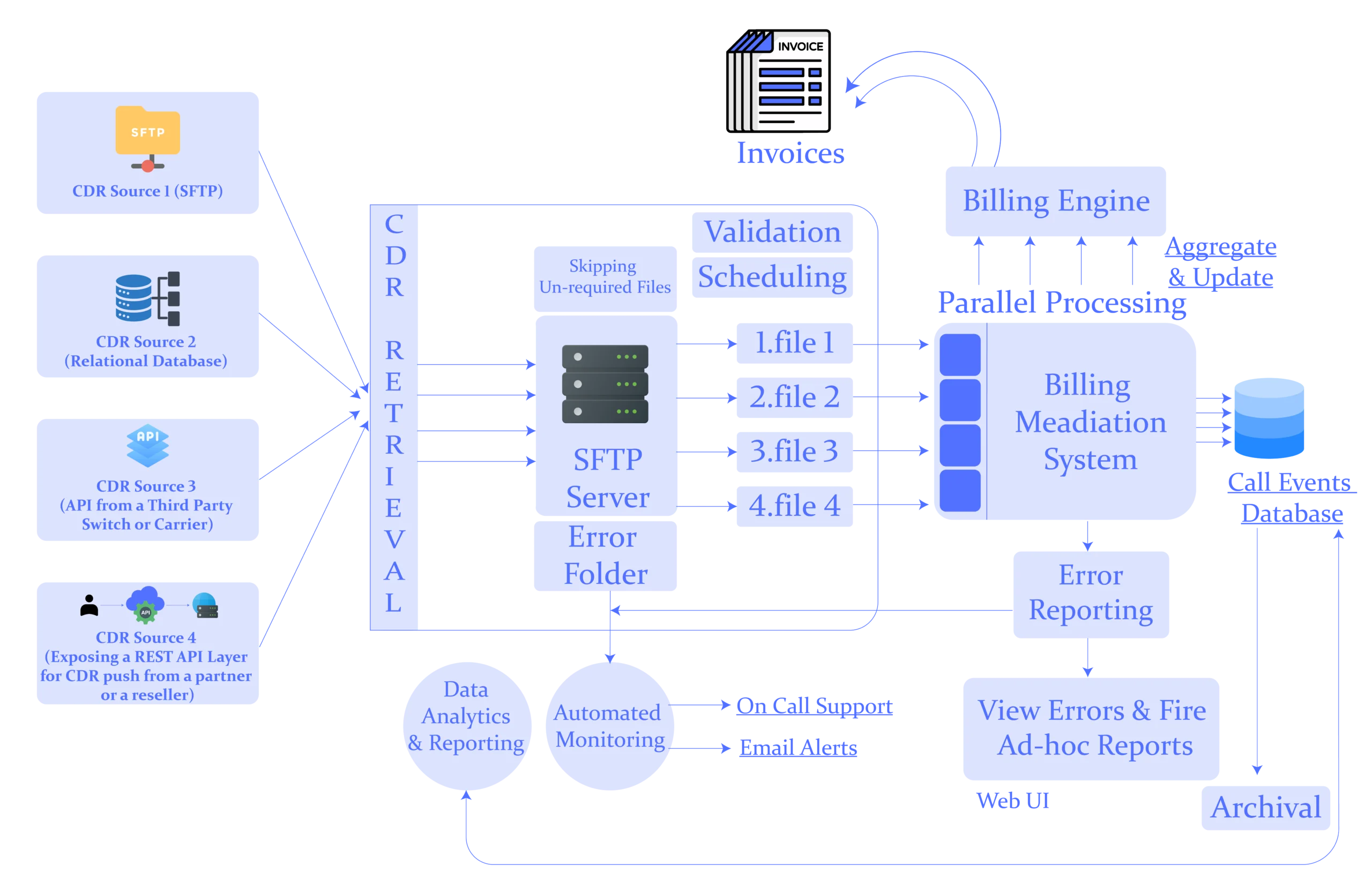
The key takeaways to ensure accurate and timely rating of usage data are:
EarnBill mediation provides a framework to ensure an end-to-end automation. This helps remove manual dependencies from an early stage of the project.
Its built-in plugins are configurable to retrieve data from various sources, skip the unwanted data and validate the required data.
It is an enterprise grade piece of software that is very scalable and ensures parallel processing of huge volumes.
It is possible to dynamically add more computing and storage resources for processing more volumes. This ensures that delays from external sources can be countered by speeding up the processing with fast configuration. If any processing lag is present for an extended period of time.
Scaling up and down as per the load on the system ensures optimal use of computing resources thus decreasing the infrastructure costs.
EarnBill offers fault tolerance & reliability that ensures every record is processed exactly once in order to ensure zero data loss during failures. Additionally, it provides auto-retry & recovery mechanisms.
The EarnBill's system design/framework supports modularity and pluggable architecture to achieve extensibility & customization for any changes as per your business requirements.
The mediation software provides an intuitive system ensuring that any errors in rating or charging are picked up and reported as soon as they take place. Such monitoring can call the support team in case of business critical errors and send emails for less critical ones.
The automatically generated error reports ensure that even the less critical errors are seen early by the people who need to see them.
The automated archival and purging of usage events data ensures that there is much less maintenance involved in running the system.
"EarnBill mediation promotes end-to-end automation ensuring smooth, secure, accurate and timely billing of usage data. It keeps your organization one step forward in the race!"
Ready to Transform Your Billing Mediation?
Discover how EarnBill's advanced mediation system can overcome these challenges and deliver accurate, timely billing