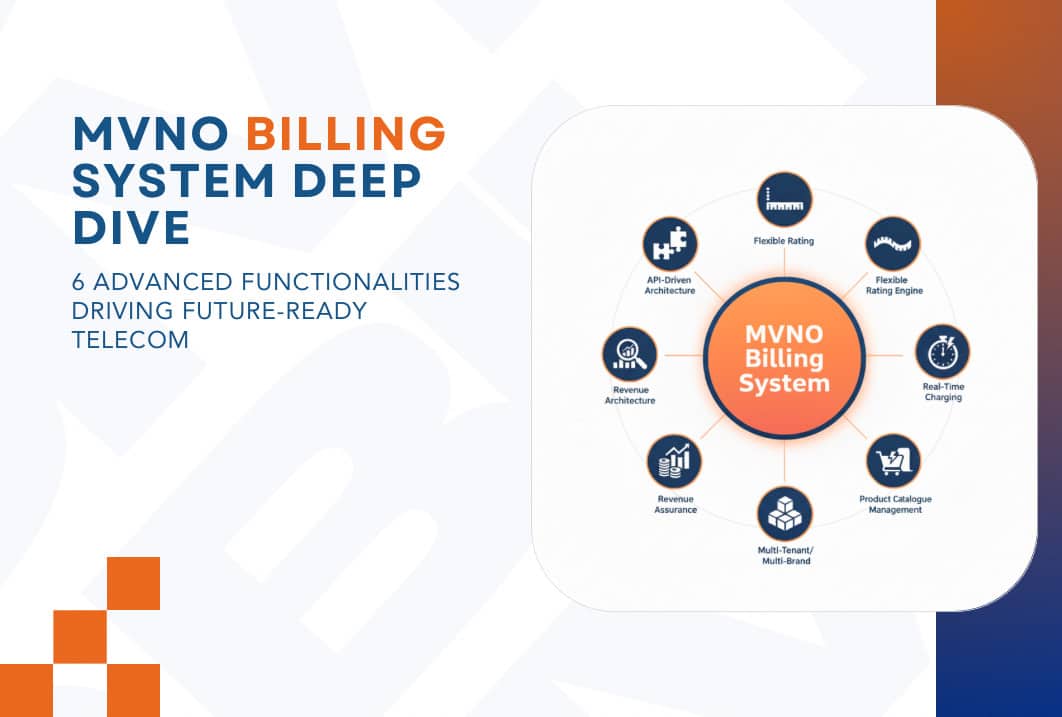
MVNO Billing System Deep Dive: 6 Advanced Functionalities Driving Future-Ready Telecom
Explore the advanced technical capabilities that modern MVNO billing systems need to handle complex charging scenarios, real-time integrations, and multi-tenant operations in today's competitive telecom landscape.
Ashok
Manager of Engineering
Oct 28, 2025
15 min read
Mobile Virtual Network Operators (MVNOs) have emerged as critical forces in the rapidly evolving telecom industry by providing flexible and customer-friendly experiences from their network-free business models. Increased market competition and changing consumer demands have made traditional billing systems insufficient for handling the complex needs of contemporary MVNO businesses. As a consequence, the more traditional Telecom Billing Systems have been enhanced to meet the MVNO Billing requirements.
The MVNO billing systems have evolved by augmenting more traditional telco features for MVNOs and developing more advanced features specific for an MVNO business model. This blog investigates 6 advanced MVNO billing system functionalities which support digital transformation and sophisticated revenue management, while addressing the requirements of emerging services including e-SIMs and IoT connectivity.
Understanding an MVNO Billing System
Modern MVNO billing functionalities have evolved into a strategic cornerstone which goes beyond revenue control to first place innovation, customer satisfaction and profit maximization. The next-generation MVNO billing platform provides MVNOs operational efficiency along with market differentiation capabilities through its real-time charging, partner settlement and regulatory compliance features. This blog investigates 6 advanced MVNO billing system functionalities which support digital transformation and sophisticated revenue management, while addressing the requirements of emerging services including e-SIMs and IoT connectivity.
Modern MVNO billing systems integrate multiple advanced functionalities for smooth revenue management
1
Flexible Rating Engine
Set-up Flexible Rate Plans
An MVNO needs a flexible ratings engines for taking care of its usage billing requirements. It is the usage billing plans that power the customization and provide the competitive edge to the MVNO. Typical usage billing plans involve 3 different sets of plans - the first set of plans are for the segment of customers who have low usage. Their monthly plan fees are low and data usage rates are higher than other plans. Since they have a very low usage, therefore they can receive the service at a low set on a monthly basis.
Customer Segmentation Strategy
1
Low Usage Customers
Low monthly fees with higher data usage rates
2
Medium Usage Customers
Higher plan fees with more mobile data coverage and lower overage rates
3
High Usage Customers
Highest monthly fees with highest data coverage and lowest calling rates
Scalable Rating Engine
A rating engine used for post-mediated usage requires ability to process large volumes of Call Data Records (CDRs) seamlessly. The rating engine that processes the rating and charging of these CDRs should be scalable to cater to high volume loads due to seasonal demands and spikes in transactions or increase in volume.
2
Real-Time Telecom Charging & OCS Integration
The system implements tight integration between its real-time charging module and OCS (Online Charging System) for prepaid accounts. The system performs immediate checks on balance status and quota availability and service permission validation.
Event-Based & Session-Based Charging
A telecom billing for MVNO should provide session-based services with support for data usage streaming and Voice over Internet Protocol. The billing system should support both real-time and batch-based rating systems when depend on service types.
Online Session Control
The billing system must control all session starting points along with real-time updating and session ending functions. The system includes an auto-session re-authorization process when certain thresholds, like data usage limits are triggered. Users can avert their plans of add money with active sessions without disrupting calls or data connections.
Real-Time Usage Notifications
MVNOs need a system that delivers immediate alerts to users through SMS, push notifications and email when they reach predetermined usage limits. Users can set different usage alert thresholds which vary by service type such as data usage at 80 percent. The system cuts down on customer complaints while protecting users from unexpected billing costs.
Support for Multi-Service Charging
MVNO processes multiple charging events simultaneously across voice, video, messaging, data and IoT services. It needs the billing system that has the ability to capture and charge the customer according to these events. A single balance account allows users to pay for multiple services through convergent charging.
Real-Time Balance Management
The system should be able to test user account balances before providing access to services. The system immediately should subtract fees from user accounts for voice services and VAS as well as SMS and data services. The system will stop service misuse and excessive consumption through the implementation of firm usage boundaries.
3
Product Catalogue Management
Configurable Plans & Offers
The platform should allow easy development of multiple plan types including prepaid and postpaid and hybrid structures. The system enables creation of plans which face specific durations and event-based offers. The system should also provide models which allow users to select between limited and unlimited usage options.
Bundling & Cross-Selling
Users should be able to create service combinations through bundling of different offerings such as data services and OTT subscriptions with free calls. The advanced MVNO billing platform enables creation of promotional bundles which provide deals with users and family groups and enterprise clients. The billing system should support product lifecycle management through its ability to launch new products and modify existing ones and retire products when necessary.
Single Catalog for All Services
Advanced MVNO billing functionalities also include having the capable billing system that can manage services that are managed under a single catalog framework that controls voice and data services, as well as SMS, roaming and Value-Added Services. This catalog framework adapts to multiple currencies product offerings to different access methods in dozens of languages.
Plan Customization & Personalization
Subscribers can receive personalized plans according to live requirement. The system allows subscribers to receive individual discounts and promotional offers while supporting data rollover rules.
Bundling and Converged Charging
The billing system should have the capability to group various services like voice, data and value-added services under single plans. The system enables billing for unified services which include mobile services and fixed-line services and OTT subscriptions.
Under an aggregator model, MVNOs can have their own branded product catalogue. There is isolated management and billing for each virtual brand, on the same platform. These modular MVNO product and billing capabilities provide isolated service creations and monetization approaches for each virtual brand.
A Multi-Tenant MVNO Billing Platform
A multi-tenant MVNO billing system has a single instance deployment of the BRM system, however can host multiple tenants under this deployment. Each tenant can be a separate sub-entity, a department of the company or a different brand.
Multi-Branded BRM System
Multi-brand capabilities allows MVNOs to launch different brands for different products and services and track revenue of each brand separately. Yet if they would like to have a centralized oversight, they can have that with a company hierarchy feature.
5
Revenue Assurance
Tracking Accurate Rating and Charging
An MVNO billing system has many moving parts and functions, it is important that the MVNO billing system is rating and calculating the appropriate charges and applying them accurately. Any overapplying could lead to customer resentment, and any underapplying charging would lead to loss of revenue. Either case is not desirable. Therefore, it is very important that there is a revenue assurance function or a module that the billing system is able to provide. Such revenue assurance module should be able to assess the expected revenue of charging and compare that with the actual charges and report any discrepancies.
Proactive Monitoring
It is also important that the revenue assurance function is able to monitor the rating and charging functions consistently takes the warnings/user alerts before there is any impact to the end customer invoices. The ability to raise alarms before thresholds are breached and allowing internal teams to take care of such charging problems would improve customer experience by a great deal. Such proactive monitoring ensures that the customers get their bills as expected, with accurate charging and ensure for the MVNO that they are not leaking any revenue due to erroneous billing.
6
API-Driven Architecture
An MVNO builds multiple integrations, some in-house with ERP systems, a CRM system, an accounting system and some external ones such as with various carriers (both local and international), payment gateways and Customer National ID verification systems etc. An API-based billing system helps build these integrations seamlessly.
Real-Time Provisioning Integration
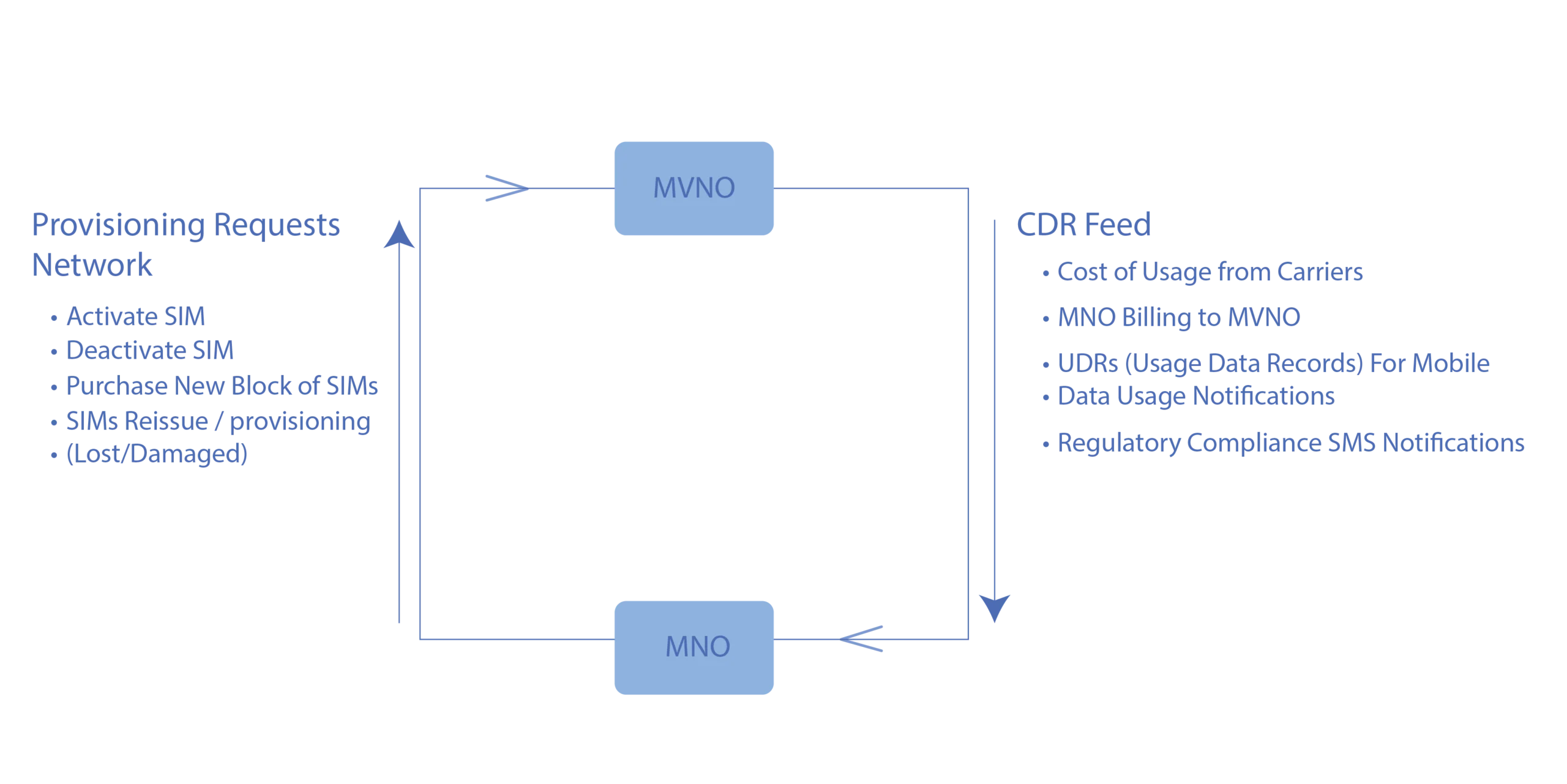
Immediate activation, deactivation, or change of services through connectivity to network elements or provisioning systems via APIs comes under advanced MVNO billing functionalities. Providing real-time synchronization between billing systems and carrier networks, creating activation, number portability, VAS provisioning is a critical part of modern MVNO billing functionalities to ensure quick customer on-boarding and service agility. The use of e-SIMs is on the rise and MVNOs are provisioning e-SIMs on the carrier networks, creating interesting new telecom products and services using e-SIMs. The IoT service providers are not far behind and using e-SIMs in a big way.
Integration with External Systems
smooth integration with CRM systems for management of customer life cycle, Payment gateways for online or recurring payments. Self-service apps for changing plans, recharges, and reviewing usage Analytics and BI solutions for in-the-moment analytics and insight have functionalities. An MVNO billing system needs out-of-box integration plugins with proven payment gateways and CRM systems.
REST APIs for all Core Functionality
Expose REST APIs for: Customer creation, updates, disablement, Plan subscriptions and top-up. Balance inquiries and usage retrieval and payment creation. This API-enabled MVNO billing capability provides easy integration to the digital ecosystem and enhances customer experience across multiple touchpoints.
Conclusion
Telecom billing for MVNO requires a good blend of core billing system, revenue management functions and advanced MVNO billing functionalities that are explained in this blog. An MVNO billing system such as EarnBill is a feature reach, powerful and scalable offering which is based on modern technical designing and engineering principles. It is also well supported by an enthusiastic team that supports your business to take your MVNO business to new heights.
6 Advanced MVNO Billing System Functionalities
1
Flexible Rating Engine: Support for diverse pricing models and high-volume CDR processing