The business environments are changing at faster rates; the way of billing procedures can make a big difference. Today, billing is not only a traditional task, it's the area for increasing customers and gaining money.
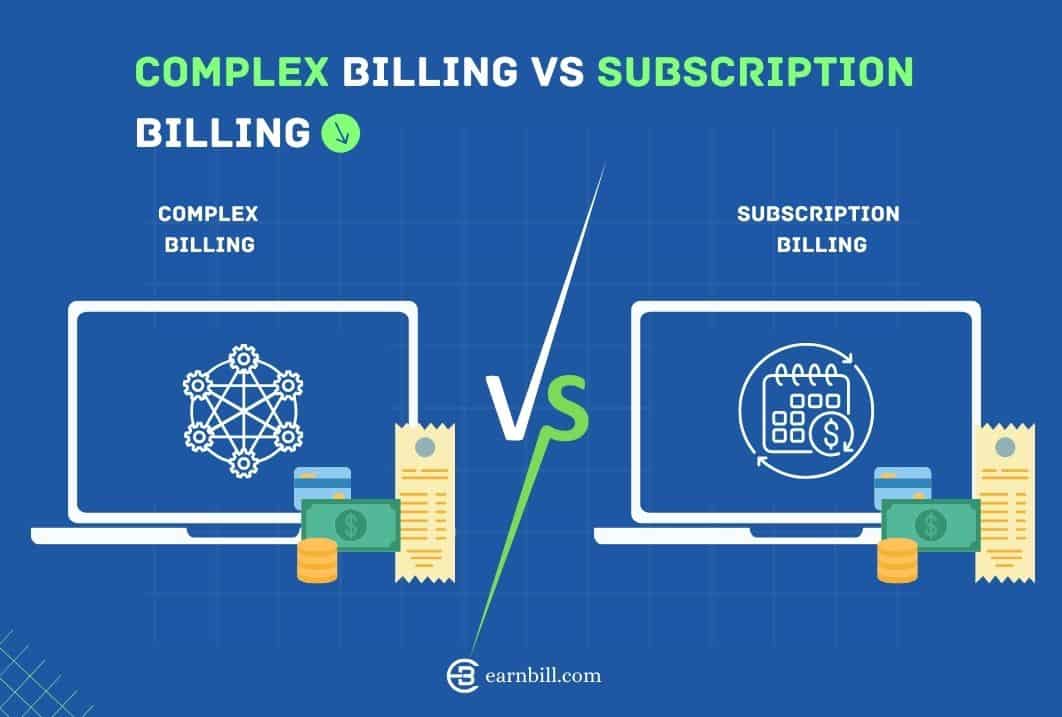
In this blog, we are going to discuss two billing methods used by businesses: complex billing systems and subscription billing. Complex billing is the process by which different pricing structures are used with advanced systems to ensure that clients receive the correct charge for their ordered services. Where subscription billing is a periodic payment by customers to continue receiving services rendered. Both models are important for any company to collect its revenues and maintain its services properly in the competitive market.
Complex billing systems refer to the processing of financial transactions that are complex in nature and involve customized structures, multiple billing cycles, and detailed customer account management. It includes hierarchical structures, where the charges can be charged to different departments or other levels within an organization. It also includes complex rating scenarios with charging, such as tiered pricing structures, usage-based charges, and discounts. This type of billing is very important, especially for enterprise applications with multiple services and patterns of use. The complex billing system will guarantee the accuracy of the invoice, the smoothness in operations, and increased customer satisfaction.
Subscription billing is a recurring process by which businesses charge customers periodically to continue accessing certain types of services. This makes the billing process easier for the business because it creates a predictable, continuous flow of revenue. This helps both parties by way of better management of the company's revenue stream and building long-lasting relationships with customers. It is particularly used in businesses related to SaaS; it secures continued cash inflow and customer retention.
How to Choose the Right Model
The right choice of your billing model would solely depend on the type of business you run and the operational framework within which it functions.
⚙️
Complex Billing Systems
This would be an multimedia provider where there is a high volume, variety, and complexity of services. This model would be suitable for companies that have varied tiers of pricing, different billing cycles, and complicated hierarchies of customers. Major industries that most benefit from complex billing systems are telecommunication, cloud computing services, and the Internet of Things.
🔄
Subscription Billing Systems
Best for business models where periodic, repeated payments are made for continuous access to their products and services. This model works well in industries like SaaS, media streaming, and e-commerce, where predictable revenue generation and customer retention are of high priority.
Summary
Complex billing and subscription billing both play a very major role in today's business. Complex billing caters to industries with varied pricing structures of their products or services and needs detailed invoicing and custom agreements. On the other side, subscription billing works for predictable, recurrent revenue models where customers are charged at periodic intervals for access to some service or product. One can opt for the one that fits the need more by realizing the strengths of each model in improving strategies on better means of revenue generation and how to deal with services provided efficiently.
Key Takeaways:
✓
Complex billing handles varied pricing tiers, multiple cycles, and hierarchical customer structures
✓
Subscription billing creates predictable revenue through periodic payments for continuous access
✓
Choose complex billing for telecom, cloud, IoT, and enterprise applications with custom needs
✓
Subscription works best for SaaS, media streaming, and e-commerce with recurring revenue models
✓
Complex billing offers higher flexibility but requires longer implementation time
✓
Both models support automation but differ in invoice complexity and pricing customization