
If you sell your services or technology to other businesses, you already know that B2B commerce is rarely a straightforward transaction. In the consumer world, a person puts a card on file, buys a subscription, and gets a single receipt. It is predictable, linear, and simple.
But when you move upmarket to service large, multinational corporate clients, that simple model falls apart completely.
Imagine onboarding a new Fortune 500 conglomerate. They love your product, but during the procurement process, their IT director hands you a list of demands:
They have 14 global subsidiaries across 4 continents.
Each subsidiary needs its own isolated sub-accounts to track usage.
The European branch needs their invoices routed to a centralized regional headquarters, while the APAC branches want individual local invoices billed in local currency.
Certain shared software licenses need to be split evenly across three separate internal cost centers.
If you try to jam this kind of corporate matrix into a standard SaaS billing platform built for simple web apps, you will quickly hit a wall. Most billing engines treat every customer as a flat, single entity. They have no concept of family trees, nested dependencies, or complex payment routing.
To win and retain large-scale enterprise clients, your underlying billing architecture must be as fluid and sophisticated as the corporations you sell to. It requires a robust framework designed specifically for complex B2B account structures.
The Operational Bottlenecks: How Complex Accounts Break Legacy Systems
When billing software cannot model the real-world structure of your customers, it creates a massive amount of hidden friction. The consequences ripple across the entire organization, slowing down growth initiatives, draining operational resources, introducing financial risk, and burdening engineering teams with unnecessary technical debt.
The Strategic Threat to Market Agility
A rigid billing system acts as a direct anchor on business growth and market expansion. Enterprise sales cycles are already long and complex. When a major pipeline deal stalls because the sales engineering team has to admit that the platform cannot support the prospect's corporate hierarchy structure out of the box, competitive advantage vanishes. Modern enterprises require an infrastructure that acts as a business enabler, allowing teams to confidently close complex deals without operational hesitation.
Financial Leakage and Revenue Recognition Risks
Complex account management without native automation is a profound financial and compliance vulnerability. When bills must be manually split between departments or calculated based on data usage across subsidiaries, finance teams are forced to rely on complex, offline monthly spreadsheets.
This manual process is slow, highly prone to human error, and inevitably leads to unbilled usage and revenue leakage. Furthermore, without a single, automated source of truth, creating audit-ready, IFRS-compliant revenue recognition schedules becomes an incredibly labor-intensive task.
Operational Gridlock and Inefficiencies
A flat billing architecture translates directly into day-to-day operational gridlock. Instead of focusing on scaling customer success, internal operations teams spend days extracting usage data, handling billing disputes, and creating customized corporate invoices by hand. If an enterprise customer changes their organizational structure through a merger or acquisition, operations teams must manually reconstruct their billing accounts, dragging down efficiency and hurting the customer experience.
Brittle Codebases and Escalating Technical Debt
From an architectural perspective, the challenge is structural. Standard subscription billing tools assume a customer is just a flat line in a database. To appease business demands, engineering teams are routinely forced to build and maintain hacky custom tools, middleware wrappers, and brittle database schemas to mimic relationships like parent-child structures. This creates immense technical debt, pulls valuable development resources away from the core product roadmap, and leaves the company with an infrastructure that threatens to break under heavy volume.
How EarnBill Resolves the B2B Multi-Tier Billing Problems
EarnBill was engineered from the ground up to handle high-volume, complex enterprise workflows. Instead of treating account structure as an afterthought, EarnBill treats it as a core architectural asset. Built on over 15 years of proven billing and revenue management expertise, EarnBill provides a robust, enterprise-grade solution that directly addresses these systemic challenges.
Here is how EarnBill transforms multi-tier headaches into a smooth, automated workflow.
Native N-Level Account Hierarchies
EarnBill does away with rigid flat-file customer databases. Instead, it offers a deeply flexible, native N-level account hierarchy framework. This means you can create customer models that perfectly mirror any real-world corporate structure, no matter how many layers deep it goes.
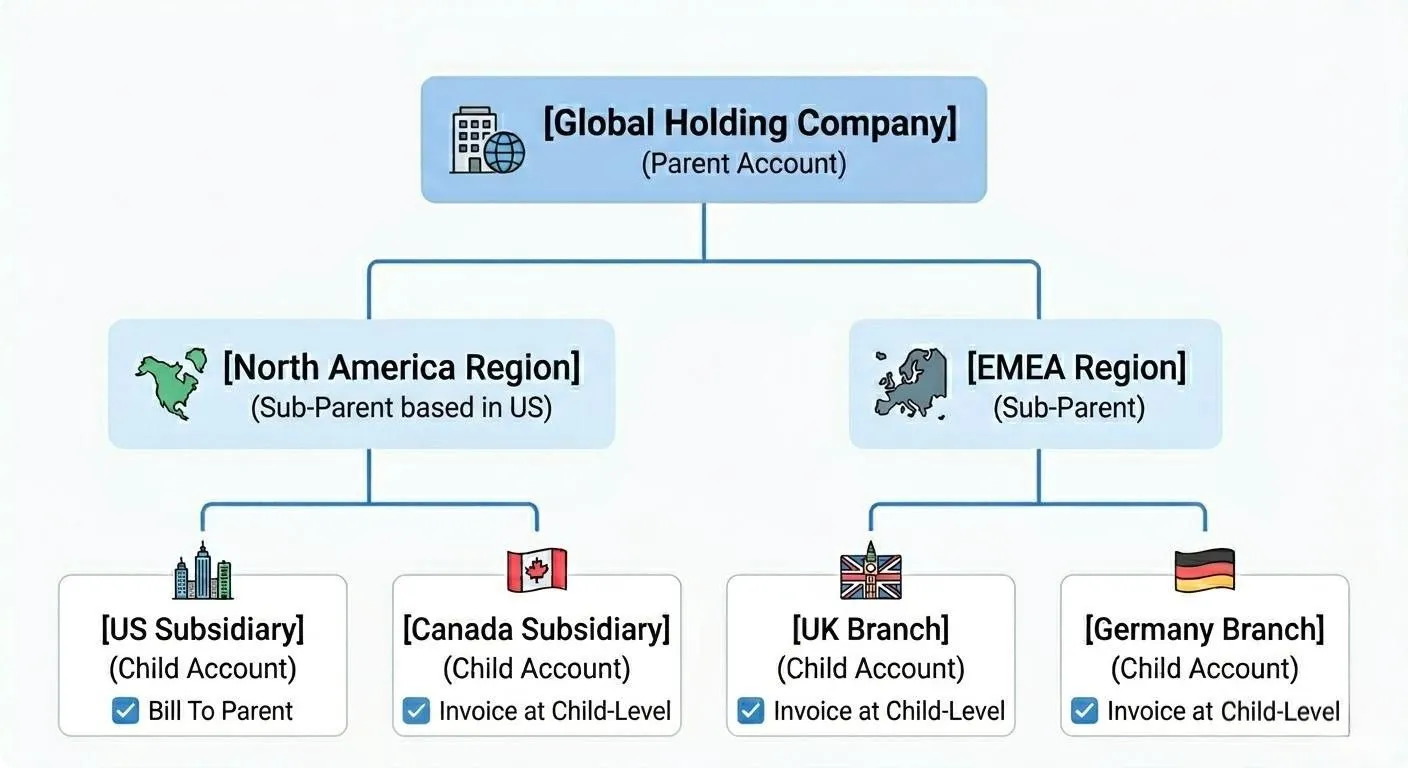
With EarnBill, you can link parents, sub-parents, and child accounts together in an infinite tree structure. Every entity in this tree can have its own distinct users, isolated permissions, and localized settings, while remaining tied to the broader corporate account.
This gives revenue teams a clear, bird's-eye view of total enterprise lifetime value, while giving the client's internal department heads the exact granular visibility they need through a branded self-service portal.
Intelligent Split Billing and Invoice Routing
You no longer need to run manual Excel workflows at the end of the month to sort out who owes what. EarnBill's core rating engine includes flexible billing logic that automates complex payment paths natively:
Roll-Up Invoicing: You can automatically aggregate all usage, consumption data, and subscription fees from dozens of child accounts up to a single parent invoice. The parent corporation receives one clean, itemized bill, while the system tracks which child account generated each charge.
Decentralized Invoicing: If a corporate client prefers that their local offices handle their own expenses, you can configure the system so that each child account is billed independently, utilizing their own local payment methods and corporate currencies.
Custom Split Logic: Need to allocate a fixed base infrastructure fee across five different sub-accounts based on a custom percentage or their proportional usage? EarnBill's framework allows you to easily map these rules so the system splits and applies the charges automatically during the billing run.
This automation completely removes the manual handling of data, eliminating human calculation errors and halting revenue leakage. Built-in compliance tools manage revenue recognition automatically, creating clear, audit-ready financial records.
Robust Multi-Tenant Ecosystem Support
For enterprises operating a portfolio of distinct brands or managing a global network of partners, EarnBill provides a highly scalable multi-tenant framework. This allows you to run multiple, completely isolated business environments under a single deployment.
Each tenant can maintain its own product catalogs, tax rules, and localized currencies. However, because they share the same robust underlying architecture, the executive team can still access centralized reporting and high-level financial health dashboards across the entire business ecosystem.
Centralized and Decentralized Billing Mediation
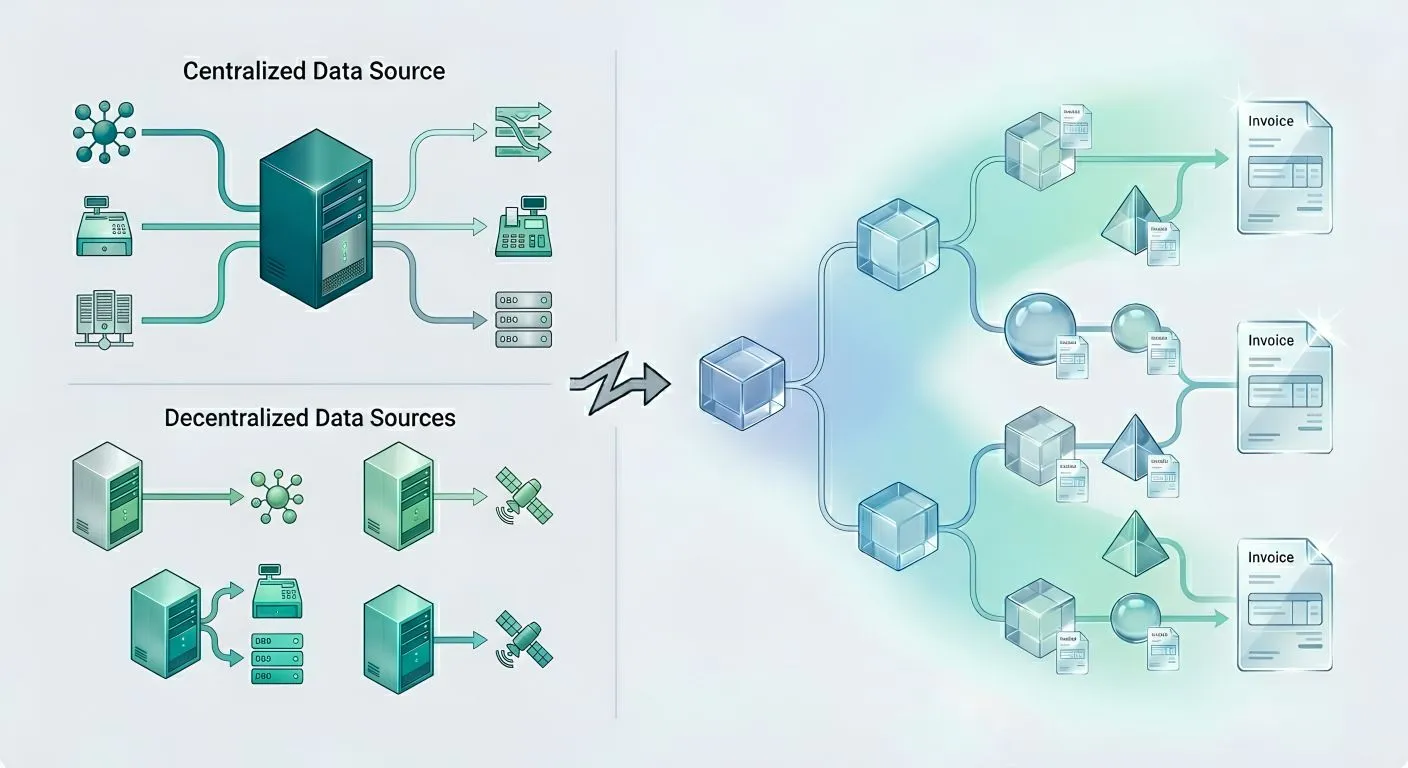
In a muti-brand, multi-country or a multi-departmental structure with distinct product offerings, it is highly likely that usage based billing will be decentralized and each sub-entity needs to run its own billing mediation batches. On the other hand, it is also possible to keep centralized mediation jobs that rate and charge usage records for users belonging to all brands, however bill them under different entities. With EarnBill, this centralized or decentralized mediation structure is a convenient matter of configuration.
Framework-Level Flexibility via Plugin Architecture
Every enterprise client has unique requirements, and no out-of-the-box software can anticipate every single edge-case business rule. This is where most SaaS billing platforms fail; they are closed ecosystems. If a feature doesn't exist, you cannot build it.
Legacy Billing Software
EarnBill Enterprise Engine
EarnBill solves this by utilizing a flexible, framework-level design derived from battle-tested architecture. Thanks to its modular plugin framework, if an enterprise client requires a completely unique revenue-sharing model or an unusual pro-rata calculation based on external network data, your engineering team can write a custom plugin to handle it.
Development teams are freed from building billing workarounds from scratch. EarnBill provides a highly scalable system equipped with an extensive suite of REST and SOAP APIs, making it simple to plug directly into current CRM and ERP ecosystems without breaking existing infrastructure.
Future-Proof Your Enterprise Revenue Architecture
As your business targets larger corporate clients, your billing infrastructure will become either an accelerator or a roadblock. Relying on basic subscription tools to manage multi-tiered corporate entities is an uphill battle that limits agility, strains leadership teams, and irritates your largest customers.
EarnBill provides the architectural foundation needed to handle complex enterprise accounts cleanly and efficiently. With native support for infinite account hierarchies, automated split billing, centralized as well as decentralized billing mediation and a modular framework designed to handle massive scale, EarnBill ensures that no matter how complex your clients' corporate structures are, your billing system can manage them with ease.
Ready to Handle Your Most Complex Enterprise Clients?
Discover how EarnBill's enterprise-grade account hierarchy and split billing framework can unlock your next tier of B2B growth.