
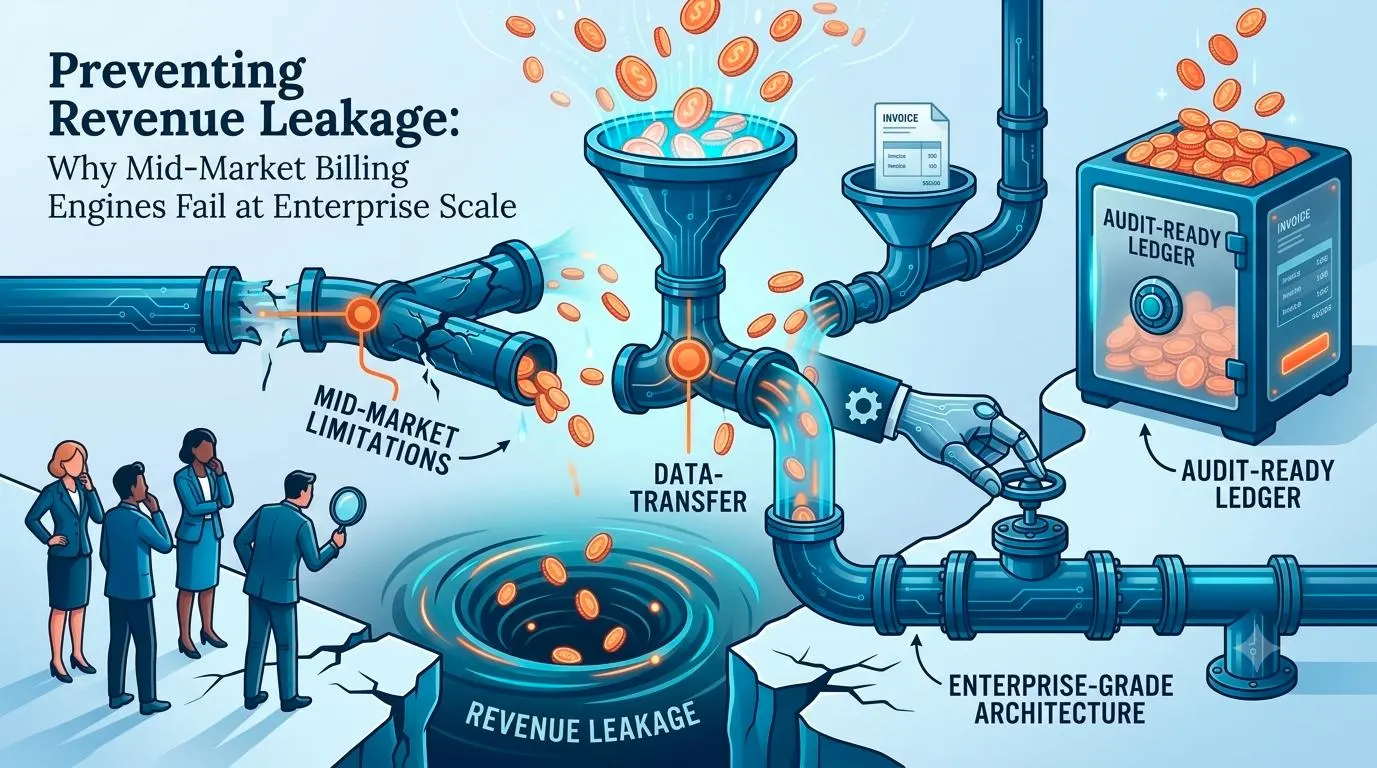
In the lifecycle of a high-growth digital infrastructure, telecom, or large-scale SaaS provider, there is a distinct tipping point where operational volume shifts from a steady stream into a massive, unpredictable flood. Transaction volumes cross the threshold into millions of events per day. Commercial agreements transform from uniform, tier-based subscriptions into highly customized, multi-layered enterprise contracts. Data begins pouring in simultaneously from legacy networks, cloud environments, and external partner ecosystems.
When an organization hits this level of complexity, the underlying billing architecture is put under extreme pressure. Unfortunately, many market leaders attempt to navigate this transition by stretching mid-market billing platforms past their breaking points.
While these platforms look modern, feature slick user interfaces, and handle standard subscription models perfectly, forcing them into a complex enterprise environment uncovers a dangerous operational reality: they leak revenue quietly, structurally, and at a scale that directly threatens an organization's bottom line.
To secure corporate margins and future-proof the business, leadership teams must look past marketing promises and analyze the exact structural failure points where mid-market engines break down under enterprise scale and complexity.
1. The Real-Time Mediation and Rating Bottleneck
At a true enterprise scale, particularly for Telecommunications, Tier-2/3 ISPs, and Cloud Infrastructure Providers, accurate billing relies entirely on data ingestion. Raw usage data, such as Call Data Records (CDRs), data packets, or API calls, must be collected from the network layer, cleansed, normalized, and mapped to the correct customer account.
Mid-market billing engines are fundamentally not designed to handle high-volume data mediation natively. When millions of concurrent usage rows hit their API endpoints, their database schemas experience severe row-locking issues and CPU throttling. To survive, these platforms rely on batch processing or push the responsibility onto external, third-party middleware plug-ins.
The Leakage Point: When data ingestion delays occur, a dangerous visibility vacuum is created. If an enterprise client experiences a sudden spike in wholesale bandwidth or network utilization, a weak rating engine cannot calculate consumption patterns in real time.
The Strategic Damage: By the time the system aggregates the batch files hours or days later, the customer may have vastly exceeded their uncollateralized credit limit. Furthermore, because the engine lacks real-time awareness, it fails to dynamically apply complex pricing caps or burstable 95th percentile rules, which require continuous mathematical aggregation over strict 5-minute sampling intervals. The resulting invoices are often sent out late, packed with errors, or forced to include unbilled consumption adjustments that are eventually written off just to preserve the client relationship.
2. Rigid Pricing Catalogs Vs Operational Agility
Enterprise market leaders win by staying agile. Capturing market share requires the ability to launch complex hybrid pricing models on the fly; blending upfront prepaid credits, traditional postpaid recurring fees, volume discounts, and granular usage-based metrics into a single unified invoice.
Mid-market platforms are built on rigid, standardized codebases optimized for predictable SaaS models. When forced to handle the highly customized pricing rules of a large enterprise contract, the system's logic fractures.
The Leakage Point: To circumvent the hardcoded limitations of the software, operations teams are forced to introduce manual workarounds. Highly complex enterprise agreements are tracked offline via dense spreadsheets, while custom, unvetted scripts are written to calculate unique discounts or custom field requirements.
The Strategic Damage: Manual intervention introduces human error and creates massive invoice dispute cycles that stall cash flow and extend Days Sales Outstanding (DSO). While an operations team spends valuable days manually auditing invoices to ensure accuracy before they go out, market opportunities pass by. If a platform requires months of custom engineering just to launch a new product catalogue or modify an existing enterprise tariff, it becomes a structural bottleneck to corporate growth.
3. The Absence of Built-In Revenue Assurance (RAS)
In a multi-million-dollar digital ecosystem, an organization cannot accurately manage what it cannot independently audit. A robust revenue pipeline requires an unalterable, audit-ready financial sub-ledger that continuously cross-references raw usage logs against final financial statements before data is pushed into the corporate General Ledger (GL).
Mid-market platforms treat billing as an isolated invoicing tool rather than a comprehensive revenue management system. They lack built-in Revenue Assurance Systems (RAS) that automate internal checks and balances.
The Leakage Point: Fractional discrepancies, such as rounding errors during complex multi-currency conversions, misapplied local tax codes, or minor rating mismatches across disparate network nodes slip through the system completely unnoticed.
The Strategic Damage: A fractional leak of just 1.5% to 3% across millions of daily high-volume transactions, compiles into millions of dollars in unrecoverable losses by the end of the fiscal year. Beyond the direct hit to net profitability, this lack of systemic visibility leaves the organization exposed to significant compliance risks during rigorous external financial and security audits.
Anatomy of a Leak: A High-Volume Telecom & ISP Use Case
To see how these abstract vulnerabilities translate into hard losses, let us analyze a common architectural failure point found in Tier-2 ISPs and Telecom providers utilizing a standard mid-market subscription engine.
Consider an enterprise customer who operates a global IoT fleet or a network of wholesale leased lines. They generate roughly 50 million raw network connection logs (CDRs) per week. Under their corporate contract, they are billed on a hybrid usage model: a base tier of 10 Terabytes, followed by highly granular, usage-based overage rates that change dynamically depending on peak vs. off-peak hours.
Here is exactly how a mid-market setup drops the ball compared to EarnBill's enterprise mediation pipeline:
Phase 1: Ingestion and Retrieval
The Mid-Market Failure: The network switches dump millions of raw files via SFTP or API streams. Because a basic billing engine cannot ingest unformatted network logs natively, it forces an external script to parse and batch the files overnight.
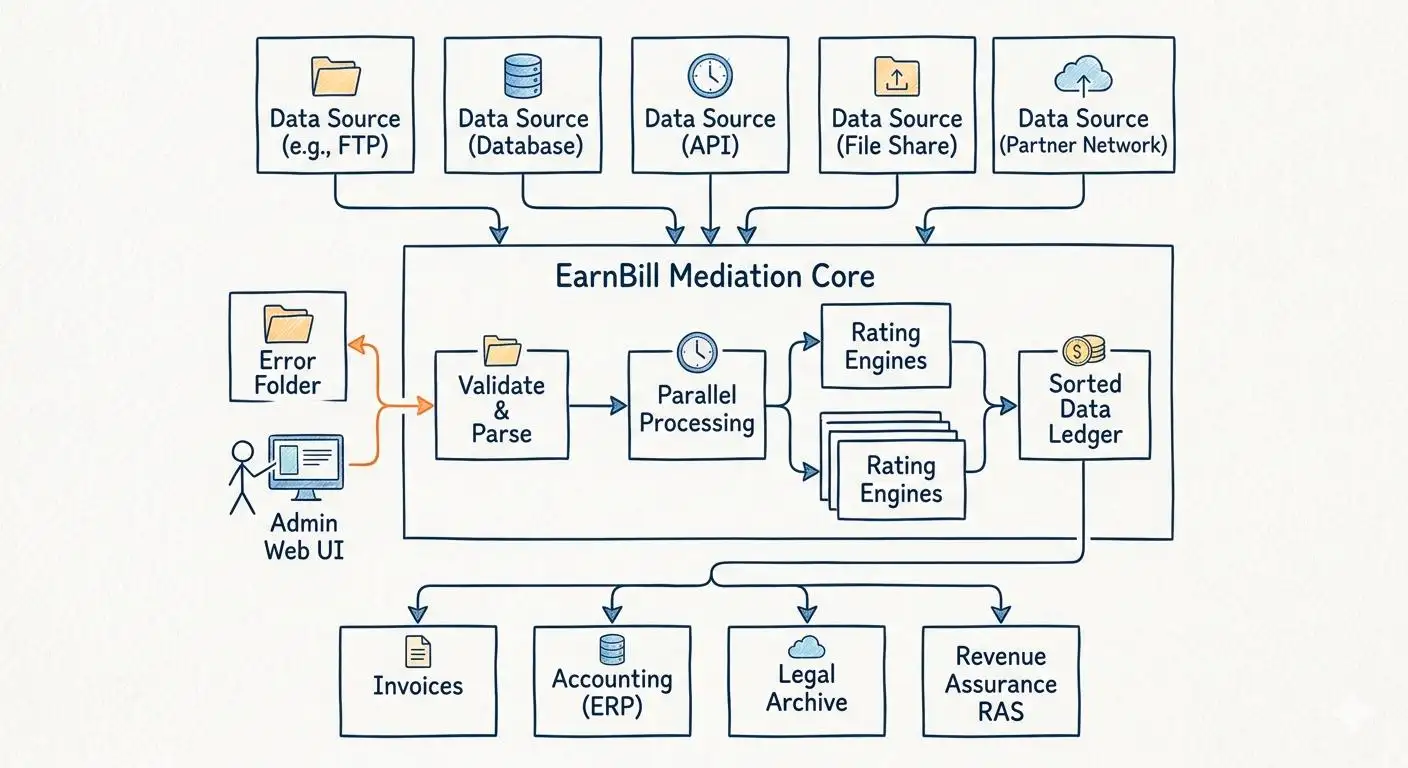
The EarnBill Advantage: EarnBill's native Billing Mediation System continuously listens to and retrieves data streams across multiple concurrent network layers (SFTP, relational databases, or partner REST APIs) without causing system latency.
Phase 2: Validation, Formatting, and Error Sorting
The Mid-Market Failure: If 2% of the incoming network records contain malformed fields (such as a missing timestamp or an unrecognized device identifier), the mid-market script chokes. It either drops the entire batch or ignores the broken lines completely. This is the definition of silent revenue leakage: unaccounted data disappears into thin air.
The EarnBill Advantage: As visualized in the operational data flow blueprint, EarnBill routes corrupted or un-required files into a dedicated, isolated Error Folder. Rather than halting the system, automated monitoring fires alerts while allowing the remaining healthy records to move through parallel processing pipelines seamlessly. Administrators can view, patch, and re-fire ad-hoc reports from the error logs through a secure Web UI, ensuring zero record destruction.
Phase 3: Parallel Processing and Rating Engine Aggregation
The Mid-Market Failure: To calculate a final invoice, a mid-market engine must load all historical rows sequentially into memory. This creates severe database row-locking. If the customer alters their billing tier mid-cycle, the engine fails to apply the retroactive pricing logic over historical 5-minute sampling intervals.
The EarnBill Advantage: EarnBill runs high-volume data through multi-threaded Parallel Processing layers. It splits mass datasets into optimized sub-streams, maps them directly against active pricing catalogs in the Rating Engine, and updates the central ledger instantly.
Why "Good Enough" Billing is Costing You Millions
When leadership looks at quarterly performance metrics, "unbilled usage" or "data reconciliation variances" are often dismissed as normal operational friction. However, at scale, the numbers tell an entirely different story.
The table below breaks down how fractional data dropouts compound across an enterprise contract portfolio over a single fiscal year:
| Operational Metric | Mid-Market Billing Engine Setup | EarnBill Enterprise BRM Platform |
|---|---|---|
| Data Ingestion Threshold | Maxes out at ~100k records/day before database row-locking | Native parallel processing scales to 10s of millions daily transactions with basic infrastructure |
| Error Handling Capability | Drops malformed logs or corrupts batches; requires manual script fixes | Automated Error Reporting & Isolation with ad-hoc re-firing |
| Average Revenue Leakage | 1.5% to 4.0% of total usage volume written off annually | Virtually 0% due to continuous loop revenue assurance |
| Financial Impact ($50M Portfolio) | $750,000 – $2,000,000 lost straight from net margins | Full revenue capture; completely audit-ready ledgers |
Eliminating the Leakage with Enterprise-Grade Architecture
Plugging revenue leaks is not achieved by hiring larger billing ops teams to manually verify data, nor is it solved by stacking patchwork software on top of an inadequate core. Protecting an enterprise bottom line requires an engine engineered from the ground up to master complex, high-transaction environments.
Built on the robust, battle-tested heritage of the jBilling core, EarnBill is designed precisely to eliminate these structural enterprise vulnerabilities.
Native High-Volume Mediation: EarnBill ingests and normalizes millions of CDRs and usage records effortlessly, removing the need for risky, slow batch processing or fragile external middleware.
Total Pricing Agility: Its flexible, open-core architecture easily handles hybrid billing models, 95th percentile burstable charging, and complex tiered pricing without requiring custom code overhauls or offline spreadsheets.
Built-In Revenue Assurance: EarnBill acts as a robust financial ledger, ensuring that every byte of consumption is tracked, rated, and verified automatically, providing leadership with absolute financial predictability and audit readiness.
Do not let an inadequate, mid-market billing engine cap your enterprise expansion, erode your hard-earned margins, or delay your time-to-market.
Book a tailored, high-volume EarnBill demo today to discover how we future-proof your revenue infrastructure and secure your bottom line at true enterprise scale.
Stop Revenue Leakage in Its Tracks
See how EarnBill's enterprise billing platform and billing mediation system eliminate revenue leakage at any scale.