
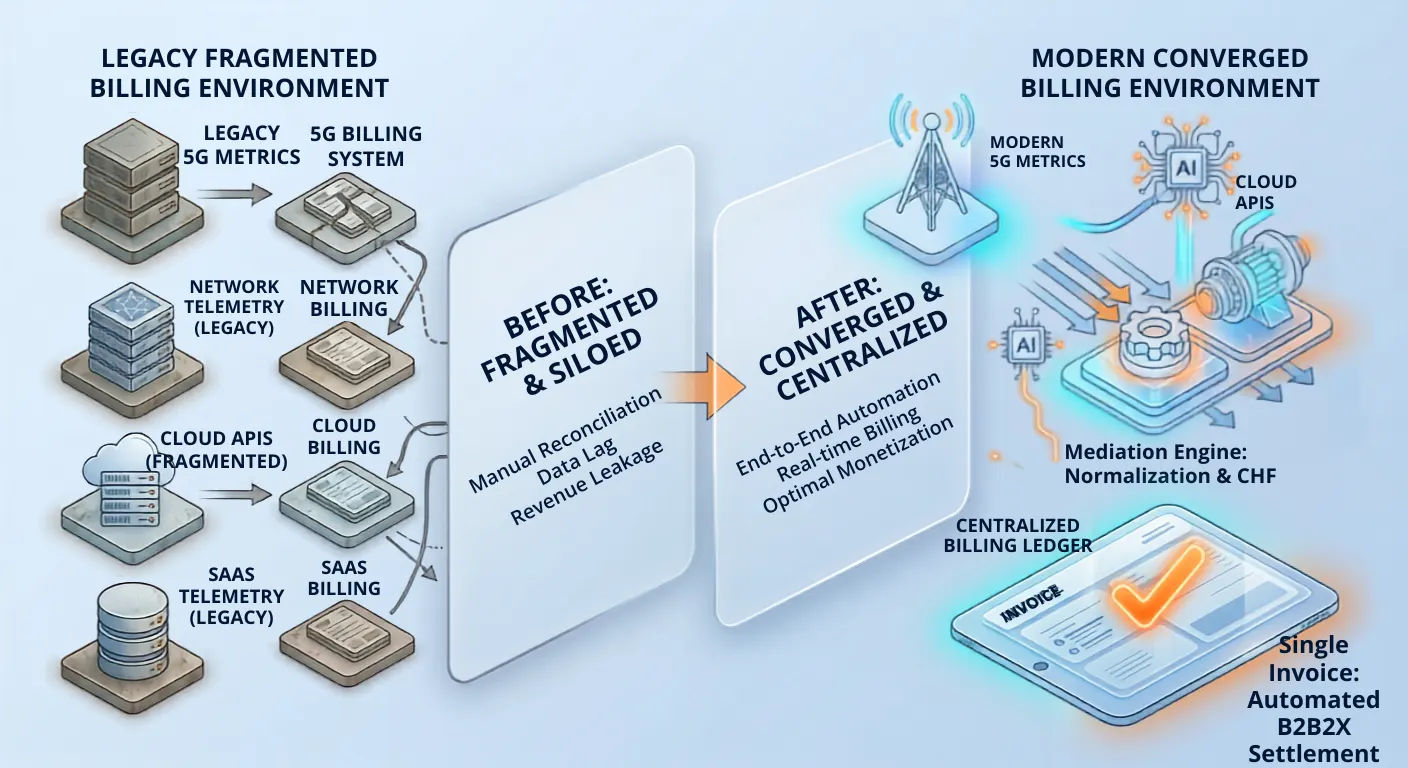
If your enterprise is blending 5G connectivity with hybrid cloud infrastructure, your legacy billing stack is likely leaking revenue every single second. Siloed billing engines simply aren't built for multi-domain convergence and it's costing you gross margins, inflating your DSO, and stalling your product agility.
Today, the playground has expanded exponentially.
We have entered the era of converged operators, where telecom connectivity, massive Smart IoT Networks, hyper-scalable Edge AI workloads, and highly complex Hybrid Cloud Platforms live under one roof. Devices are no longer just consuming data; they are triggering real-time edge computing workloads, streaming telemetry across private 5G Standalone (SA) slices, and orchestrating automated global B2B2X ecosystems.
For modern leadership, this convergence introduces a severe operational bottleneck: legacy billing engines cannot handle multi-domain convergence. If your business is blending physical connectivity with cloud infrastructure, relying on siloed billing systems is a major risk to your margins. To successfully monetize modern consumption business models, companies must transition to a true Hybrid Billing System.
The Architectural Flow of Modern Hybrid Billing
When network usage logs and cloud subscription data live in separate silos, your finance team loses real-time visibility. Moving to a unified hybrid billing ledger reduces closing cycles from weeks to hours, completely eliminating cross-border partner settlement friction and protecting your operating margins.
A modern Hybrid Billing Platform must seamlessly bridge the gap between high-velocity network events (3GPP protocols) and cloud-native application telemetry (REST APIs). It must ingest, normalize, and reconcile these two worlds in real time to prevent revenue leakage and keep Days Sales Outstanding (DSO) low.
Here is how a unified subscription and consumption billing architecture processes a mix of real-time network usage and postpaid enterprise cloud tiers:
| Stage | Process | Techno-Functional Reality |
|---|---|---|
| 1. Data Input | Unified Event Ingestion | Concurrently captures real-time 3GPP network events (GTP-prime, Diameter/HTTP2) from IoT assets and API telemetry from hybrid cloud gateways and Edge AI endpoints. |
| 2. Mediation | Real-Time Charging Function (CHF) | Correlates and normalizes disparate data formats (bytes, API calls, CPU hours, AI tokens) into billable units, filtering duplicates instantly. |
| 3. Unified Ledger | Convergent Rating & Balance Management | Evaluates events against complex multi-tenant hierarchies and contracts. Deducts from prepaid balances or appends to a postpaid enterprise account. |
| 4. Invoicing | B2B2X Settlement | Consolidates fixed subscriptions, real-time usage costs, and tiered volume discounts into a single, immutable invoice for clients and wholesale partners. |
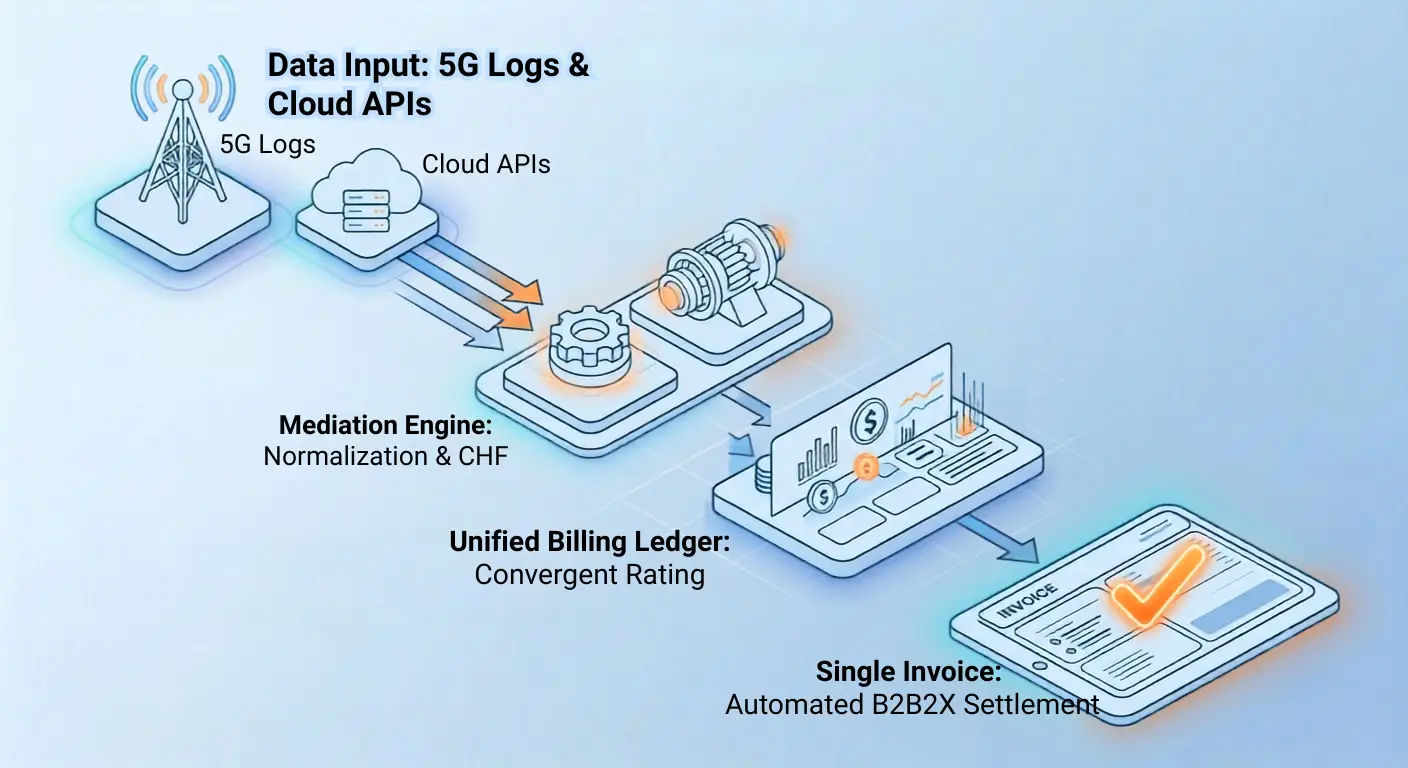
This flow ensures that no matter how complex the service bundle is, the customer receives a clean, transparent bill, and the finance team gets accurate, real-time revenue data.
The Clash of Two Worlds: Why Legacy Billing Fails
To understand why a unified platform is necessary, we must examine the fundamental architectural conflict between traditional prepaid and postpaid billing engines. Historically, telecom networks and cloud infrastructure platforms operated on completely separate software stacks.
1. The Real-Time Network Trigger (The IoT/MVNO Problem)
IoT devices and consumer MVNO SIMs operate with a risk of getting into a credit. If an IoT device runs out of its quota for prepaid data, the network must intercept and handle that event the exact moment the balance hits zero. This requires a real-time Online Charging System (OCS) or a 5G Charging Function (CHF) capable of processing thousands of low-latency updates per second.
2. The Complex Postpaid Tier (The Enterprise Cloud Problem)
Conversely, enterprise Hybrid Cloud services care very little about millisecond-level cutoffs. Instead, they care about complex contractual logic: volume discounts, multi-region tiered pricing, minimum spend commitments, and prorated mid-month adjustments. This processing typically happens via batch jobs at the end of a billing cycle.
When the Systems Collide
What happens when an enterprise customer buys a converged solution that includes both components? Consider a global logistics provider that bundles smart cellular tracking tags (IoT devices) with a high-performance cloud analytics platform.
If you attempt to stitch together a traditional real-time telecom billing engine with a standard SaaS subscription tool, the architecture cracks under the weight of modern ecosystem billing:
The Problem: The systems cannot communicate in a shared language. The real-time engine doesn't understand enterprise cloud tiering, and the subscription engine cannot handle real-time network balance exhaustion.
The Result: The business faces revenue leakage, the engineering team inherits heavy technical integration debt, and the end customer receives confusing, fragmented invoices.
Bridging the Gap with Prepaid and Postpaid Convergent Billing
A true Hybrid Billing System solves this structural conflict via prepaid and postpaid convergent billing. Instead of maintaining duplicate, synchronized databases for network balances and software subscriptions, modern convergent platforms utilize a single Unified billing ledger to act as the ultimate financial source of truth.
Let's look at a practical, real-world scenario that demonstrates how this architectural shift functions in a complex B2B2X ecosystem.
Practical Business Scenario: Scaling Billing for a Connected Fleet Ecosystem
The Scenario & Challenge
To understand how hybrid billing works in practice, consider a commercial fleet management provider operating thousands of connected vehicles across multiple regions. Each vehicle relies on three distinct technology layers: local Edge AI devices for driver safety monitoring, onboard telematics sensors sending continuous vehicle health data, and centralized cloud platforms for fleet routing and long-term analytics.
In a complex deployment like this, the core challenge lies in managing three distinct, highly variable billing streams:
- High-frequency micro-transactions from Edge AI event processing (such as real-time driver distraction alerts or immediate video snippet uploads).
- Variable telemetry usage measured by raw data volume (MB/GB) across multi-carrier SIM networks.
- Subscription-based recurring fees for central fleet management software and reporting dashboards.
Before Implementation: Fragmented Billing Workflow
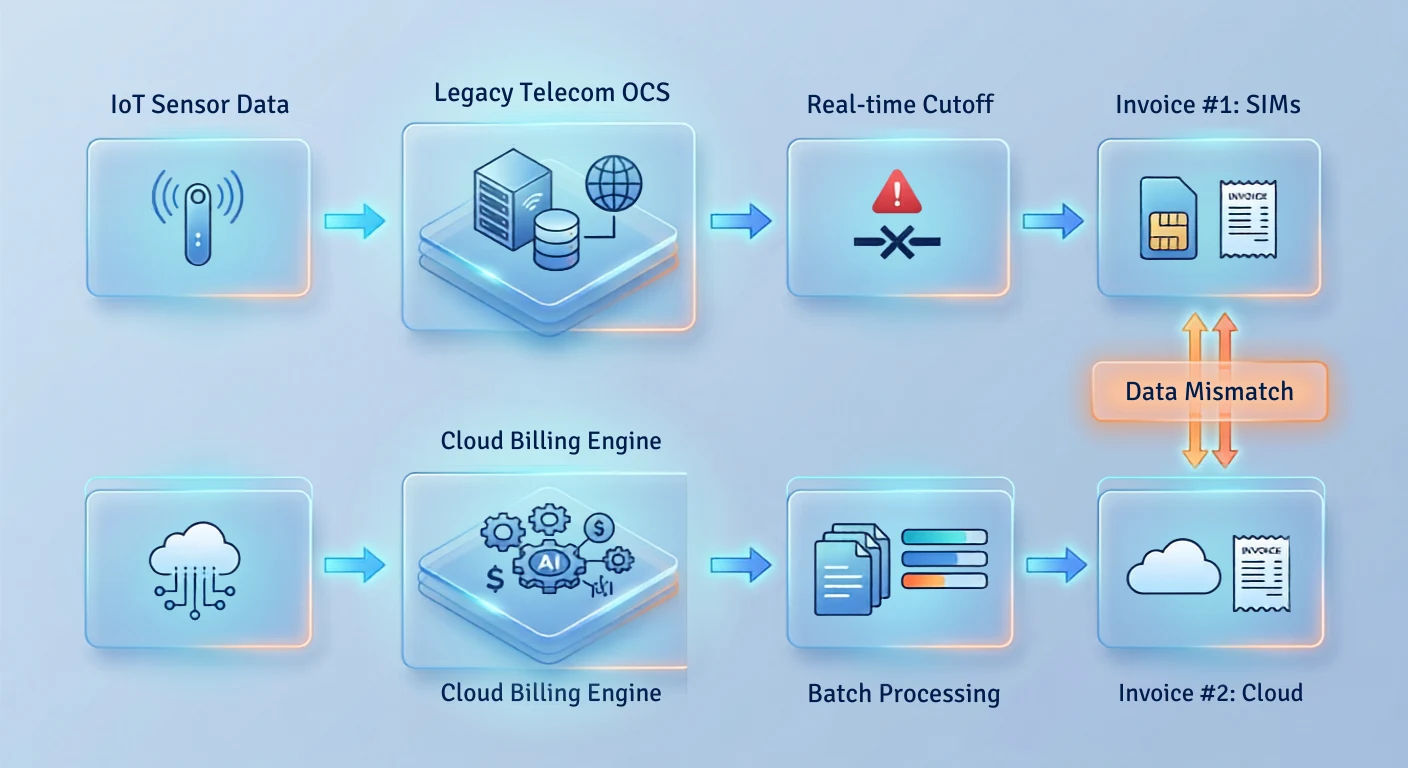
Without an integrated hybrid billing engine, a fleet management business typically faces a disconnected operational workflow:
- Data Disconnect: Telematics usage sits in telecom carrier portals, Edge AI event logs remain in local hardware management tools, and software subscriptions live in a conventional ERP or billing engine. If the service provider relies on the telecom carrier OCS system, and if a sub-fleet exceeds its prepaid cellular data limit, the telecom system abruptly suspends the SIM cards. However, the cloud billing engine would keep charging the client the full monthly postpaid subscription for the analytics dashboard, even though no data was flowing into it.
- Manual Reconciliation: At the end of every billing cycle, finance teams are forced to manually pull usage records from multiple sources, stitch them together using spreadsheets, and attempt to rate usage against custom enterprise contracts.
- Partner Settlement Confusion: The solution providers rely on third-party roaming partners for international tracking. Manually reconciling the wholesale partner data costs against the cloud usage tiers could take the finance team over 15-20 days after the month end, affecting their Days Sales Outstanding (DSO).
- Billing Leakage and Delays: Because edge usage is disconnected from central billing, high-usage spikes or unexpected edge alerts go unrated until weeks later, leading to billing disputes, delayed payments, and unrecoverable revenue leakage.
The Solution
Relying solely on a traditional Telecom OCS (Online Charging System) often leaves fleet and IoT providers stuck. Telecom OCS platforms were built to handle standard connectivity sessions: data, voice, and SMS. They simply lack the flexibility to ingest and rate non-telecom revenue streams like Edge AI processing fees, hardware micro-events, or multi-tiered SaaS subscriptions. Without a platform that provides true hybrid, convergent billing capabilities, providers are forced to build fragile custom workarounds that limit financial visibility and complicate accounting.
This is where a modern monetization platform becomes essential; one built specifically for complex digital solutions that require deft handling and the seamless convergence of different charging streams into a single account. EarnBill fills this gap, offering full automation alongside fine-grained control over ledger reporting and financial accuracy.
EarnBill addresses this practical challenge by delivering a unified, scalable hybrid billing architecture designed specifically for multi-layered IoT platforms.
- Edge-Level Rating: EarnBill's lightweight edge rating agent processes dynamic event triggers directly on the vehicle gateway (e.g., instant charging for premium video verification requests).
- Cloud-Based Aggregation: Bulk data consumption and recurring software subscriptions are ingested and processed centrally.
- Unified Converged Engine: Both real-time edge triggers and batch cloud data feed into a single rating platform, ensuring every charge is consolidated under a single customer account against customized rate plans.
After Implementation: Converged Hybrid Billing Workflow
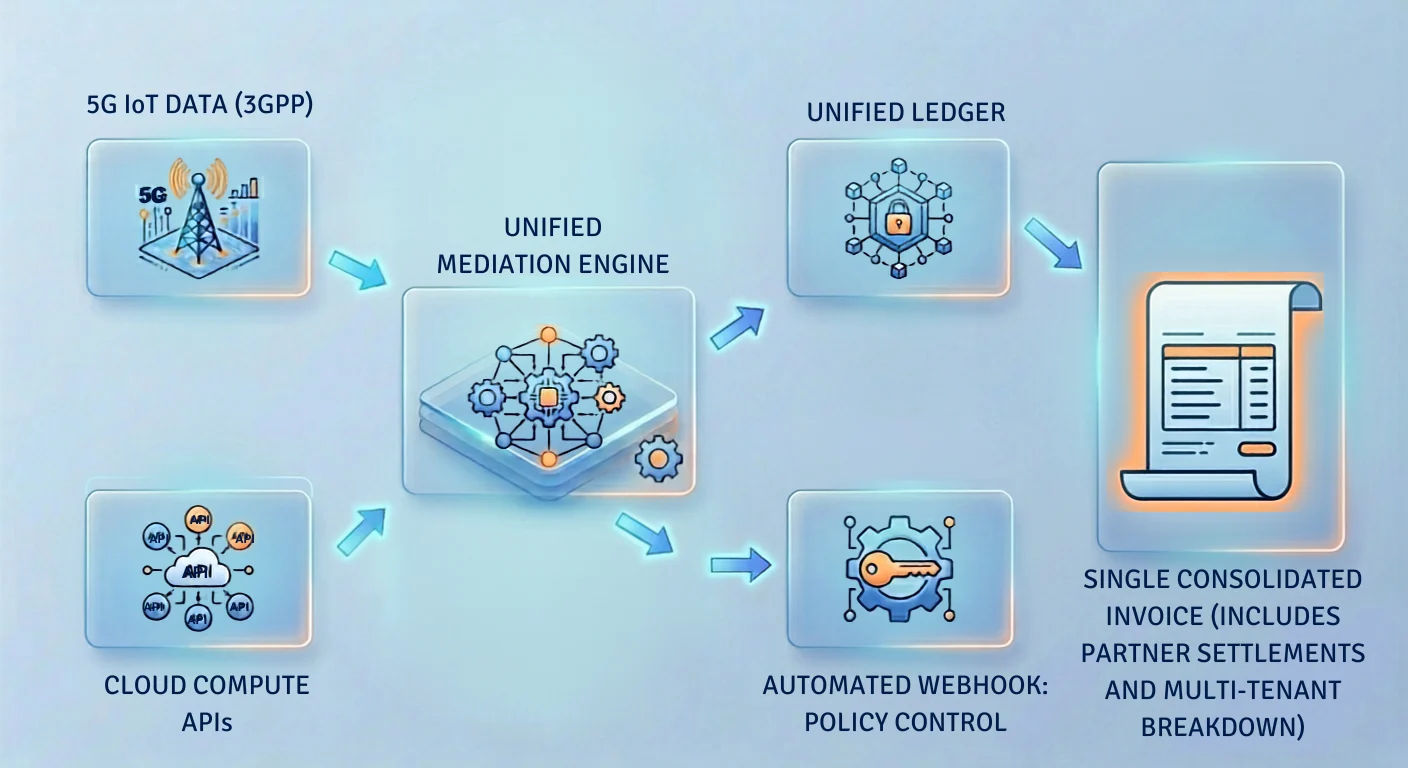
When structured around EarnBill's converged model, the billing workflow becomes streamlined, automated, and predictable:
- Real-Time Event Ingestion: Edge event triggers and telemetry streams are instantly captured and rated at the source or via high-throughput cloud APIs.
- Automated Policy Control: Real-time credit limits and usage thresholds dynamically notify administrators or temporarily restrict bandwidth before unexpected overages occur.
- Consolidated Invoicing: At the end of the billing cycle, the system automatically generates a single, itemized bill reflecting recurring SaaS subscriptions, variable telemetry usage, and event-driven edge fees.
The Outcome
By implementing EarnBill in a multi-tiered IoT business model, a fleet provider can achieve significant, measurable operational improvements:
- Eliminated Rating Lag: Real-time data processing removes end-of-month reconciliation bottlenecks entirely.
- Plugged Revenue Leakage: Automated event rating guarantees that every edge alert and megabyte of data is captured and accurately billed.
- Improved Cash Flow: Automated, accurate invoices minimize customer disputes and substantially reduce DSO (Days Sales Outstanding).
- Flexible Monetization: The business gains the agility to launch new pricing models such as pay-per-safety-event or tiered regional telemetry plans without overhaul of their underlying billing infrastructure.
What the Business Needs to Consider
Upgrading a core billing engine is a major strategic decision. Each business, engineering, finance and operations stakeholder views this transformation through a distinct lens. A unified hybrid billing system addresses these priorities directly:
1. Business: Market Agility and B2B2X Monetization
To capture new market share, your product teams must have the freedom to experiment. If a product manager wants to launch a bundle that combines 200 hours of Edge AI processing, 10,000 IoT connections, and a flat-rate enterprise software license, the billing platform cannot be the bottleneck. A unified hybrid system eliminates time-to-market constraints, transforming billing from an administrative headache into your primary growth engine.
2. Engineering: Zero Technical Debt and Standards Compliance
Maintaining separate platforms for network and cloud workloads results in a fragile web of custom integrations and sync scripts. A modern hybrid platform reduces architectural complexity by supporting both 5G network elements and cloud frameworks out of the box. Alignment with TM Forum Open APIs ensures that the platform drops seamlessly into your existing OSS/BSS landscape without requiring a high-risk rip-and-replace project.
3. Finance: Real-Time Accrual Visibility and Margin Protection
Siloed billing leads to fragmented financial data. When usage logs live in one system and subscription records live in another, auditing for ASC 606 / IFRS 15 compliance is incredibly labor-intensive. A Unified billing ledger provides an unalterable, real-time audit trail. It ensures you track unbilled revenue dynamically and automates complex partner settlements, protecting your gross margins from hidden costs.
4. Operations: Process Automation and Customer Retention
The operational cost of resolving billing errors is a massive drain on support teams. If an enterprise customer receives multiple conflicting invoices, or if automated network cutoffs are triggered accidentally due to sync delays, customer trust erodes immediately. Streamlining operations into a single, multi-tenant invoice improves user experience and dramatically reduces operational overhead.
Moving Beyond Legacy Limits
As Smart IoT, Edge AI, and Hybrid Cloud technologies continue to merge, the underlying business models will only become more intricate. Relying on patchwork billing systems designed for simpler digital solutions is no longer a viable option for growing digital service providers.
Investing in a comprehensive Hybrid Billing System equips your enterprise with the agility to launch creative pricing models, the control to stop revenue leakage, and the scalability to handle immense data volumes. It bridges the gap between real-time network realities and complex enterprise accounting, ensuring your infrastructure is built to scale profitably.
Don't let rigid architecture stall your 2026 revenue goals. Contact our team today to see how EarnBill simplifies complex subscription and consumption models at scale.
Unify Your Billing Across IoT, Cloud, and Telecom
See how EarnBill's hybrid billing platform converges prepaid and postpaid billing into a single ledger with real-time mediation, B2B2X settlement, and TM Forum Open API alignment.