
Marketing Strategies:
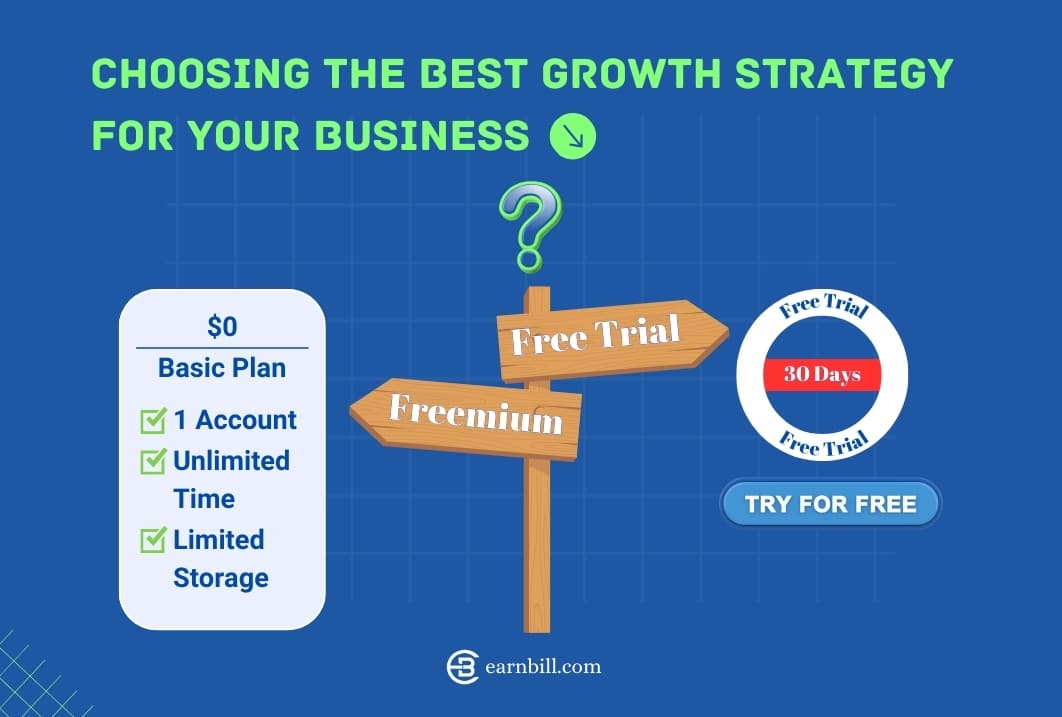
"Freemium Vs Free Trials" is a question a lot of companies still have to consider at some point. Freemium and Free trials are some of the most popular acquisition strategies, which are part of the product marketing cycle. They are exceptional in building brand awareness, provide exponential growth, reducing marketing costs and the time to market.
Freemium model is a customer acquisition strategy where basic features are offered for free and more advanced features are offered for a premium.
Users basically get to try out a new product for an unlimited amount of time and make a decision on whether or not to purchase a premium version of the same product.
On the other hand, in a Free Trial customer acquisition strategy, the user is offer basic or all features for free for a limited amount of time. This way, users get to try out the service before making the purchase decision.
Both Free trials and Freemium strategies work a lot better than a traditional sales model, where a demo is provided to the customer, because the prices are kept exceptionally low and prevent competitor equalization, for a specified time period.
Freemium Vs Free Trials: Find your Best Strategy
These are tremendously popular on-boarding strategies for desktop and mobile softwares and applications.
In both of these models, users can explore your product and see if it works for them at no cost. These strategies compete with each other in terms of freemium, flexibility, and function for which they are offered.
Is Freemium Pricing Strategy right for you?
Freemiums do not have a time frame for which the service remains free. Freemium thrives in a highly competitive and distributive market. If you are a start-up, freemium could end up costing you a lot of money. If you do not have an existing user base or the brand recognition, you can not stay in the red long. Think data cost! Information for a freemium service. Customers need to purchase the premium version to get the features in addition to the free features, in the basic version. If you can structure your business around it, a freemium model is a great way to get people through the door.
Key Advantages:
- Creates a bigger barrier for users to convert - it cannot be a niche service with a tiny audience
- If you end up going away the service for free to those not willing to pay and pay for it, freemiums creates a greater incentive for the user
- To build their means around the free service, if it means they can continue to use it for free
- There are a lot easier to buy it from the freemium version as they are already getting familiar with it
- B2B SaaS model has a lot of valuable services greater tendency to be users, empowering them not giving up overall better user experience
This strategy needs a bigger market for users to convert. It cannot be a niche service with a tiny audience or you will end up giving away the service for free to those that willing to pay and pay for it. Freemiums creates a greater incentive for the user to build their needs around the free service. If it means they can continue to use it for free. There are a lot easier to buy it from the freemium version as they are already getting the free service, empowering them not giving up overall better user experience.
Is Free Trials Pricing Strategy right for you?
The idea behind Free trials is to demonstrate the value of the product to the customer and lead them to a purchase. Free trials usually allow the users access to all or almost all features of the service, for the specified time. Users will be charged for the premium version, if they do not cancel their subscription post the Free trial period. The users assume the risk of maker the purchase decision, while actively using the product, as opposed to other models; such is a one-time product demo. Free trials gives a higher conversion rate, of 5% to 25% also in the industry that a creates because of this deadline.
Critical Considerations:
- Since it has a higher conversion rate, the market also can be a bit smaller than the freemium base
- This deadline also makes the free trial effective for a lot of monetarily engaged users
- Both of which could have been converted
It requires additional personal information from the users, including the payment information, in order to activate the free trial. They generally ask the price of what the freemiums provide, to the free trial users offers the full product with refining to UI feature limitations or the toleration is to the free frame. Trials end within the specified time. Usually 1 week to a month. For organized people, this is no problem. But for beta people, it makes an atmosphere of pressure and can affect their assessments.
Questions to Ask from Users:
- → Additional information can be gained from the users with an end-of-trial survey, where if they are trying to cancel the free trial, they can be asked for the reasons.
- → It will include questions like: Was the product too expensive?
- → Were the features inadequate?
- → Was the time duration too short?
- → Other reasons (where they can be prompted to specify)
The Best of Both Worlds:
There are various hybrid models which combine the best qualities of both of these strategies. Below are the 2 most common models.
➜ Freemium with a Free Trial
If you have a lot of features within your service, you can live the user in with a freemium offering where they get a lot of value and combine that with a free trial for the premium version with the additional or standard features. This allows the user to experience the features before they decide to upgrade.
➜ Free Trial with a Freemium
If the user decides to end a trial without making a purchase, they can be offered a freemium version of the service with the basic features, as a form of advertisement. This way the user can be lured in and be prevented from going to a competitor for the service.
Overall, both freemium and free trials come with their own set of Pros and Cons. These need to be assessed by individual procedures as each of them have their own unique set of needs operating under unique environments and circumstances.
Key Takeaways:
Quick Comparison:
Ready to Choose Your Strategy?
EarnBill supports both freemium and free trial models with flexible billing automation to maximize your conversions