
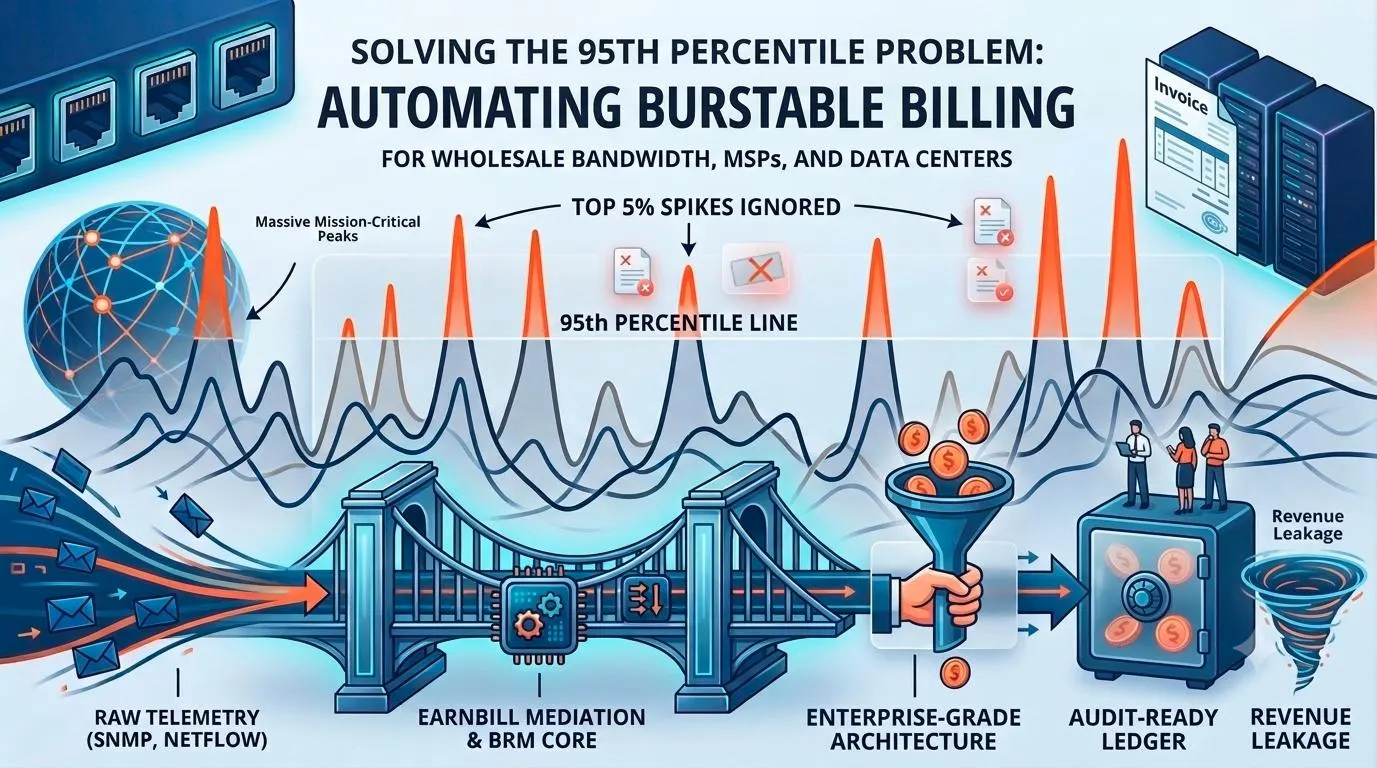
For Wholesale Telecommunications providers, Managed Service Providers (MSPs), and Tier-3 Data Centers, bandwidth is not just an infrastructure component, it is the lifeblood of the commercial product catalog. Unlike standard software-as-a-service (SaaS) models that thrive on predictable, flat-rate monthly active user counts, enterprise network utilization is inherently erratic. A client operating a global logistics network or a high-frequency trading platform does not consume bandwidth in a flat, uniform line. They operate in valleys occasionally punctuated by massive, mission-critical peaks.
To accommodate these fluctuations without forcing clients into prohibitively expensive, over-provisioned fixed contracts, the industry standard relies heavily on a flexible model: burstable billing using the 95th percentile method.
On paper, the mathematical logic of 95th percentile charging is elegant. It allows network operators to ignore the top 5% of temporary usage spikes, billing customers instead on their sustained peak usage. However, translating this mathematical concept into an operational billing lifecycle at an enterprise scale exposes a dangerous friction point. Many expanding network providers attempt to force this highly technical network-layer logic into rigid, mid-market billing engines or homegrown scripts.
The result is a structural failure. When a billing engine cannot natively process high-volume network telemetry data, it leaks revenue, creates catastrophic invoice dispute cycles, slows down market velocity, and introduces severe financial audit risks. To secure corporate margins and protect capital efficiency, infrastructure leaders must move past manual workarounds and deploy a billing architecture engineered to bridge the gap between complex network engineering and institutional financial ledgers.
1. The Engineering Crisis: Ingesting Telemetry at Scale without System Choking
From an architectural standpoint, the 95th percentile model represents a data ingestion nightmare for conventional billing platforms. Every single leased line, port, and cross-connect across a global network infrastructure continuously generates usage records. To calculate a single customer's 95th percentile metric over a standard 30-day billing cycle, a network must capture utilization logs, typically via SNMP or NetFlow, at strict 5-minute sampling intervals.
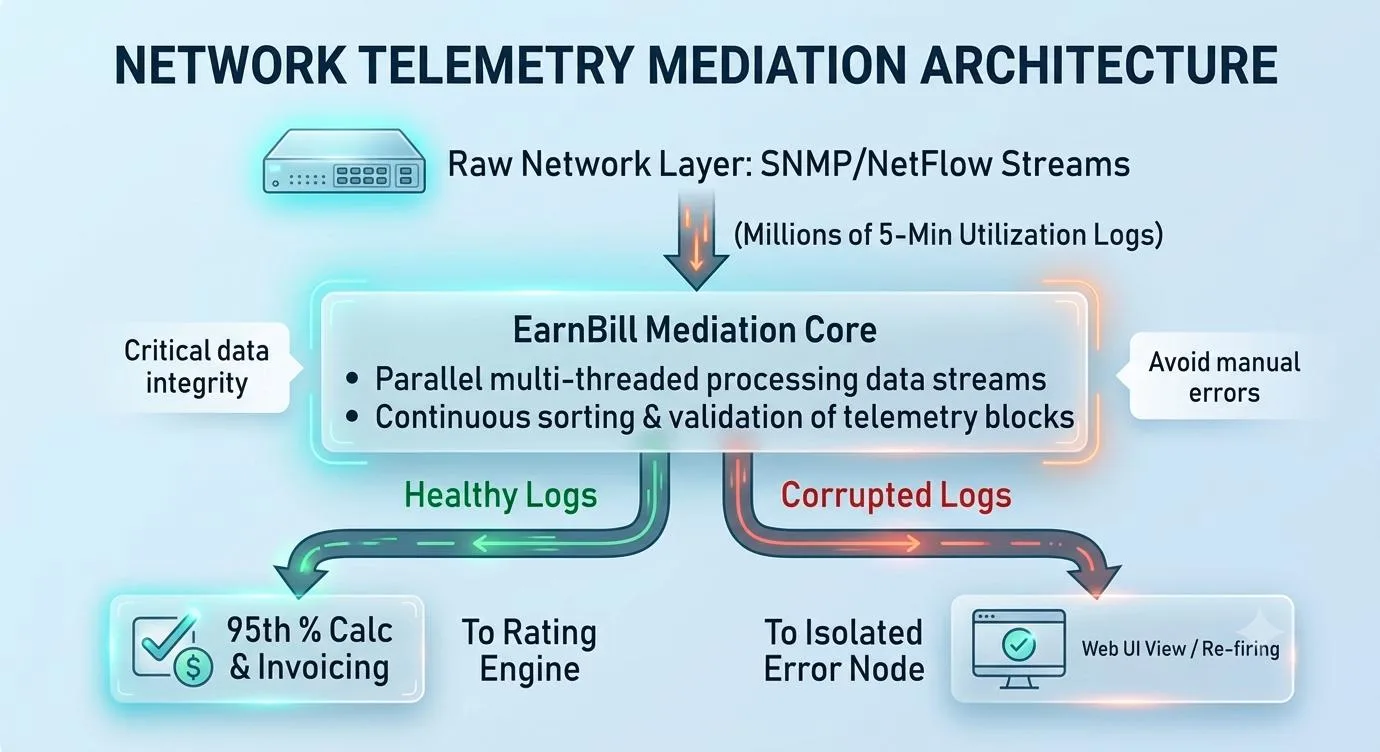
For a single enterprise account, this translates to 8,640 distinct data points per month. When scaled across a portfolio of hundreds of enterprise clients utilizing multi-port architectures, the data volume easily explodes into tens of millions of raw database rows.
Mid-market subscription engines simply lack the structural architecture required for native data mediation. When fed millions of raw usage events, their databases experience severe row-locking bottlenecks and CPU choking. To circumvent this infrastructure limitation, operations teams usually build custom, external scripts to pull data from network monitoring systems, run calculations offline, and manually dump a single aggregated number into the billing engine at the end of the month.
This makeshift architecture introduces immense vulnerability. If an external script encounters a minor runtime error, a malformed timestamp, or a dropped packet from a core router, the entire batch calculation fractures. Basic billing tools react to dirty data by crashing completely or silently dropping the unreadable rows. This represents an unseen revenue leak. If a system cannot guarantee that 100% of network logs are accurately retrieved, validated, and normalized, an organization is actively donating free, unmetered wholesale bandwidth to its largest clients, directly eroding infrastructure margins.
2. The Operational Friction: Eliminating Manual Disputes and Spreadsheet Dependency
In a competitive market environment, operational agility is a primary differentiator. When a sales organization secures a major wholesale contract, they win by offering customized pricing structures: variable baseline commitments, regional tiering, or custom caps on burstable ceilings.
However, if the backend infrastructure relies on rigid billing codebases, this commercial creativity turns into an operational nightmare. When forced to handle complex, multi-tiered leased line billing agreements, standard software structures break down. Because the system cannot automatically align raw 5-minute intervals with bespoke, multi-tiered contract rules, the fulfillment team is pulled into an ongoing cycle of manual intervention.
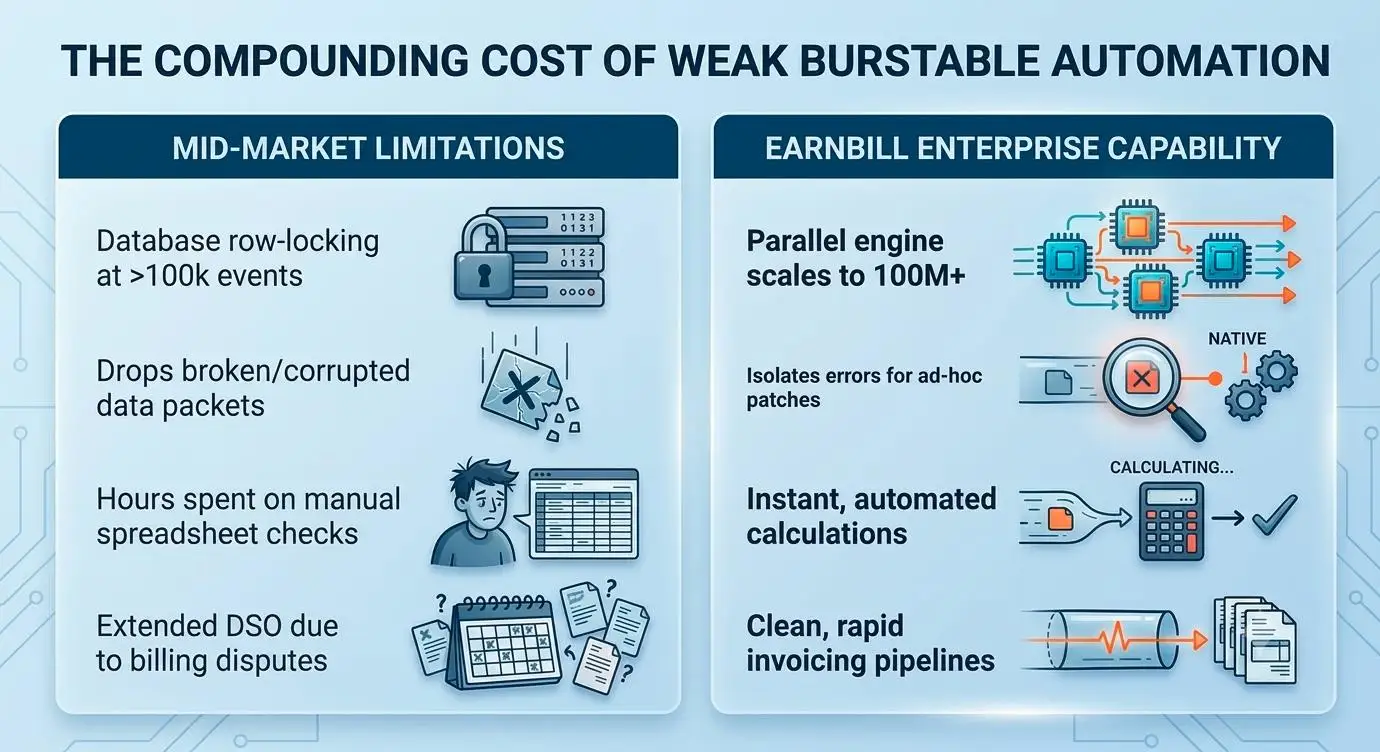
Highly technical personnel spend valuable hours downloading data blocks, cleaning them inside offline spreadsheets, and manually cross-checking calculations against paper contracts before an invoice can be finalized. This excessive manual handling dramatically extends Days Sales Outstanding (DSO) and stalls corporate cash flow.
Worse, invoices produced through manual workarounds are prone to human error. When an enterprise customer receives a high-value invoice that lacks transparent, granular usage reporting, their procurement team immediately raises a formal billing dispute. Accounts receivable processes grind to a halt as teams spend weeks tracing log history to prove usage validity. A business cannot scale its market presence efficiently if its core operations team is stuck retroactively auditing past cycles rather than deploying new revenue-generating infrastructure.
3. The Financial and Legal Reality: Audit Risks and Sub-Ledger Control
From a financial compliance perspective, a revenue pipeline must be transparent and verifiable. Every dollar of recognized revenue must be auditable back to the exact network event that generated it.
Standard mid-market subscription engines treat billing as a surface-level invoicing tool rather than a compliant financial ledger. They accept total numbers pushed from external systems without maintaining an internal, step-by-step audit trail of how those figures were generated.
During rigorous external financial, security, or SOC 2 Type II audits, this lack of structural transparency represents an immediate compliance risk. If an auditor asks to see how a $150,000 burstable invoice was calculated for a specific quarter, a patchwork system of custom scripts and manual spreadsheets cannot provide an unalterable, compliant proof-chain.
Furthermore, minor discrepancies like rounding variations during multi-currency international billing or misapplied local telecommunication taxes slip through unmonitored. Across a high-volume wholesale portfolio, a fractional variance of just 1% or 2% can quietly accumulate into hundreds of thousands of dollars in annual losses. True financial oversight requires an automated sub-ledger that continuously cross-references raw telemetry packets against active contract tariffs before any data is posted to the corporate General Ledger (GL).
Streamlining the Core: How EarnBill Automates 95th Percentile Billing
Resolving the complexities of 95th percentile charging cannot be achieved by adding more manual checkpoints or stacking brittle middleware onto a platform built for simple subscriptions. It demands an enterprise-grade Billing and Revenue Management (BRM) engine engineered specifically for high-volume, consumption-heavy environments.
Built on the robust core of jBilling, EarnBill bridges the gap between complex network operations and corporate financial accuracy.
Native Network Telemetry Mediation: EarnBill continuously collects, normalizes, and validates raw SNMP, NetFlow, or API data streams directly from the network layer. Malformed data is automatically isolated in a dedicated error folder for ad-hoc remediation, ensuring zero record destruction and plugging hidden revenue leaks.
Automated 95th Percentile Calculations: The rating engine runs multi-threaded parallel processing streams to sort millions of usage logs into exact 5-minute intervals. It automatically removes the top 5% of usage spikes and accurately computes burstable overages against complex pricing structures without requiring offline scripts or manual workarounds.
Robust Revenue Assurance: Acting as a compliant financial sub-ledger, EarnBill maintains an unalterable audit trail from raw telemetry ingestion to the final line-item invoice. It connects seamlessly with your corporate ERP, reducing invoicing errors, lowering DSO, and ensuring total audit-readiness.
Do not allow rigid, mid-market billing limitations to cap your network growth, stall your operational velocity, or erode your infrastructure profit margins.
Book a customized high-volume EarnBill demo today to discover how we automate complex burstable billing and secure your revenue pipeline at a true enterprise scale.
Automate Burstable Billing. Eliminate Revenue Leakage.
See how EarnBill's enterprise billing platform natively handles 95th percentile calculations, billing mediation, and revenue assurance at wholesale scale.