
ISP Billing
Middle East ISP: 3x Capacity
High-performance OCS with millisecond response times
Read Case Study →A phased implementation story of how a full-fledged Australian telecom company consolidated mobile, internet, VOIP, and fixed-line billing across multiple brands on a single platform and doubled revenue within three years.
 Australia

This is a case study of a full-fledged Telecom Billing System implemented in Australia. The telecom company provides its subscribers with various telecom services. Mobile services, internet services, fixed-line services, and VOIP. For each type of service, they had 2 or 3 different service providers (carriers) who were providing the underlying networks and infrastructure. As such, this telecom company can be categorised as an MVNO (Mobile Virtual Network Operator) if you consider only the mobile services.
All services were essentially postpaid services, but with prepaid subscriptions. Customers paid for their service at the end of the billing period after receiving the invoice containing their usage charges and plan fees. On the invoice, the plan fee was charged in advance (prepaid) and the usage charges were per actual usage charged in arrears (postpaid).
This case study can be framed as a case study of a postpaid billing solution, also an MVNO billing solution, and a multi-brand billing solution . As there were multiple brands under one company. The implementation does not use the multi-tenancy feature of the system; instead, it meets multi-brand requirements through a single tenant. For a case study on a multi-tenant billing system, refer to the Multi-brand Call Center case study.
Implementing billing for a full-fledged telecom is rarely straightforward. This engagement involved a combination of data migration, multi-brand complexity, deep carrier integrations, and strict compliance requirements. All to be delivered in a phased, live-production rollout.
The client was using an existing billing system and the data was migrated to EarnBill. A simple set of CSV file formats were provided by the EarnBill team for this purpose. The CSV files were generated for customers, subscription orders, one-time fees, pending balances, historical invoices, recurring payments, and payment instruments like credit cards and bank accounts. A standard migration utility was used to load the data from these CSV files into the EarnBill system.
The following diagram illustrates the phased implementation plan for the solution. From the initial Internet Services brand through to a full multi-brand telecom operation.
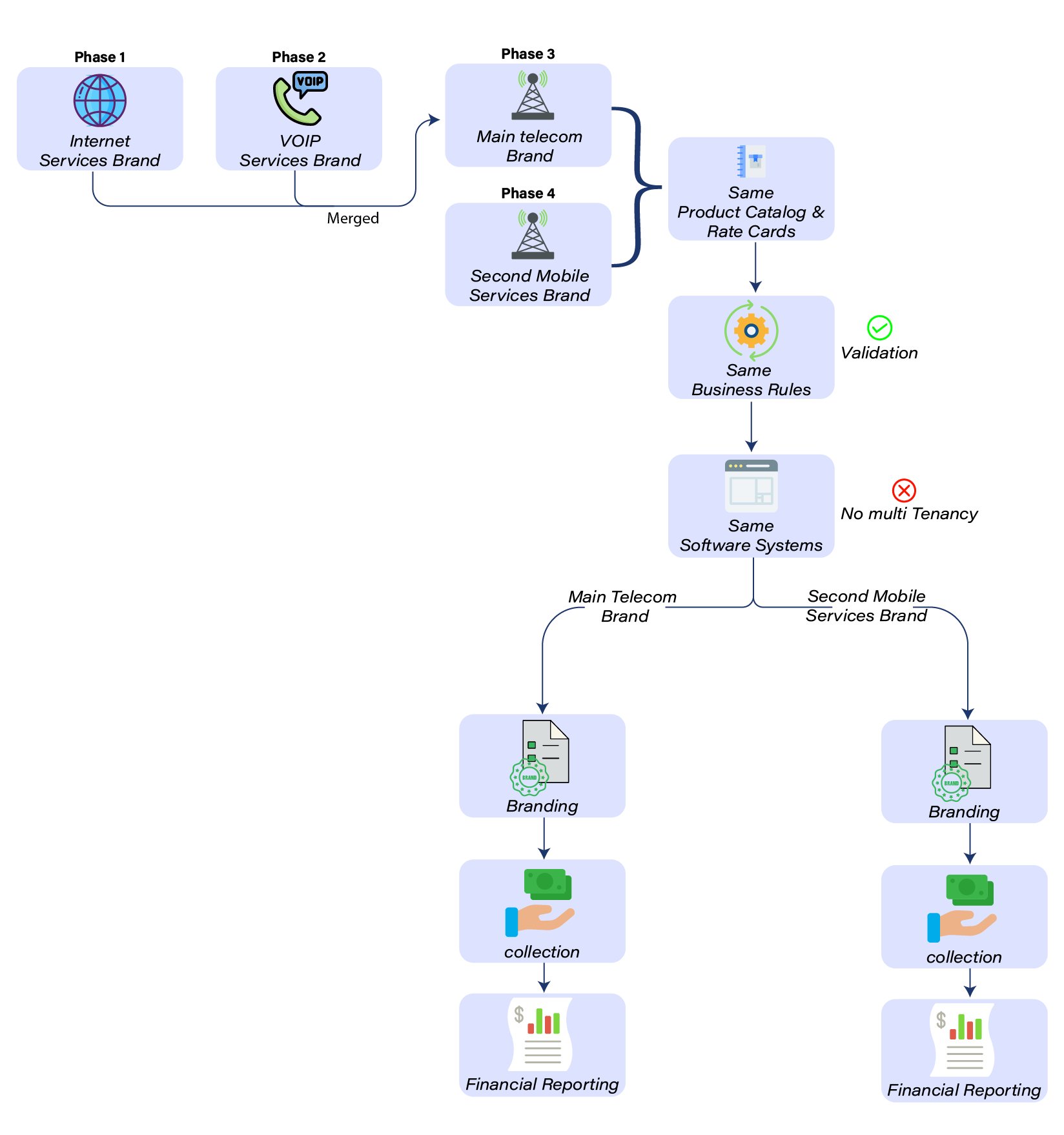
Multi-brand Billing under the umbrella of Same Entity with Same Business Rules
The project started with one of the sub-brands being made live with subscription billing. This sub-brand was offering internet services in Australia. It did not have any consumption (usage) based billing. Only the recurring charges for plan fees. This was an easier brand to make live, with only a couple of customisations.
The custom work included:
The next phase involved making the VOIP services brand live. This project included data migration, changes to the invoice design, and support for each subscription to have multiple VOIP numbers linked on them.
It was also possible to add new VOIP numbers to an existing subscription by paying for each extra number. The billing involved recurring billing based on plan fees and some recurring charges for additional VOIP numbers.
This was the main Telco brand with subscribers across mobile services, fixed-line services, VOIP services, and internet services. It was the biggest brand with the largest number of subscribers. Different carriers provided the underlying network infrastructure. These services included subscription billing as well as usage billing.
There were about 5 carriers catering to various services, with 2 key mobile network operators. The carriers and MNOs provided mediation files to process usage charges for end customers. There were about 12 different mediation file formats. This was the largest integration effort in the project.
At this juncture, the in-house CRM integration was made live. This integration mainly included:
A year after going live with the main Telecom brand, a new pan-Australia mobile services brand was launched. This involved new branding for invoices and notification messages, a different payment gateway merchant account to collect payments, and changes to support new mobile plans.
This brand was launched within 2 months of initiating the project and increased the client's business by approximately 70% over 2 years.
The uniqueness of this Telecom Billing implementation is that it allowed multiple brands to coexist within the same entity in the billing system. The system could be customised so the client could acquire different brands and merge them under one entity. All 3 brands were live under the same brand and in Phase 4, a new brand was launched using the same entity without using the multi-tenancy of the system. From a system point of view, all brands needed to be applied with the same business rules and offer similar plans and rates, but for the outside world and customers, they appeared as different companies with separate invoice designs and payment collections.
This phase streamlined certain system aspects, resolved pending issues, and delivered new features. Key improvements included:
EarnBill (formerly jBilling) Cloud was deployed with client-specific customisation, following a structured delivery model that covered design, development, configuration, and long-term operational support.
A stable and scalable implementation for the Telecom Billing System that grew alongside the business across all 4 brands and service types.
Reduced capital and operational expenditure compared to the previous system and other competitive Telecom Billing offerings in the market.
The system scaled with increased business volume. The second mobile brand alone increased client business by approximately 70% within 2 years of launch.
Annual revenue growth of over 100% was achieved within a 3-year period, driven by the ability to launch new brands and services rapidly on the same platform.
Starting with a simpler brand (internet services only) allowed the team to validate the platform, refine the customisations, and build operational confidence before tackling the more complex main telecom brand.
Running multiple customer-facing brands under a single billing entity (same business rules, shared product catalogue, but separate branding and payment collection) is a powerful and cost-effective approach when the underlying operational model is consistent across brands.
Daily automated functional checks and operations monitoring alerts help catch billing or rating issues before they reach customers. Preserving both revenue integrity and customer trust in a postpaid model where errors surface late.
See how EarnBill handles multi-brand telecom billing, carrier mediation, and postpaid workflows at scale.