Invoice generation in the telecom billing world means producing invoices for customers for the services that they have availed of, so that customers can pay their bills. This includes usage data collection and aggregation, pricing rules application, cost calculation, and generation of an invoice with presentable transactions for a specified billing period.
What's the Invoice Generation Process for Telecom Billing?
In the context of telecommunication billing, invoice generation is the process of compiling a bill for various applicable charges related to the service, its additional usage, adjustments, and previous dues for a specified billing cycle.
A typical invoice usually comprises the below details:
The objective is to make sure that there is transparency and correctness in the way billing is done and to provide a detailed breakdown of charges.
Invoice Generation Process in Telecom Billing
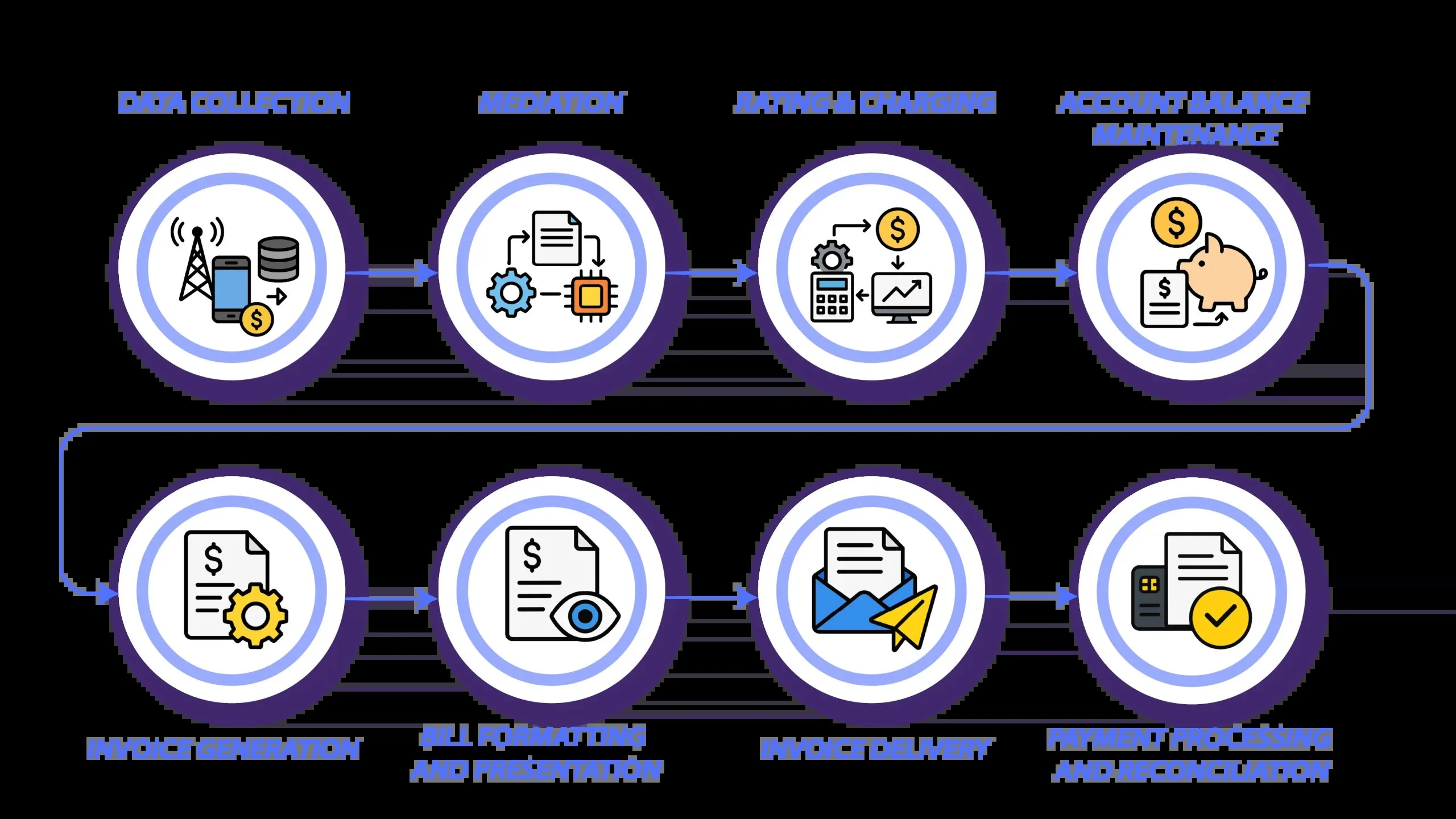
In the telecom billing system, the process of generating invoices follows an almost universally defined workflow, which more consists of the following:
1Data Collection
This step gathers raw usage data from telecom networks along with transaction data related to customers and sends it to downstream systems like billing or analytics for more processing.
- Call Detail Records (CDRs)
- SMS records
- Data session logs
- Roaming usage
- Value-added services
- Prepaid top-ups or postpaid subscriptions
- Promotions or discounts applied
The collection can be real-time or batch from network elements or service platforms.
2Mediation
The collected usage data is standardized and validated through a process referred to as mediation, ensuring that:
- The uniform format exists across all service types
- Duplicate or invalid records are removed
- Data is aggregated for high transactions
In other words, mediation is the act of data preparation for rating and charging.
3Rating & Charging
Post-mediation process, the rating engine takes care of calculating the cost of opted services and usage as per tariffs and billing rules. This includes:
- Initiating rate plans (for example, 0.10/min, 0.05/MB)
- Free usage (for example, 100 free SMS)
- Discounts or Rewards to the customer
- Overage charges
The charges are, thus, appropriately applied to the customer's account as per profile, service type and pricing model.
4Account Balance Maintenance
This step ensures that the recent charges are reflected in the customer's account.
- Postpaid bill for the amount owed
- On prepaid accounts, deductions may appear if applicable (i.e., for advance billing or recurring fees)
Also considered in the current context are adjustments due to refunds, credit for services and penalties.
5Invoice Generation
Now that all the valid charges and adjustments have been collated or worked on, the invoice document may be proceeded with then:
- Invoice number and date
- Account ID for the customer name
- Start and end dates of billing cycles
- Plan Usage Summary
- Individual items with much detail (for example, 150 local calls @ $0.10/min)
- One-time Charges (for example, device activation fee)
- Discounts, Taxes, and Level Charges
- Total amount and due date
This invoice generation process can take place in many modes; the most popular ones include PDF, HTML, printed bills and even digital invoices that could be used for email and SMS purposes.
6Bill Formatting and Presentation
The produced invoice follows a readable yet compliant generation process.
- Completely broken down charges
- Special highlighting for overdue amounts (if any)
- Summary section on top for easy reference
- Localization-influencing factors such as language, currency and taxation rules as per the locality of customers
Such customer-friendly formats tend to enable a clear bill impression that speeds up the payment processing.
7Invoice Delivery
Then, invoices are sent to customers through their different channels:
- SMS link
- Customer self-service portals
- Printed hard copies (via postal service)
- Mobile billing applications or dashboards
Some telecoms allow customers the option of personalizing and configuring invoice deliveries for better engagement.
8Payment Processing and Reconciliation
Post-invoice delivery:
- The customer pays through any of the channels available (bank, online, auto-debit, etc.)
- The billing system captures the payment status and reconciles it with the invoice
- The non-payments may trigger reminder notifications or may apply late fees
9Dunning & Collections (If Required)
For overdue invoices:
- Automated reminders via SMS, Email, and IVR
- Apply grace periods depending on policy
- Suspension or downgrade if still unresolved
- The marking accounts may go for collections if it is not resolved
Key Features of the Telecom Invoice
A telecom invoice contains:
- Header: Invoice number, date, customer name, and billing cycle
- Usage Summary: Calls, Sms, and roaming data
- Itemized Charges: Breakdown of individual charges with applicable discounts
- Payment Info: Due date, total due, previous balance, payment options
- Customer Support Info: Numbers, email, self-service links
Telecom Invoicing Challenges
The multiple transactions in the telecom invoicing process make it the most challenging one. It has different pricing plans and also different usage patterns of millions of users. The most trying aspect of this scenario is data inconsistency, wherein usage records are often incomplete, duplicated, or delayed, especially in roaming or inter-network cases.
Furthermore, multi-complicated pricing models, including promotional offers, bundled services and customized enterprise agreements, cannot ensure accurate rating and billing. In addition, there are still other factors like integration issues between the billing systems and the network elements, lack of real-time data visibility and system failures that cause inaccurate bills, disputes, and late payments.
Key Takeaways
- Invoice generation is the final step in the telecom billing process that creates detailed, accurate bills for customer services and usage
- The process involves 8 key stages: Data Collection, Mediation, Rating & Charging, Account Balance Maintenance, Invoice Generation, Bill Formatting, Invoice Delivery, and Payment Processing
- Data consistency and accuracy are critical challenges due to complex pricing models, promotional offers, and integration issues
- Multiple delivery channels (email, SMS, portals, printed copies) ensure customers receive invoices through their preferred method
- Transparency and detailed breakdowns in invoices help reduce disputes and improve customer satisfaction
- Automated dunning and collections processes help manage overdue payments systematically
Understanding the invoice generation process is essential for telecom operators to ensure accurate billing, timely revenue collection, and positive customer experiences. A well-designed invoicing system not only reduces disputes and revenue leakage but also builds trust and transparency with customers.