The billing process in telecom is defined as a set of sequential procedures, predominantly automated with minimal manual intervention, necessary to determine, capture, rate, produce invoices for multiple real-time events, and collect payments. This process ensures accuracy and regulatory compliances on the other hand. It is core to how telecom operators generate and safeguard their revenues.
Telecom billing handles millions of real-time events like voice calls, SMS, data, roaming, and VAS (Value-Added Services). Any error in the process can cause unaffordable levels of revenue loss, regulatory violations, or a bad customer experience.
Now, let us discuss every step of the process in detail to appreciate how this complex yet precise system works from start to finish.
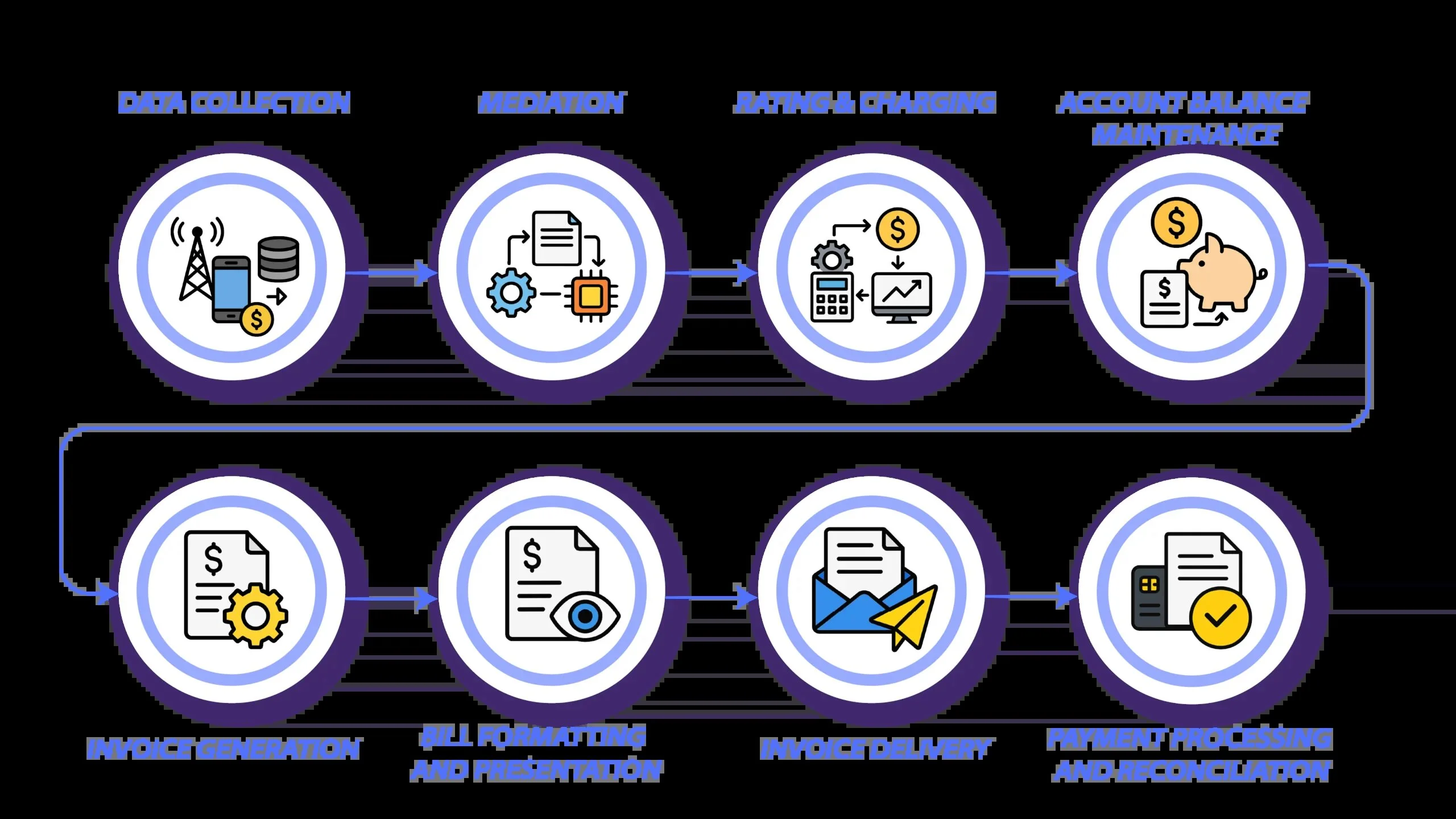
1 Service Usage Data Capture
Every user interaction with the telecom network generates an event: calls, messages, mobile data sessions, and subscription services. Network elements record these events and convert them into raw data records.
Data Sources:
Types of Raw Data Records:
- CDRs (Call Detail Records)
- EDRs (Event Detail Records)
- UDRs/PDRs (Usage/Packet Detail Records)
These raw data records are generated for each usage session and stored for a finite period before mediation.
2 Mediation System – Data Transformation & Pre-Processing
This critical middleware processes the raw records into a standardized billing format. A single customer could generate thousands of records each day; therefore, it is the responsibility of mediation to ensure a clean and consistent input for any downstream systems.
Key Activities Performed:
- Data collection from several switches, gateways, and sources
- Data validation to check for inadvertently omitted fields or malformed entries
- Data enrichment with extra attributes like rate plan, geo-location
- Duplicate removal to save billing the same usage a second time
Batch Management:
Grouping micro-events (e.g., data packets) into an appropriate billable amount (e.g., MBs)
For example, A customer streams a video from 6:00 to 6:30 PM, and the mediation system takes the micro records, which are hundreds in numbers and combines them into a 10-minute session for rating engine delivery.
3 Rating Engine – Application of Economic Value to Usage
The rating engine converts a given usage into charges according to rate plans, taxes, discounts, and policies. It is probably the most complicated module, especially in hybrid (prepaid + postpaid) environments.
Parameters on which services are rated:
- Type of service: Voice, SMS, data, roaming, VAS
- Tariff plan: A postpaid plan, a corporate plan, a prepaid youth plan, or a family bundle
- Time: Peak, off-peak, night, weekend
- Geographical scope: Local, national, international, intra-network, inter-network
Based on the type of service, one-off vs. continuous, in the case of a prepaid scenario, an international call for two minutes is rated in real time, a deduction for balance takes effect instantaneously, and a usage confirmation is sent to the user's terminal. Being postpaid, however, the same call is stored and charged later at the end of the billing cycle.
4 Billing Engine – Invoicing
After usage events are rated, the billing engine collects all data related to a customer account and creates a monthly or weekly invoice based on the customer's billing cycle preference.
The components of an invoice comprise:
- Charges for rated usage: Calls, data, SMS
- Subscription charges: Services/ monthly rental fees
- Pro-rate charges: If the plan is activated mid-cycle
- One-time charges: SIM replacement, activation
- Recurring charges: Network fees, caller tunes
- Taxes and regulatory charges: VAT, service tax, and universal levy
- Discounts or promotional adjustments: Discounts, Buy one get one, Percentage discounts, Bulk Discounts
The system finally generates, summarizes, and formats all details in the customer's preferred language and currency.
Most invoices are generated as PDF, XML, CSV, or hard copy for printing and uploaded to the Bill Repository.
5 Bill Delivery and Presentation
Bills must be delivered with transparency and on time to create trust and encourage faster payments.
Accepted delivery channels include:
- Email with PDF attachment
- Self-care portals and apps (interactive bills)
- SMS with mini-bill
- Hard copy (for enterprises or regulatory needs)
Another variable in presenting the bill is:
- Overview of the account
- Detailed usage breakdown
- Total due and due date
- Payment history
- QR code for UPI payments
Some advanced bills use data visualizations such as usage graphs, plan comparison charts, and alerts for when overuse occurs.
6 Payment Collection in Billing Process
Payments are undertaken through the payment gateways and financial institutions integrated therewith. The payment of each amount should be reconciled appropriately against the billed amount to create records.
Mode of payment:
- Online banking
- Debit/credit card
- UPI
- Mobile wallets
- IVR-based payment
- Auto-debit and ECS mandate
- Payment counters in telecom outlets
Charging systems:
- Real-time balance updates
- Auto-adjustment for overdue or partial payment
- Generation of receipt and SMS/email confirmation
- Payment failure alerts
- QR code for UPI payments
- Enterprise customers may have bulk payments or dedicated account managers to process settlements
7 Disputes and Adjustments in the Billing Process
At times, users question their bills. This module tracks the handling of billing grievances, verifications, and credits.
Some classic disputes:
- Call charges as Wi-Fi
- Charges for services never asked for
- Billing date inconsistency
- Roaming charges for local use
Resolution steps:
- Open CDRs/UDRs from the billing system
- Analyze rating rules applied
- Approve adjustments or refunds
- Monitor orders are applied, and credit notes are issued
A well-managed dispute usually is handled and stored and therefore maintains NPS.
8 Collection and Dunning Management
When a customer fails to comply with the payment due date, the operations dunning incur collection procedures.
Step-wise automatic processes:
- SMS and emails to remind
- IVR calls or push app alerts
- Payment grace period
- Imposition of Penalty
Escalation process:
- Temporary suspension of service
- Partial barring (data only or calls only)
- Handoff to external collection agencies
- Initiation of legal escalation or blacklisting
Dunning parameters are customized according to customer values. VIPs may enjoy more grace, while low ARPU ones will be suspended much faster.
9 Revenue Assurance and Audits
The last layer guarantees that each usage event gets billed, preventing revenue leakage.
Revenue assurance systems conduct:
- Reconciliation: Between records at the switch level and billing totals
- Leakage detection: Identification of missed charges or unbilled services
- Margin analysis: For services vs. costs
- Audit trails: For regulatory and finance verification
- Validation of data integrity
These checks assist in maintaining the firm's finances, investor confidence, and telecom law compliance.