
Understanding Bill Cycles in Telecom Billing
A bill cycle in telecom billing is a recurring time window for determining a customer's service usage, compiling it, and ultimately billing. The bill cycle specifies the dates when invoices are issued and payments are made. Billing cycles are, therefore, instrumental in timely revenue collection, accurate invoicing, and uninterrupted customer service.
Generally, billing cycles span 30 days, thereby providing a consistent charging period for voice, data, SMS, and other telecom services. Billing cycles can be calendar-based (for example, 1 to 30 of each month) or anniversary-based (based on the date when the customer started the service).
Let's assume that you have taken a mobile plan. The telecom operator will start counting your usage of calls, texts, and data from a particular date. That counting shall continue until the end of your billing cycle, typically between two fixed dates, like the 5th of one month to the 4th of the following month. After that, it collects instances of all your usage in an invoice, which it sends to you for payment.
Types of Bill Cycles in Telecom
Operators in telecom support multiple bill cycle structures to accommodate different user segments and operational models. For example, Calendar-Based Bill Cycles run from fixed calendar dates, for instance, from the 1st to the 28th of each month, for all users in a particular segment.
Calendar-Based Bill Cycles
These run from fixed calendar dates, for instance, from the 1st to the 28th of each month, for all users in a particular segment.
This makes accounting easy, and this model is uniquely used in business plans or large corporate accounts.
Anniversary-based Bill Cycles
These are initiated on the date of service activation for each customer. So if you signed up on March 18th, your bill cycle will be from the 18th of first month to the 17th of the next. It is a personalized recovery schedule and is quite popular in consumer mobile plans.
Usage-based or Event-Driven Cycle schedules typically apply in prepaid or usage-intensive models when billing resets once certain usage thresholds set in precedence, like volume or data limits and upon such expiration, billing resets.
How Bill Cycles Operate Behind the Scenes
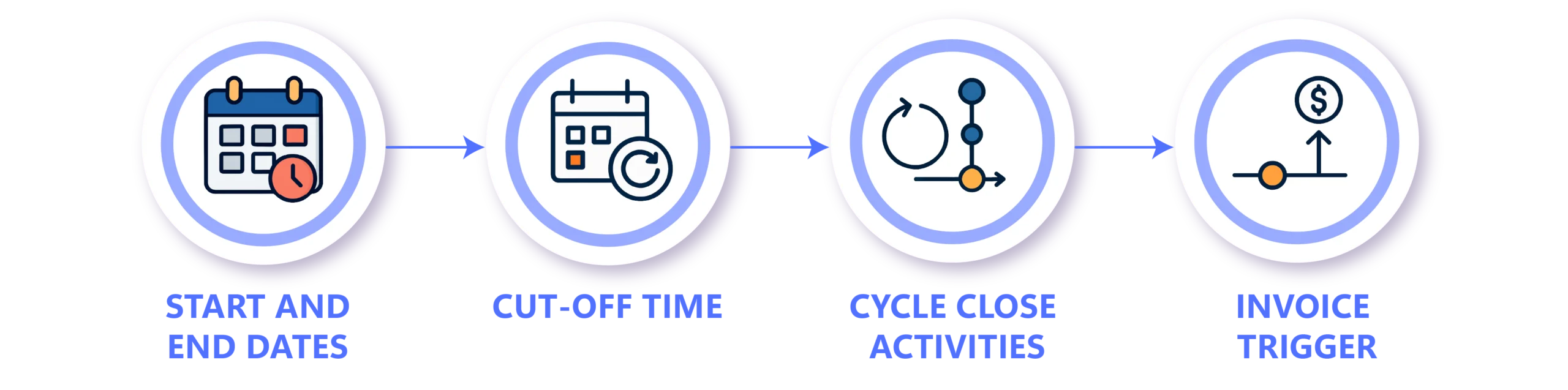
A Telecom billing system must track all the requirements for each bill cycle:
Monthly
This is the most common billing cycle, where bills are generated once every month on a predetermined bill cycle date.
Quarterly
This is a less popular method but often utilized in utility services, where bills are generated once every three months.
Weekly
For post-service or high-usage clients, bills are generated weekly.
Daily
This is usually used for real-time services or prepaid top-up, where bills are generated daily or after every action.
One-Time
For one-time expenses such as device purchases or activation fees.
Start and End Dates
Mark the period for which the customer is actually billed. The duration of the cycle is recorded for reporting.
Cut-off Time
Each time shows when the recording of usage for the ongoing cycle is ended.
Cycle Close Activities
Closing of usage records, calculations of prorated charges with applicable taxes and discounts.
Invoice Trigger
This starts the generation and customer notification about invoice delivery.
In addition, the adoption of a bill cycle should be a reflection of the customer's contract specifications and local regulations. For instance, in most countries, local telecom legislation states that telecom vulnerable laws state the maximum time allowed between the closing period of a customer's bill cycle and the issue of bills, which is meant for consumer protection.
Why Bill Cycles in Telecommunication?
There are not just internal tools. All aspects of customer experience:
- Cash Flow – Regular cycles give operators forward-looking visibility to revenue, thus enabling financial planning.
- Customer Trust – Fixed dates for billing establish reliability and minimize confusion.
- Operational Efficiency – Allows systematic batch processing of invoices, usage data, and collections.
- Compliance with Regulation – Providers are billed and notified transparently.
Challenges in Handling Bill Cycles
- Multiple Products and Plans – Telecoms offer voice, data, broadband, and OTT, possibly with different cycles.
- Variable Dates – Millions of customers with varying start dates need individualized tracking.
- Dynamic Changes – Upgrades, downgrades, or suspensions during the service, which will require an adjustment.
Telecoms manage this with advanced billing systems that support automation, real-time updates, and integration with CRM, mediation, and rating systems.
Key Takeaways
- A bill cycle is a recurring time window that determines when customer usage is compiled, invoiced, and payment is due
- Common cycle types include calendar-based (fixed dates for all users), anniversary-based (based on service activation date), and usage-based (triggered by usage thresholds)
- Bill cycles typically span 30 days but can be monthly, quarterly, weekly, daily, or one-time depending on the service
- The cycle includes four key stages: Start and End Dates, Cut-off Time, Cycle Close Activities, and Invoice Trigger
- Benefits include improved cash flow visibility, customer trust, operational efficiency, and regulatory compliance
- Challenges involve managing multiple products with different cycles, varying customer start dates, and dynamic service changes
Understanding bill cycles is fundamental to telecom billing operations. They provide the framework for systematic revenue collection, accurate invoicing, and transparent customer communication. Modern billing systems automate these complex processes, ensuring that millions of customers with different plans and activation dates receive accurate, timely invoices.