
A prepaid billing plan requires an upfront payment, whereas a postpaid billing plan allows customers to pay for services at the end of the month rather than at the beginning. This means customers can continue to use services like voice, data, and text messages throughout the month. It also allows customers to select from any available plan and bundle to match their specific needs and preferences.
What is Postpaid Billing?
Postpaid billing is a payment mechanism for companies. A company allows its customers to use their service first, then charges them according to their usage at the end of a billing cycle. Mostly, postpaid plans come with monthly plans. This plan has a predefined number of calls, text messages and data. As well as the flexibility of using more than what has been allocated under specific conditions.
With a postpaid billing service, customers do not need to monitor their account balance or top up at any given time. As a result, smooth and uninterrupted service is provided to the customer. Additionally, it helps companies to maintain a consistent revenue stream.
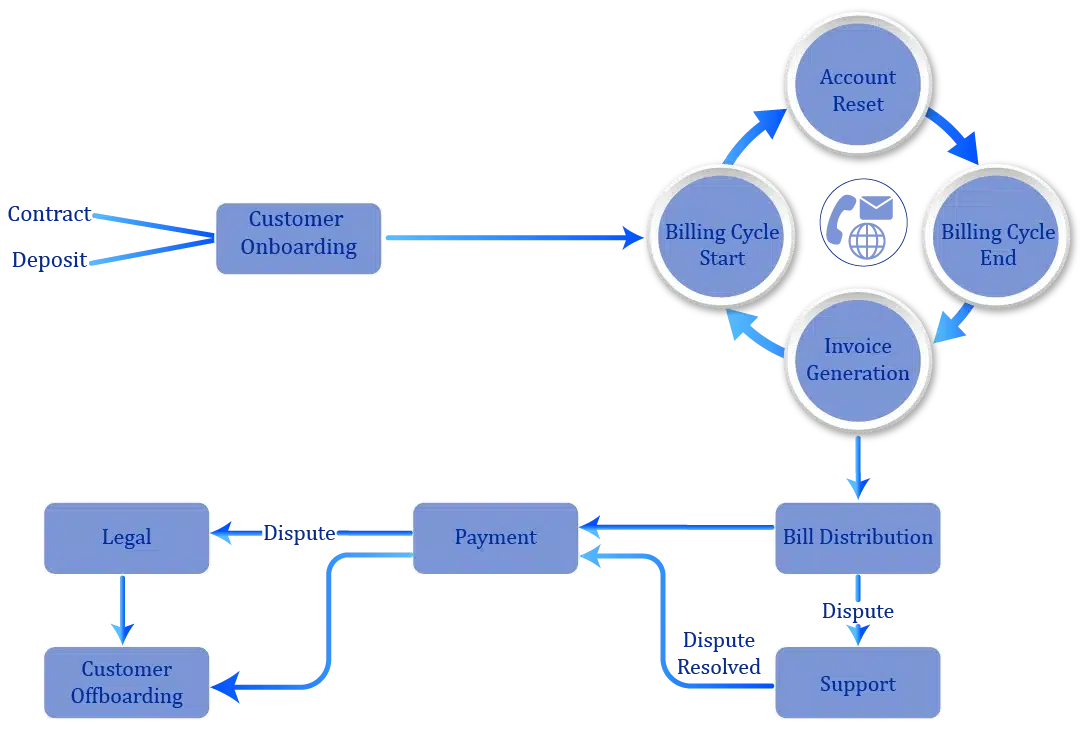
The diagram above details the high-level postpaid billing lifecycle from a service provider's perspective. Here's a step-by-step breakdown:
How Postpaid Billing Works, Step by Step
Customer Onboarding
In the initial stage, the customer signs the contract for the service and pays the initial deposit if there is one. Most of the time, after signing up, customer details are verified as per local regulations, an account is set up in the system, and the selected postpaid billing plan is allocated.
Billing Cycle Start
After customer onboarding, the billing cycle begins. As per the billing period. Often monthly, the customer's usage of the service is tracked.
Billing Cycle End
At the end of the billing period, all usage of the service within that billing cycle has been recorded and will be considered in the invoice.
Invoice Generation
The rating engine/billing mediation does the calculation based on customer usage and the plan subscribed to. Services used and corresponding charges are detailed in the invoice.
Account Reset
Once the invoice is generated, the billing cycle starts again and the account resets all usage tracking.
Bill Distribution
Invoices are delivered to the customer, through physical mail, email, or an online account portal.
Payment
The customer is expected to make payment for the invoice on or before the due date. Payment methods can vary and might include direct debit, credit card, online payments, or in-person payments.
Support
If a customer has any questions or issues with billing, support mechanisms are in place to resolve these queries.
Legal
In most cases, this refers to any legal actions or procedures that may arise if there are disputes, unpaid bills, or problems regarding contract termination.
Customer Offboarding
Either the customer decides to end their relationship with the company, or the company terminates the service. The customer goes through an offboarding process in which the service is discontinued and the account is deactivated.
Pros and Cons of Postpaid Billing
Postpaid billing suits certain markets and customer profiles well. But like any model, it comes with trade-offs worth understanding.
- How Does Postpaid Billing Work in EarnBill?
- Future predictions for Postpaid Billing.
- Prepaid vs Postpaid Billing
Postpaid Billing FAQs
What is a postpaid bill?
A postpaid bill is a charge a customer pays after using a service. With postpaid billing, the provider lets the customer use calls, data and other services throughout a billing cycle, then bills them for their actual usage at the end of that cycle, typically every month.
How does postpaid billing work?
Postpaid billing works in a cycle. The customer is onboarded and assigned a plan, their usage is tracked through the billing period, and at the end of the cycle that usage is rated, an invoice is generated, and the customer pays for what they used plus any plan or overage charges.
How is a postpaid bill calculated?
A postpaid bill is calculated by rating the customer's recorded usage against their plan at the end of the billing cycle. Allowances included in the plan such as calls, texts and data are covered by the plan fee, any usage beyond the allowance is charged at the plan's overage rates, and the total is combined with taxes and recurring charges.
What is postpaid bill payment?
Postpaid bill payment is the customer paying their invoice after the billing cycle ends. Because charges are settled in arrears, the customer never needs to pre-load a balance. They receive a detailed bill for the period's usage and pay it by the due date.
What is the difference between prepaid and postpaid billing?
In prepaid billing the customer pays in advance and draws down a balance as they use the service. In postpaid billing the customer uses the service first and is billed for actual usage at the end of the cycle. Prepaid caps spending to the available balance, while postpaid provides uninterrupted service with a monthly invoice.
Ready to Implement Postpaid Billing?
EarnBill's postpaid billing system handles the full lifecycle. From onboarding and recurring invoices to mediation, dispute management, and financial reporting.