A Postpaid Billing System is a system in which the billing software caters to various postpaid charging scenarios. The postpaid charging scenarios could be recurring billing scenarios or one-time billing scenarios.
What is Postpaid Billing?Postpaid Billing Model
Postpaid billing is used in various services in day-to-day life. Electricity bills, phone bills, internet bills. There is a periodic recurring invoice that applies charges based on the usage or consumption of the service in a particular billing period.
It is impossible to measure the consumption of a service until the usage actually takes place. In that sense, all usage or consumption is postpaid. A subscription or rental may be prepaid or postpaid, but usage is always postpaid. In a truly prepaid service, there is a continuous polling mechanism, behind the scenes, using a prepaid billing system , to check if usage has crossed a certain threshold, and if so, the service is temporarily stopped until the quota is recharged.
Therefore, a prepaid billing system allows usage to take place up to a certain level (or up to a certain time period like 30 seconds) and then validates if the total usage consumption for the billing period has crossed the quota in that time frame. There is definitely a chance of small minuscule billing leakage in such a scenario, because usage that takes place during the polling frequency time frame could overshoot the quota by a small amount.
This problem is not faced in the postpaid billing model. In this model, usage consumption can be measured and charged quite accurately with the postpaid billing system.
A postpaid billing model trusts the end customer more and allows the service to be utilised for the entire month (or the agreed recurring billing period). It measures the total charges incurred for the elapsed billing period and raises an invoice at the end. The user then pays for that invoice after-the-fact. Meaning after using the services for the entire month. That is why it is called a postpaid billing model.
When should postpaid billing software be considered?
Typically, in markets that are advanced with a well-earning consumer base, the postpaid billing model is preferred. The Postpaid Billing Model allows the consumer flexibility to use the system on the go without worrying about recharging their account balance mid-cycle. Many times, B2B services are based on postpaid plans as corporate customers prefer postpaid services.
EarnBill's Postpaid Billing System
EarnBill provides a comprehensive Postpaid Billing Solution with out-of-box postpaid features and plugins. Although EarnBill is a Convergent Billing System, it can be configured to be a purely postpaid billing system, or purely a prepaid billing system, depending on the client requirement.
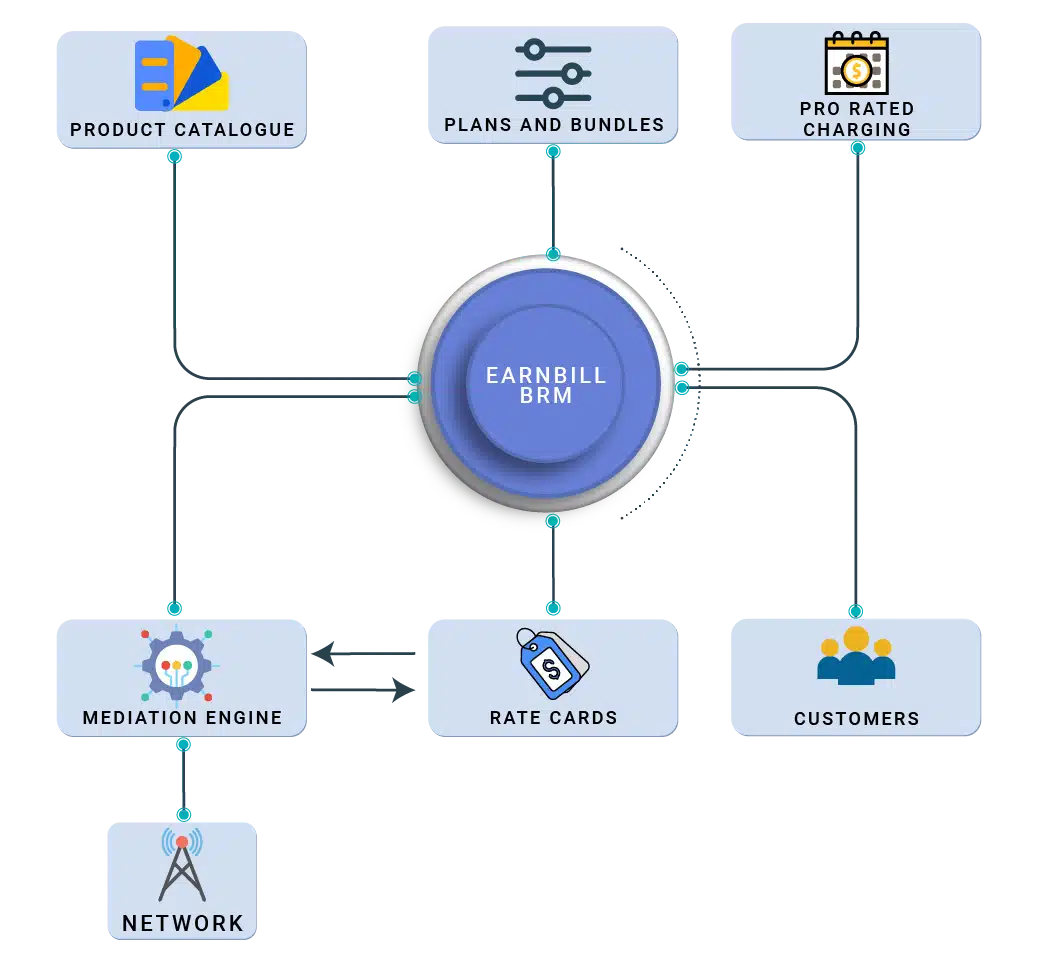
Inside EarnBill's Postpaid Billing Capabilities
Product Catalogue
The Product Catalogue allows you to define and configure Products, Pricing, Plans, and Bundles. EarnBill provides a comprehensive Product Catalogue feature and supports more than a dozen different pricing strategies. Giving service providers great flexibility to configure their product offerings in the system easily.
Under the Product Catalogue, two features that stand out as postpaid billing features are Postpaid Billing Plans and Free Usage Pools:
Postpaid Billing Plans
EarnBill allows easy configuration of postpaid billing plans. You can define a plan subscription with an initial period discount, installation fees, usage consumption pricing, and bundle pricing, all under one single plan.
To define bundle pricing, add bundled products in the plan and override the default pricing at the bundle level. For example, a Service Provider selling toll free numbers can add a special bundle with 5 toll free numbers included in the plan, while any additional toll free number carries an extra charge. Similarly, an ISP can bundle 5 Static IPs at a lower plan price, with additional IPs charged separately. EarnBill provides an easy mechanism to define bundle-level pricing that overrides product-level pricing.
It is also possible to define varying bundle charging periods within the plan. For example, an installation fee can be a one-time charge, while static IPs are charged monthly along with the plan fee.
Free Usage Pools
A typical postpaid plan also contains free usage pools. Also termed as 'Included Quantity' on the plan. A free usage pool defines the included quantity, the period for which the free quota is allowed, and additional rules such as whether to roll over or lapse remaining quantity when the pool period expires.
A free usage pool is associated with an EarnBill plan, and more than one pool can be linked to a single plan. For example, a mobile service plan could set up a data pool with 30 GB included, Local and National Calls up to 100 minutes, and a quota of 100 SMSes. Three different pools, all associated with the same plan.
Recurring Billing
With EarnBill's Recurring Billing functionality, postpaid billing plans and associated recurring bundles are charged onto invoices based on the various recurring billing rules defined in the system. EarnBill provides a complete recurring billing solution that allows billing to be executed at various frequencies. Daily, weekly, monthly, and also supports differing billing cycles at the customer level and charge level.
As an organisation, you could choose different billing frequencies and strategies, such as:
- 1-monthly billing for the organisation and the same billing cycle (1-monthly) for all customers
- Daily billing cycle with anniversary billing cycles based on service activation date (1-monthly, 2-monthly, ... up to 31-monthly) for customers
- Bill all customers twice in the month, such as 1-monthly and 15-monthly
Prorating or Pro Rata Charging
With postpaid charging, it becomes necessary to have prorating or pro rata charging enabled for partial period billing, such as when a customer adds a new service in the middle of their billing period, or cancels a service mid-cycle.
For example: a 1-monthly customer receives a bill for their existing service on the 1st of every month. If that customer subscribes to another postpaid billing plan on the 15th of the month, the first invoice for the new service will charge a partial period from the 15th to end of month, in a postpaid manner.
Billing Mediation
To understand how billing mediation works in EarnBill, check out: Billing Mediation Feature.
Billing Mediation is a telecom billing feature that allows rating and charging of raw CDR (Call Data Records) data received from the network or from the underlying carriers. Such as MNOs or Mobile Network Operators. Mediation in telecom is a complex postpaid billing feature that processes the feed ofCDRs and assigns the associated usage charges for a customer onto their invoice.
The process can require scaling to handle tens or hundreds of millions of call records per day. The scalability and accurate charging of CDRs is one of the most significant highlights of EarnBill's capabilities.
Rate Cards
Rate Cards is a feature closely associated with Telecom Billing and Billing Mediation. It allows the Telecom Service Provider to maintain a complex system of rating for consumption of various telecom services. Typically, the rate cards maintain route-based rates for local and national usage. For international calls and other usage, the rate cards allow maintaining thousands of rates easily. Based on the country where calls are placed and the service provider on the termination side.
Rate cards also provide flexibility in charging usage with a connection charge and duration increment parameters for calls. For example, if a call is less than 30 seconds, it may still be charged for 30 seconds; if more than 30 seconds, it may be charged for the whole minute. Rate Cards allow the Telecom company such fine-grained rating parameters.
Financial Reports
EarnBill comes with many crucial financial reports that allow for tracking and monitoring postpaid invoicing. The financial reports from EarnBill make it easier for the finance department to reconcile balances and achieve accurate annual financial reporting.
Some of the key reports available out of the box:
Ready to Explore EarnBill's Postpaid Billing System?
From flexible recurring billing and proration to mediation, rate cards, and financial reporting. EarnBill covers the full postpaid billing lifecycle on a single platform.