Home /
Blog /
Telecom Billing Software for 5G Success
Industry Trends
Telecom Billing Software for 5G Success: Real-Time Charging and Global Compliance
The arrival of 5G is more than just faster speeds. It is a complete transformation of how
telecom operators deliver, manage, and monetize services. With ultra-low latency, massive device
connectivity, and new service models, traditional billing and revenue management systems are
under unprecedented pressure to evolve.
Amol Gadre
Founder & CEO,
EarnBill
Mar 13, 2026
9 min read
The New Demands
of 5G
5G networks are not just about mobile data. They enable advanced use cases like IoT
connectivity, smart cities, autonomous vehicles, and immersive AR/VR experiences.
Each of these services requires flexible monetization models, from pay-per-use to
dynamic subscription tiers.
This shift means telecom operators need more than legacy billing systems. They require telecom billing software that
can handle complex, real-time scenarios while ensuring compliance across multiple
geographies.
Real-Time
Charging: The Heart of 5G Monetization
In the 5G era, customers expect instant service activation, transparent usage tracking, and
immediate billing updates. That is where a real-time charging system
becomes critical.
Why real-time charging matters for 5G operators
Instant usage tracking: Every byte consumed must be
accounted for in real time.
Dynamic pricing models: Operators can roll out new offers
instantly, whether it is a weekend data pack or an IoT device bundle.
Customer trust: Real-time visibility into usage and charges
builds confidence and reduces billing disputes.
Without real-time charging, operators risk revenue leakage and customer dissatisfaction.
These are two things no telco can afford in a competitive 5G market.
Compliance and
Global Expansion
Telecom operators are increasingly global, serving customers across borders. This brings
real challenges in taxation, regulatory compliance, and reporting. A modern revenue
management system for telecom must:
Compliance is no longer optional. In the 5G landscape, it is a competitive
differentiator. Operators that get this right earn customer confidence and open doors to
new markets.
Integration and
Scalability: The Hidden Backbone
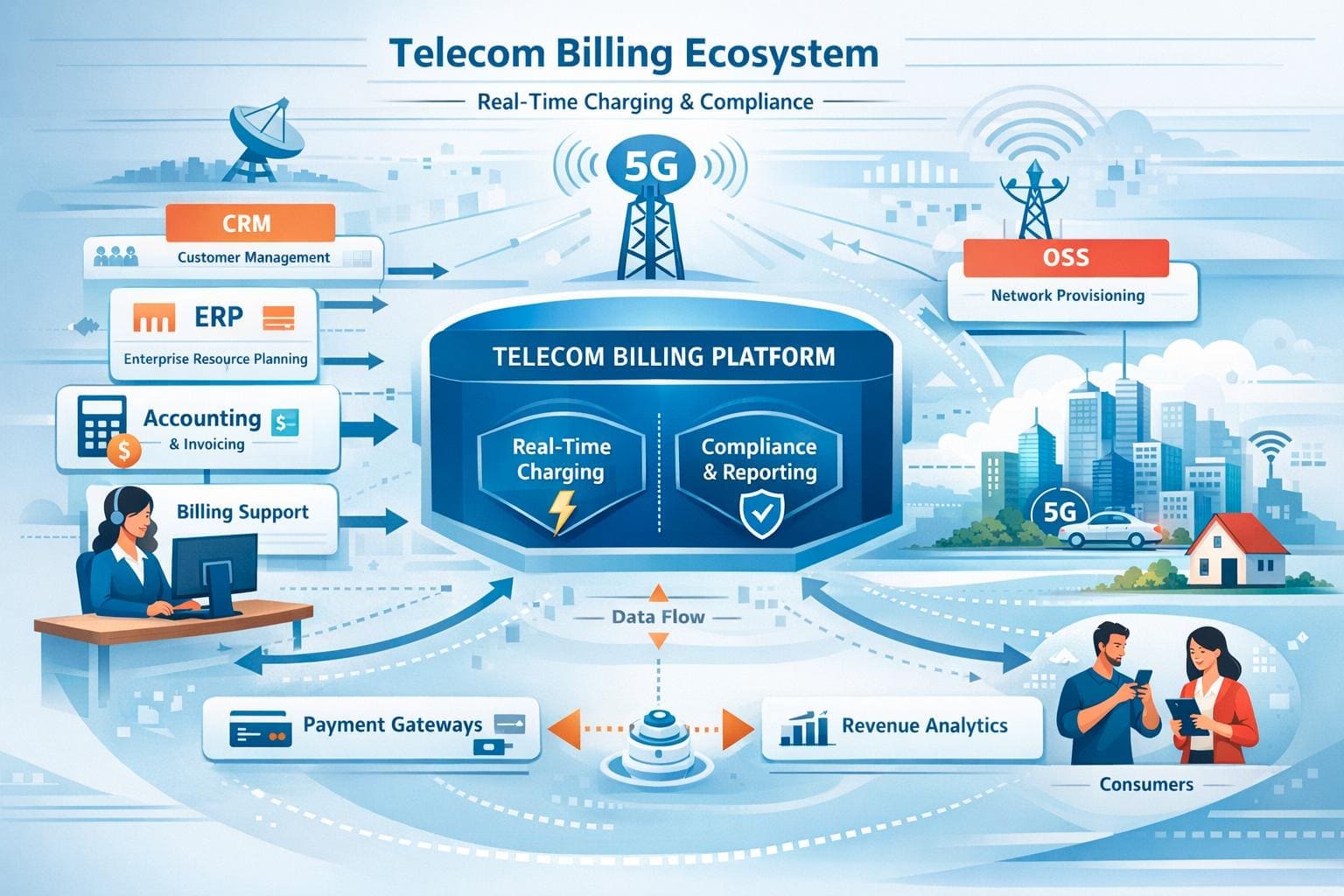
5G services do not exist in isolation. They rely on seamless integration with CRM, ERP, payment
gateways, and OSS/BSS platforms. Scalable billing
mediation ensures that data from millions of devices flows smoothly into the billing
system without bottlenecks.
Equally important is a scalable Online Charging System (OCS) that can handle
massive transaction volumes while remaining highly configurable. Operators must be able to
customize features quickly when rolling out new services, without waiting months for system
upgrades.
Key
integration touchpoints for 5G billing
CRM for
customer management
ERP for
enterprise resource planning
Payment
gateways for collections
OSS for
network provisioning
Revenue
analytics dashboards
Accounting
and invoicing systems
Ease of
Customization: Staying Ahead of the Curve
The pace of 5G innovation means operators cannot afford rigid systems. Billing platforms
must allow:
✓
Rapid rollout of new
features and service bundles.
✓
Configurable
workflows for different service types.
This agility ensures operators can experiment with new business models while maintaining
operational stability.
The Road Ahead
Telecom revenue management in the 5G era is about speed, compliance, and
scalability. Operators that embrace modern billing systems will be able to
monetize new services faster, reduce revenue leakage, and maintain customer trust.
The Growth of
Prepaid Plans
As 5G adoption accelerates, prepaid plans are witnessing significant growth, particularly in
emerging markets where affordability and flexibility drive consumer choice. Customers
increasingly prefer prepaid models that allow them to control spending while still accessing
high-speed data and advanced services.
For operators, this trend demands agile charging systems capable of handling
micro-transactions, dynamic bundles, and real-time balance updates. Realtime
charging ensures transparency and trust, while monetization platforms enable
operators to craft innovative prepaid offerings that resonate with diverse customer
segments.
The e-SIM
Offerings
The rise of e-SIM technology is reshaping customer onboarding and service portability. With
e-SIMs, users can switch carriers seamlessly, activate plans instantly, and manage multiple
profiles without physical SIM cards. This flexibility empowers consumers but also
intensifies competition among operators.
To stay ahead, telcos must leverage realtime charging and monetization systems that can
support instant provisioning, cross-border roaming, and dynamic pricing models. By
integrating e-SIM capabilities with advanced monetization engines, operators can deliver
frictionless experiences while capturing new revenue streams.
The Critical
Role of Real-time Charging and Monetization
Whether it is prepaid growth, e-SIM adoption, or the broader 5G ecosystem, realtime charging
and telco
monetization systems are the backbone of sustainable success. They enable operators
to move beyond static billing into dynamic, event-driven monetization, supporting everything
from IoT device connectivity to enterprise SLAs.
By ensuring compliance, scalability, and agility, these systems transform 5G from a
technological upgrade into a business revolution.
Where EarnBill
Fits In
At EarnBill, we have built a platform that meets all these requirements. From
integration-ready telecom billing software to a
real-time charging system and
a revenue management system for telecom designed for compliance,
scalability, and customization, EarnBill empowers operators to thrive in the 5G era.
With features like scalable billing mediation, configurable OCS, and ease of
customization, EarnBill ensures your business is ready for whatever the future of
telecom brings.
Frequently Asked
Questions
1. What is a real-time charging system in telecom?
A real-time charging system enables
telecom operators to track usage and apply charges instantly as services are
consumed. It supports dynamic pricing, immediate balance updates, and transparent
billing, critical for 5G services like IoT, streaming, and mobile data.
2. How does 5G impact telecom billing?
5G introduces ultra-fast connectivity and diverse service models, requiring telecom
billing systems to support real-time charging, flexible pricing, and scalable
mediation. Legacy systems often struggle with the speed and complexity of 5G monetization.
3. What is a telecom revenue management system?
A telecom revenue management system handles billing, charging, taxation, payment
collection, and compliance across services and geographies. It ensures accurate
invoicing, regulatory reporting, and end-to-end revenue management, from onboarding
a new business or a customer to invoicing and collecting payments. It is also known
as a process that manages all activities under the quote-to-cash workflow in a
business environment or a process that covers revenue inception to revenue posting
and revenue realization.
4. Why is compliance important in telecom billing?
Telecom providers must comply with local and international tax regulations (for
example, GST, VAT), data privacy laws, and audit requirements. A compliant billing
system automates tax calculations, supports multi-currency invoicing, and generates
audit-ready reports. It also covers security compliance requirements such as ISO 27001, SOC 2, PCI DSS and
GDPR.
5. What integrations are essential for telecom billing platforms?
Modern telecom billing platforms should
integrate with CRM, ERP, accounting systems, and OSS for network
provisioning. These integrations enable seamless workflows, accurate data flow, and
faster service activation.
6. Can telecom billing systems support customization for new services?
Yes. EarnBill is a leading billing platform that offers configurable workflows and
modular architecture, allowing operators to quickly launch new services, adjust
pricing models, and adapt to market changes without major system overhauls.