The Mobile Virtual Network Operator (MVNO) landscape has shifted dramatically. We are
rapidly moving away from the old era of being "low-cost alternatives" or basic brand
resellers, and moving toward becoming specialized connectivity powerhouses. Driven by the
surge in IoT, the flexibility of eSIMs, and a massive global demand for data-heavy prepaid
services, MVNOs are scaling at a record pace.
However, rapid growth often exposes a critical structural weakness: the billing engine.
As you scale from thousands to millions of sessions, how do you monetize services in real
time without falling victim to revenue leakage or getting bottlenecked by your host Mobile
Network Operator (MNO)?
To truly scale, MVNOs must transition to their own Diameter-based Online Charging System
(OCS) - a strategic move that delivers independence, product
agility, and absolute revenue assurance.
Two Major
Challenges: Legacy Tech and MNO Dependence
Most emerging MVNOs launch by taking the path of least resistance: relying entirely on
traditional offline billing or depending directly on the host MNO's charging system. In a
low-volume environment, this works just fine. But as traffic spikes and you attempt to
differentiate your brand, the cracks appear in two distinct ways:
1
Unseen Revenue Leakage: The Quiet Margin Loss
Traditional systems authorize usage after the fact. For prepaid and hybrid models,
this delay is more than a technical lag - it's a direct financial risk. Without
real-time credit control, a user can easily exceed their balance before the system
"checks in", leading to massive revenue leakage.
Furthermore, these legacy stacks struggle with the low-latency requirements of
modern 4G and 5G networks, resulting in dropped sessions, compliance gaps, and
frustrated customers who won't hesitate to churn.
2
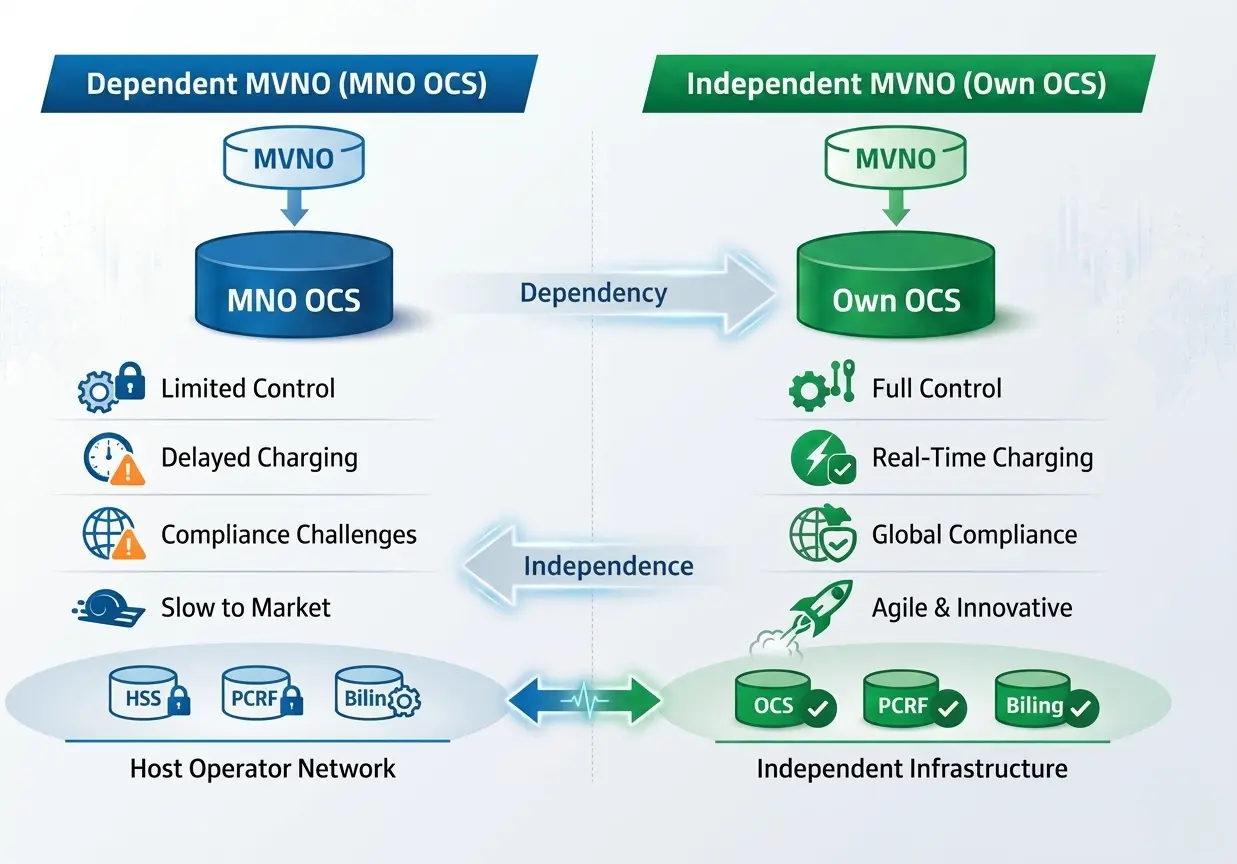
The Bottleneck of MNO Dependence
While using your host MNO's OCS keeps initial overhead low, it eventually suffocates
growth. A mid-tier MVNO trying to build a unique product portfolio quickly runs into
walls:
Limited Control: Your pricing and data bundles remain
strictly tied to the MNO's rigid policies.
Slow
Innovation: Want to launch a new promotional offer? You have to
wait weeks or months for MNO approval and technical provisioning.
Weakened Negotiation Power: Without your own core
infrastructure, you lack the leverage to negotiate better wholesale
agreements or pivot to multi-network models.
The Turning
Point: The Power of the Diameter Protocol
In modern telecommunications, Diameter is the gold standard for signaling.
It is the evolution of the older RADIUS protocol, engineered specifically to handle the
high-speed complexities of LTE and 5G networks.
When you integrate a dedicated, independent Diameter-based OCS, you aren't just updating an
IT billing stack - you are taking control of your network's heartbeat.
[Network Core / 4G & 5G]
│
▼ (Sub-millisecond
Latency)
[Diameter-Based OCS] ──► Real-Time Authorization (Gy/Ro)
│
├──► Policy Sync (PCRF/PCF) for QoS & FUP
│
└──► Multi-Region Tax & Compliance Engine
Real-Time Credit Control (Gy/Ro
Interfaces)
Diameter allows for instant, two-way communication between the network and your billing
engine. Before a single packet of data is sent or a call is connected, the OCS
authorizes the session. As the user browses, streams, or roams, credit is deducted in
real-time "slices". If the balance hits zero, the session terminates instantly -
completely eliminating the "grey zone" of over-usage and protecting your margins.
Deep Policy Integration (PCRF/PCF)
Scaling isn't just about counting bytes - it's about managing quality of service (QoS).
By syncing directly with Policy and Charging Rules Functions, a Diameter OCS can enforce
fair usage policies (FUP) or throttle speeds based on the user's specific tier, all
automatically, without manual intervention.
High-Concurrency Architecture with
Hybrid Flexibility
Modern OCS solutions are built for high availability. Whether you have ten users or ten
million, the system handles concurrent sessions with sub-millisecond latency. This
architecture effortlessly bridges the gap between prepaid and postpaid models, allowing
you to offer seamless hybrid bundles to enterprises and consumers alike.
From Operations
to Strategy: The Business Impact
For a C-level executive or a Product Manager at an MVNO, owning a Diameter OCS is a
strategic growth lever, not an operational expense. Shifting from a dependent reseller to an
independent operator yields tangible business outcomes:
Revenue Assurance
By eliminating leakage and tracking every single bit in real time, MVNOs typically
see an immediate boost in margins - often by as much as 12%.
Bring Agility in Your Product
Launches
Want to launch a "Social Media Only" bundle, a 2-hour "Unlimited Roaming" pass, or
specialized IoT connectivity? An independent MVNO OCS allows you to configure and
deploy complex offerings in days, not months, without waiting for MNO approval.
Customer Trust &
Transparency
Nothing damages a digital brand faster than a delayed balance update or surprise
overage charges. Real-time notifications and instant balance visibility build
long-term subscriber loyalty.
Global Expansion &
Compliance
Automated tax calculations and regulatory alignment can be managed across multiple
regions simultaneously, lifting the geographical constraints imposed by a single MNO
framework.
Why EarnBill is
the Strategic Choice for Scaling MVNOs
At EarnBill, we believe your billing system should accelerate your business, never
bottleneck it. Our Diameter-based OCS is specifically engineered for the complexities and
fast-paced nature of the modern telecom market.
✓
Integration-Ready: Our OCS speaks the exact native language of
your core network, supporting 3GPP standards to ensure a seamless, plug-and-play
experience with your existing infrastructure.
✓
Global
Scalability: With built-in support for multi-currency,
multi-region, and multi-tenant deployments, EarnBill grows smoothly alongside
you as you expand across borders.
✓
Compliance-Driven: We handle the regulatory heavy lifting -
from regional tax variations to strict data privacy laws - so your team can stay
laser-focused on customer acquisition and market differentiation.
Conclusion
The difference between an MVNO that merely survives on razor-thin margins and one that
dominates the market is the ability to monetize intelligently and independently. By
migrating to a dedicated, Diameter-based OCS, you secure your revenue, empower your
customers, and build an agile foundation fully ready for the 5G and IoT era.
MVNOs that invest in their own OCS don't just scale, they lead.