Home /
Blog /
Why MVNOs Must Upgrade Billing Software: A 2026
Survival Guide
Best Practices
Why MVNOs Must Upgrade Billing Software: A 2026 Survival Guide
The tools that launched your MVNO can quietly become the biggest obstacle to scaling it. Here
are five unmistakable warning signs; and what modern billing infrastructure can do about them.
Amol
Founder & CEO, EarnBill
May 21, 2026
7 min read
When you first launched your MVNO, simplicity was the goal. Relying on your host MNO's basic
data feeds or using a traditional offline billing setup made perfect sense. It kept your
overhead low and got your brand into the market quickly.
But a funny thing happens when you scale from a few thousand subscribers to tens of
thousands: the tools that got you here start working against you.
In a low-volume environment, processing data usage in batches every few hours (or days) is
fine. In today's 5G, eSIM, and data-heavy world, that delay is a massive financial risk. If
your team is spending more time reconciling mysterious balance discrepancies than launching
new features, you've likely hit a wall.
Here are 5 unmistakable signs that your MVNO has outgrown legacy
infrastructure and needs a modern MVNO billing software to
survive.
1
You Are Experiencing "Unseen" Revenue Leakage
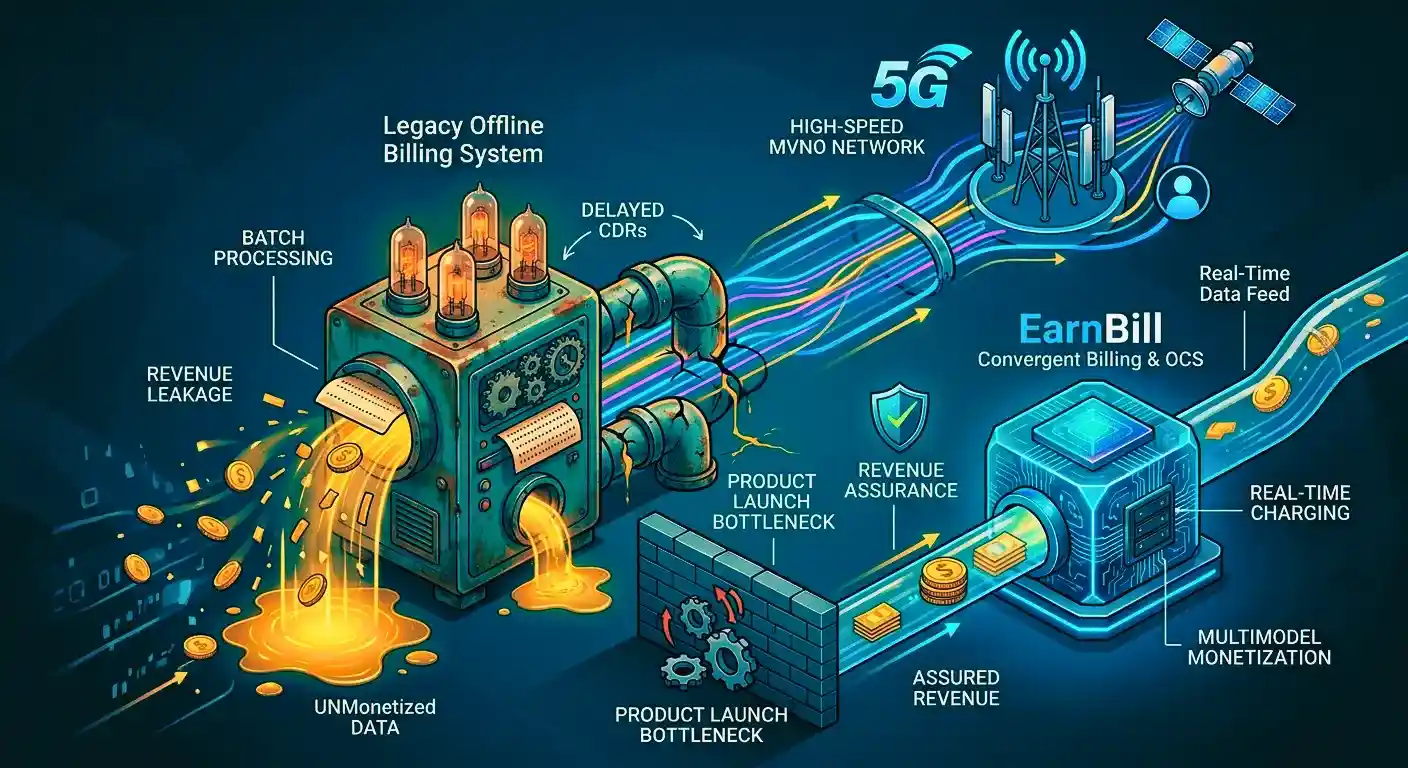
With offline billing, customer usage data is processed after the fact. For prepaid or
hybrid subscribers, this creates a dangerous "grey zone." A user can start streaming
high-definition video or roaming on a costly international network, blast right through
their credit limit, and keep going because the system hasn't "checked in" yet.
By the time the batch file processes hours later, the balance is negative, the user
disappears, and your business absorbs the loss. This revenue leakage in
telecom isn't just an operational nuisance; it strips away your
margins silently. If you notice a growing gap between the wholesale data you buy
from your MNO and the retail usage you can actually bill for, your offline system is
leaking cash.
2
Your Product Team is Trapped in "MNO Slow-Motion"
Want to launch a 3-hour unlimited social media pass for a weekend festival? Or a custom
IoT data tier for a new enterprise client?
If you rely on traditional billing tied strictly to your host MNO's legacy stack, your
product team is stuck in a bottleneck. You have to submit requests, wait weeks for
provisioning, and navigate rigid policy limitations. In a market where digital-first
brands win on agility, waiting months to launch a simple promotion means you've already
lost the customer.
3
"Bill Shock" is Driving Up Customer Churn
Nothing destroys customer trust faster than a delayed balance update or an unexpected
overage charge. When data usage isn't tracked in real time, subscribers cannot get
accurate notifications about their remaining limits.
When they finally receive a text saying their balance is empty or worse, a
surprise bill - they don't blame the underlying technology; they blame your brand.
If your customer support team is flooded with disputes over usage timing, it's a
clear indicator that your backend cannot keep up with subscriber expectations.
4
You Can't Seamlessly Mix Prepaid, Postpaid, and
IoT
Legacy systems often require separate silos for different payment models. You might have
one platform handling basic prepaid top-ups and an entirely separate workflow handling
enterprise postpaid invoices.
As you grow, managing these fragmented systems becomes an operational nightmare. It
prevents you from offering modern hybrid bundles (like an enterprise client who wants
postpaid corporate data but allows employees to top up personal usage via prepaid
wallets) and stops you from scaling into lucrative IoT verticals.
5
Manual Data Reconciliations Are Clogging Your
Operations
If your finance team spends the first week of every month manually pulling CSV files,
running complex Excel macros, and trying to normalize messy Call Detail Records (CDRs)
just to generate accurate invoices, your operations are fundamentally bottlenecked. This
manual overhead doesn't scale. It introduces human error, slows down financial
reporting, and distracts your brightest minds from strategic growth.
The Turning
Point: Offline vs Online Charging
To move past these limitations, growing operators must understand the fundamental shift from
offline vs online charging.
Network Event ──► Instant Gy/Ro Authorization ──► Balance Checked ──► Rated per
Packet ──► Zero Leakage
Offline billing acts like a restaurant bill, you consume everything first and pay at the
very end, hoping the customer doesn't walk out. Online charging (via a dedicated OCS) acts like a secure
turnstile; it checks the balance and authorizes usage packet by packet, millisecond by
millisecond.
To bridge this gap and gain complete control over your business, you need a unified, convergent billing system
that acts as a single source of truth for every type of subscriber, network event, and
payment model.
Why EarnBill is
Built Differently for Scaling MVNOs
Most legacy telecom platforms require you to buy massive, rigid software suites that take a
year to deploy. On the flip side, generic SaaS billing tools lack the deep network mediation
capabilities required to process raw telecom data.
EarnBill fills this exact gap. It is an agile, robust telecom billing engine
designed specifically to help mid-market MVNOs break free from MNO dependencies without the
enterprise complexity.
✓
Native
Network Mediation & Real-Time Rating: EarnBill doesn't just
generate invoices; it speaks the language of your core network. It normalizes,
parses, and rates complex usage data in real time, instantly plugging the
revenue leaks that legacy systems ignore.
✓
True
Convergent Architecture: Whether you are managing consumer prepaid
eSIMs, enterprise postpaid accounts, or high-volume IoT sensors, EarnBill
handles them all inside a single dashboard.
✓
Unmatched
Product Agility: Stop waiting for your MNO. EarnBill gives your
product managers the autonomy to design, test, and launch complex, tiered data
bundles and promotional discounts in days, keeping you steps ahead of the
competition.
✓
Built for
Global Scalability: With native multi-tenant, multi-currency, and
multi-region tax compliance frameworks, EarnBill ensures that your billing
infrastructure remains seamless as you expand across borders.
Take Back Control of Your Margins
Continuing to scale an MVNO on top of an outdated, batched billing setup is like trying
to build a skyscraper on a cracked foundation. The more subscribers you add, the heavier
the operational burden and financial risk become.
Upgrading to a modern, automated MVNO billing software
isn't just an IT upgrade; it's a strategic pivot. It gives you the freedom to innovate,
the transparency to win customer loyalty, and the absolute assurance that every single
byte of data moving across is accurately monetized.