Home /
Blog /
AI Monetization Platforms Compliance Guide
Best Practices
AI Monetization Platforms: A Comprehensive Compliance Guide for Global Deployments in 2025
Navigate the complex landscape of tax regulations, data security mandates, and compliance requirements across major countries when deploying AI monetization platforms globally.
Krunal
Technical Architect
Dec 22, 2025
18 min read
As AI monetization accelerates globally, service providers face a complex challenge: navigating compliance across multiple countries, each with its own tax rules, regulatory frameworks, and data-security mandates. Whether you are monetizing tokens, API calls, compute cycles, or hybrid usage models, compliance is no longer a back-office function. It's a core capability of any AI monetization platform.
This guide breaks down the essential compliance requirements across major regions and explains how a modern platform like EarnBill meets them out of the box.
Tax Compliance for AI Monetization Platforms
AI services are classified as digital services, which means they are subject to VAT, GST, Sales Tax, or Digital Services Tax depending on the customer's location. The AI monetization platforms need to be region-aware and provide taxation support for major countries.
Below is a region-by-region breakdown of taxation support needed in the AI monetization platforms.
United States – Sales Tax (State Level)
The U.S. has no federal VAT. Instead, each state defines its own rules.
Key Requirements
Digital services are taxable in many states (e.g., WA, TX, PA). The key requirements in like United States are:
Economic nexus thresholds (e.g., $100K sales or 200 transactions):
Economic nexus refers to a business's obligation to collect and remit sales tax in a state, even without physical presence, once it crosses certain economic activity thresholds.
Example: Let's say your AI platform earns $120,000 in sales from customers in Pennsylvania in a calendar year.
Pennsylvania's economic nexus threshold is $100,000 in gross sales.
Since your platform crossed $100k, you are now subject to collect, collect and remit Pennsylvania sales tax, even if your company is based in California and has no office or staff in PA.
These thresholds vary by state. Some states have eliminated the "200 transactions" rule and rely solely on dollar-based thresholds.
Destination-based sourcing:
In destination-based sourcing, sales tax is calculated based on the buyer's location, not the seller's.
Example: You sell an AI subscription to a customer in Seattle, Washington.
Washington is a destination-based state.
You must apply Seattle's local sales tax rate, not the rate where your company is headquartered.
This ensures tax revenue goes to the jurisdiction where the product is consumed.
Exemption certificate management for B2B customers:
Some B2B customers like resellers or tax-exempt organizations are not required to pay sales tax. They provide exemption certificates to prove their status.
Example: A retailer in Texas subscribes to your AI service for resale.
They give you a valid Texas resale certificate.
You must store and validate this certificate.
If audited, you'll need to show proof to justify why you didn't collect tax.
Poor exemption management can lead to penalties during audits. Many platforms integrate certificate tracking to stay compliant.
Implications for AI Monetization
Token packs, API usage, and subscriptions may be taxable depending on the state.
Requires state-level tax mapping, nexus tracking, and automated rate updates.
Canada – GST/HST/PST
Key Requirements
GST (5%) federally
HST in certain provinces
QST in Quebec (separate registration)
Digital services are fully taxable
Implications for AI Monetization
Requires automated GST/HST/PST calculation
Must store customer location evidence for audits
European Union – VAT for Digital Services
Key Requirements
VAT applies to all digital services
OSS/MOSS for simplified multi-country filing
Requires two pieces of location evidence
Reverse charge for B2B with valid VAT ID
The AI Monetization Platform should be able to store the location of the customer, validate the VAT ID for a B2B customer and apply reverse charge invoice, and apply VAT of the entitled EU country for a B2C customer. The AI monetization platform should store the audit trail about the validation of the VAT id, location of the customer and VAT calculations for a period of 10 years which is a EU regulation requirement.
Implications for AI Monetization
AI platforms must support VAT ID validation (VIES)
Reverse charge workflows
Country-specific VAT rates
OSS reporting
United Kingdom – VAT for Digital Services
Post-Brexit, the UK operates its own VAT system.
Key Requirements
VAT applies to digital services at 20% standard rate
Foreign providers must register for UK VAT if selling to UK customers
Place of supply rules determine VAT applicability
B2B transactions may qualify for reverse charge if the customer provides a valid UK VAT number
Implications for AI Monetization
AI platforms must support: Support UK VAT calculation
Validate UK VAT numbers (via HMRC)
Apply reverse charge for eligible B2B transactions
Maintain UK-specific invoice formats
Australia – GST (10%)
Key Requirements
Digital services to Australian customers are taxable
Threshold: AUD 75,000 annual turnover
Foreign companies must register for GST
Implications for AI Monetization
AI platforms must collect GST on subscriptions, token packs, and usage.
India – GST (18%)
Key Requirements
Digital services fall under OIDAR
Foreign companies must register for GST
GST applies to:
API usage
Token consumption
SaaS subscriptions
Implications for AI Monetization
Requires GSTIN, compliant invoice formats, and monthly filings.
Regulatory Compliance Requirements
Beyond taxes, AI monetization platforms must comply with country-specific regulations governing digital services, AI usage, and consumer protection.
United States
FTC Act
Prohibits deceptive billing and advertising. AI platforms must ensure transparent pricing and claims.
State Privacy Laws (CCPA/CPRA, VCDPA, CPA)
Require user consent, data rights, opt-outs, and disclosure of data practices. Some jurisdictions require deletion and portability.
NIST AI Risk Management Framework
Voluntary guide for trustworthy AI design, emphasizing fairness, accountability, and risk mitigation.
Canada
PIPEDA
Mandates consent and safeguards for personal data used in AI services, including cross-border transfers.
AIDA (Proposed)
Proposed law to regulate high-impact AI systems, focusing on harm prevention and algorithmic accountability.
Explicit Consent
Required for collecting and using personal data in AI models, especially for profiling and automated decisions.
United Kingdom
UK GDPR
Governs lawful AI data processing, profiling, and user rights post-Brexit.
Data Protection Act 2018
Supplements UK GDPR with enforcement powers and sector-specific rules.
ICO Enforcement
Oversees AI fairness, transparency, and bias mitigation in automated decision-making.
Australia
Privacy Act 1988
Requires AI platforms to handle personal data transparently and securely under 13 privacy principles.
Consumer Data Right (CDR)
Enables users to control and share their data with AI services for competitive offerings.
AI Ethics Principles
Voluntary guidelines promoting human-centric, fair, and accountable AI monetization.
India
DPDP Act
Establishes consent-based data governance for AI platforms, with clear rules on processing and retention.
CERT-In
Requires AI platforms to report cybersecurity incidents and maintain logs for compliance.
Sectoral AI Guidelines
Emerging frameworks emphasize ethical use, transparency, and inclusion in AI deployment.
European Union
GDPR
Requires lawful basis, data minimization, and user rights for AI-driven personalization and profiling.
EU AI Act
Classifies AI systems by risk level, mandates transparency, human oversight, and documentation for high-risk use cases.
Key Requirements
Explicit signed consent, right to access, and data residency for sensitive AI applications.
Data Security & Payment Compliance
AI monetization platforms handle sensitive data: usage logs, billing details, payment information - requiring powerful security frameworks.
ISO 27001 – Key Requirements
Risk assessments: Organizations must identify security risks and implement controls to mitigate them.
Access control: Personnel should have access to sensitive systems and data.
Incident management: A documented process must exist for detecting, reporting, and resolving security incidents.
Continuous monitoring: Security controls must be reviewed and improved on an ongoing basis.
SOC 2 Type II – Key Requirements
Security: Systems must be protected against unauthorized access and any cyber threats.
Availability: Services must operate reliably and meet uptime commitments.
Processing integrity: AI results and system operations must be accurate, complete, and timely.
Confidentiality: Sensitive business or customer data must be protected from unauthorized disclosure.
Privacy: Personal data must be collected, used, and retained according to strict privacy principles.
GDPR (EU) & UK GDPR – Key Requirements
Lawful basis for processing: AI platforms must have a valid reason (e.g., consent, contract) before collecting or using personal data.
Data minimization: Only the minimum data necessary for the AI service may be collected or processed.
Right to access/delete: Users can request a copy of their data or ask the platform to erase it entirely.
72-hour breach notification: Any data breach must be reported to regulators and affected users are still emerging.
Data processing agreements: Contracts with vendors must define how personal data is handled, protected, and processed.
PCI DSS (Credit Card Security) – Key Requirements
Tokenization of card data: Card numbers must be replaced with secure tokens so raw card data is never stored.
Encrypted transmission: AI platform information must be encrypted when transmitted over networks.
Quarterly vulnerability scans: Platforms must undergo regular security assessments to payment systems.
Annual audits: A certified external must review systems yearly to confirm PCI compliance.
Why EarnBill Is the Ideal AI Monetization Platform?
EarnBill is engineered for global AI monetization at scale, with compliance built into its core architecture.
Out-of-Box Capabilities
✓
Automated Sales Tax/VAT/GST calculation
✓
Multi-country tax rules (USA, Canada, UK, EU, India, Australia)
✓
VAT ID validation & reverse charge
✓
SCCP & UK GDPR-ready workflows
✓
PCI DSS-compliant payment integrations
✓
ISO 27001 & SOC 2 aligned security controls
✓
Regulatory compliance mapping for AI-specific laws
✓
Audit transparency & localization options
Why this matters
Faster global expansion
Reduced compliance overhead
Enterprise-ready trust and security
smooth scaling for multi-country AI deployments
Conclusion
Compliance is a strategic differentiator for AI monetization platforms. As AI services expand across borders, providers must navigate a complex landscape of tax rules, regulatory frameworks, and security mandates.
The EarnBill monetization platform eliminates this complexity by offering a fully compliant, globally scalable monetization engine that adapts to every country's requirements, ensuring you stay compliant, secure, and future-ready.
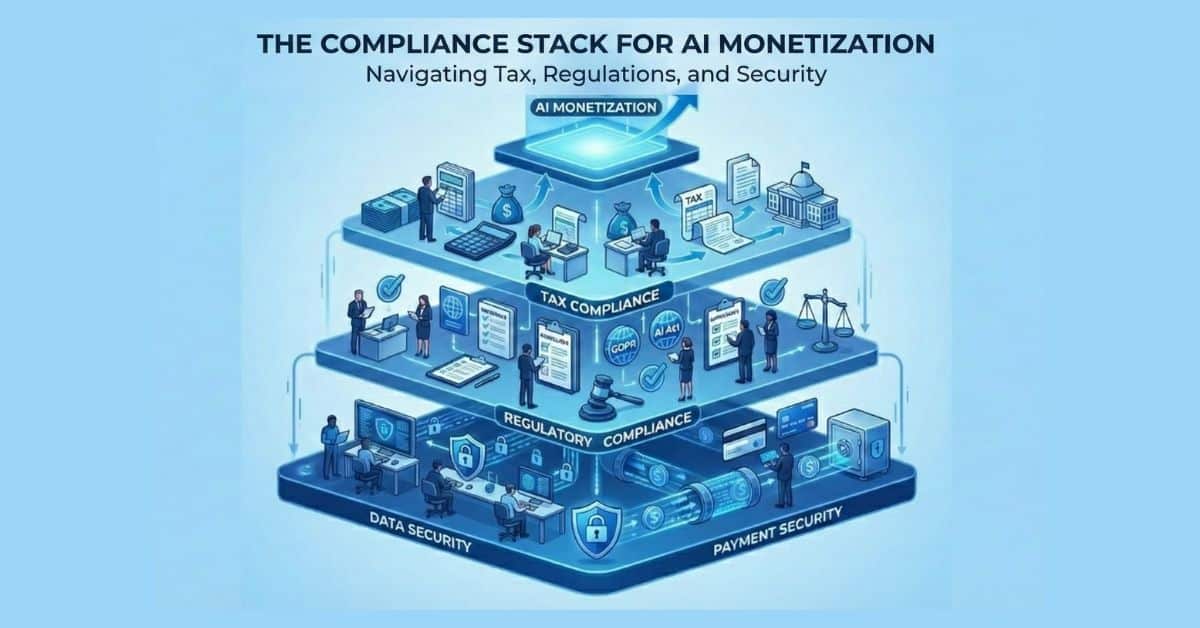
The Compliance Stack for AI Monetization
1
Tax Compliance
VAT, GST, and sales tax rules for US, Canada, EU, UK, Australia, and India
2
Regulatory Compliance
GDPR, UK GDPR, CCPA, PIPEDA, DPDP Act, and AI-specific regulations
3
Data Security
ISO 27001, SOC 2 Type II security frameworks
4
Payment Compliance
PCI DSS for secure credit card processing
TAGS
AI MonetizationComplianceTax ComplianceGDPRVATGSTData SecurityPCI DSSBest Practices
Share this article:
Deploy AI Monetization with Built-in Compliance
Discover how EarnBill handles tax compliance, regulatory requirements, and data security out-of-the-box for global AI deployments